
🔮 Exponential View #567: The rewiring of work; Development 2.0; Texas storage, AI microdrama, Hollywood++An insider’s guide to AI and exponential technologies
Hi, Welcome to the Sunday edition, in which we make sense of the week behind us. If you prefer listening, here’s my latest podcast episode, where I unpack NVIDIA’s bet on Groq and OpenClaw – and what it means for the organizations you run. Watch on YouTube or listen here:
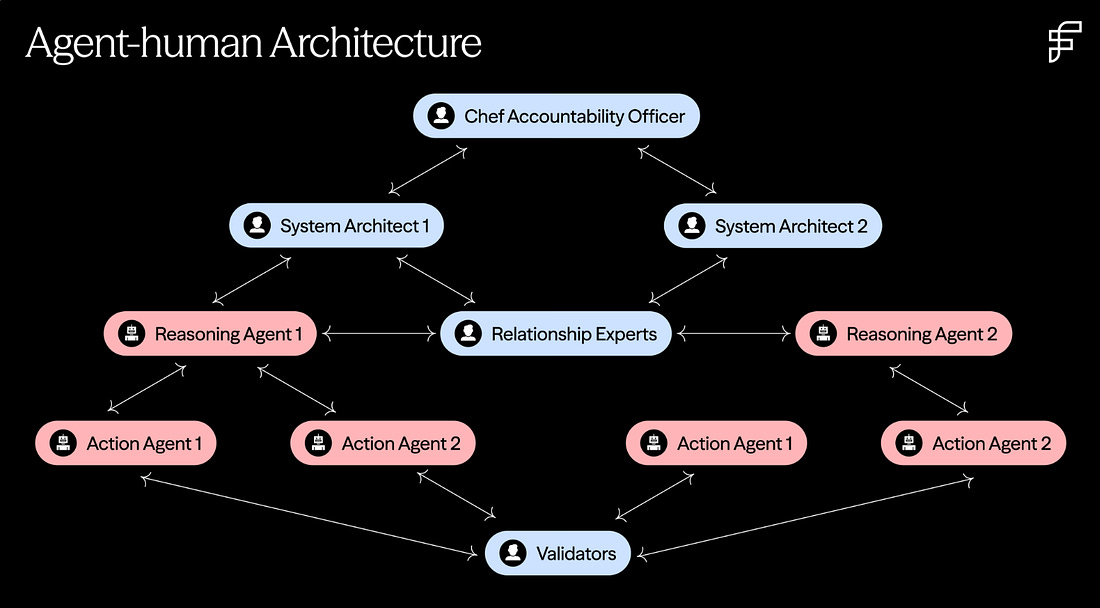
Let’s go! The great AI reorgAs I’ve written extensively recently, the agentic stack has matured quickly. It is on its way to becoming the default infrastructure; and I’d expect by the end of the year to see mature implementations which will deal with the reliability, complexity and security concerns that bedevil frameworks like OpenClaw today. Firms that reshape around agents have smaller teams, fewer silos and a spectrum of jobs that only humans can do better than machines. Those human roles include direction-setting, validation and verification, and accountability. Small, nimble teams, like EV’s, are already on this trajectory. Meta’s boss, Mark Zuckerberg, is building a personal agent to pull information faster to make his leadership calls. He’s hoping the agentic layer at his company – one agent per person – will flatten the management structure around him. Investors Joanne Chen and Leo Lu quantified the change in this useful report: teams are getting smaller, organizations need fewer deep specialists and the bar for those staying in their jobs is rising.
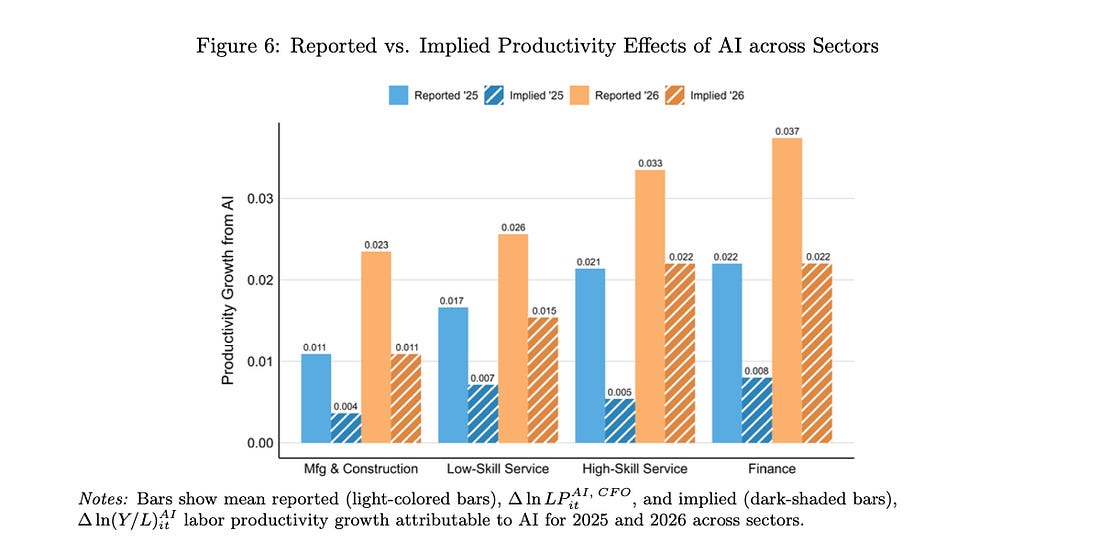
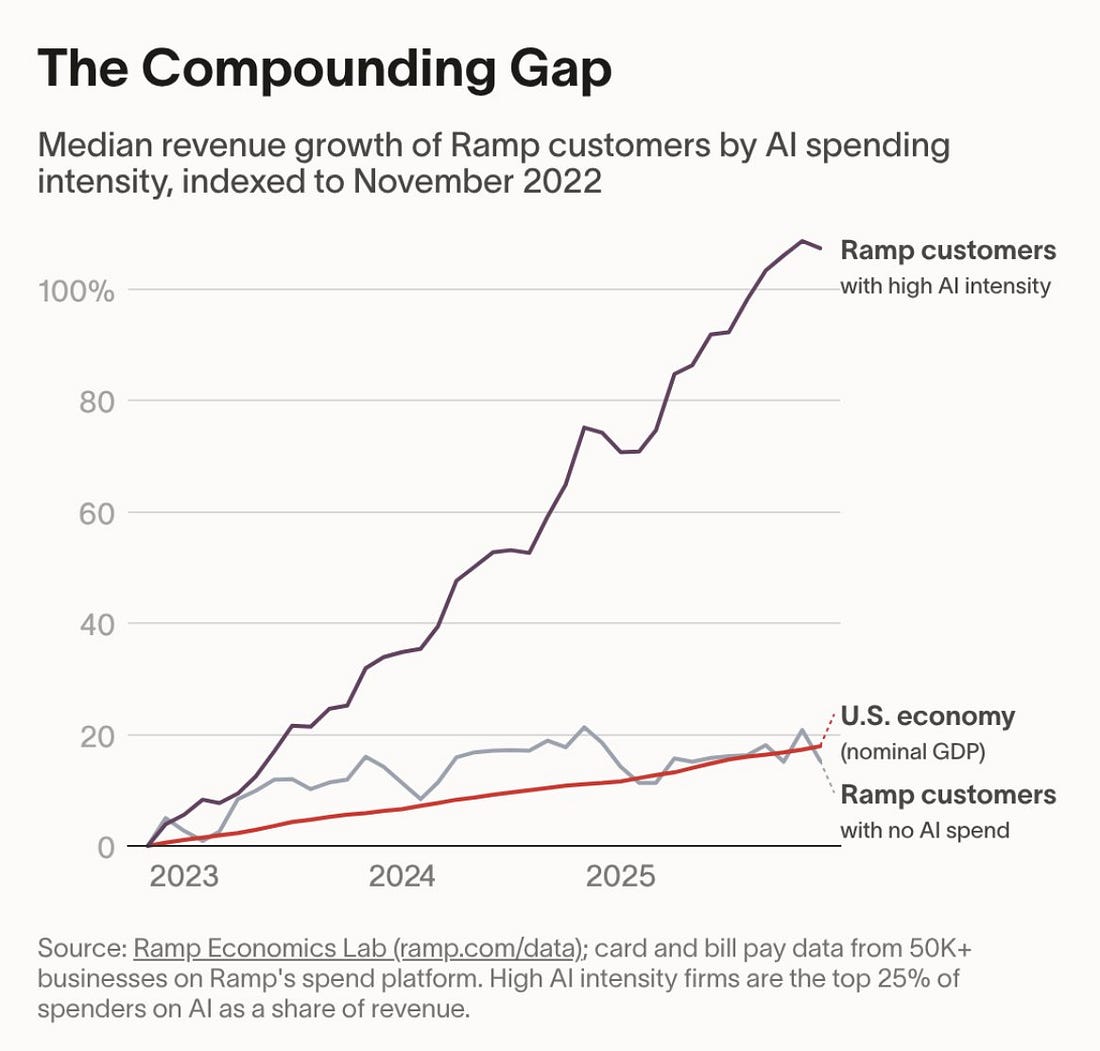
Some of this is visible in economic data. The National Bureau of Economic Research’s (NBER) study of nearly 750 executives shows that reallocation of labor is happening; AI use is “substituting the routine clerical activities while complementing higher-skill analytical and managerial work.” Measured output gains still lag what those leaders are feeling, but there is a belief that AI is giving them more than the numbers show. What the office data is not capturing – and I wrote about it in EV#564 – is a considerable learning curve individual early adopters are experiencing. This isn’t yet showing up in productivity statistics. Anthropic’s Economic Index update this week shows that early, high-tenure adopters develop specific skills through learning-by-doing that allow them to use advanced models for complex tasks. I see this in my own use. Falling behind in AI isn’t a technology challenge, it’s a learning problem. Learning compounds as the AI frontier advances, and those who move earliest and fastest have an advantage. Ramp, a fintech platform, spotted the compounding gap in its customer base – since 2023, top-quartile AI spenders on Ramp have more than doubled revenue; the bottom quartile has remained flat.
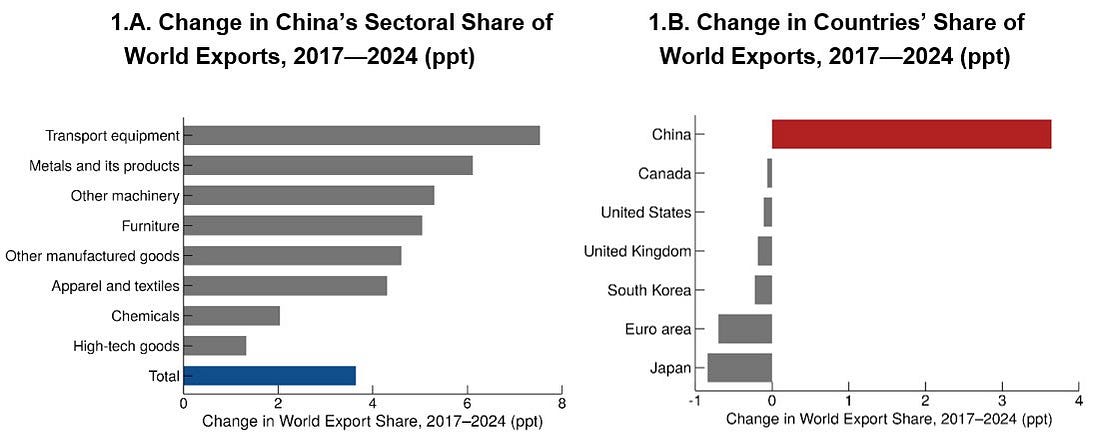
Development 2.0The World Bank has just published a report in which chief economist Indermit Gill says the Bank’s old stance on industrial policy “has not aged well – it has the practical value of a floppy disk today.” The Bank is revising the doctrine codified in the 1993 East Asian Miracle report, which concluded that the “promotion of specific industries generally did not work” and held little promise for other developing economies except under unusually demanding conditions. What Gill is saying is extraordinary. The East Asian Miracle helped teach a generation of development economists to treat “picking winners” as exceptional, risky and mostly non-replicable. In the new report, the World Bank says industrial policy is “more replicable than previously thought” in a world with higher educational attainment, better macro management and more scope for targeted tools like industrial parks and skills programs than for tariffs and subsidies. This is close to what I was getting at in my 2022 essay on catalytic government, the state was returning not to replace markets, but to steer them through incentives, coordination and strategic investment. China is a big part of that revision. The old logic assumed that as China moved up the value chain, it would vacate lower-end manufacturing and leave room for poorer countries to climb the ladder; instead, between 2017 and 2024, China pushed deeper into autos, batteries and other higher-value exports without surrendering much lower-end share, which is not how the old sequencing story was supposed to work.
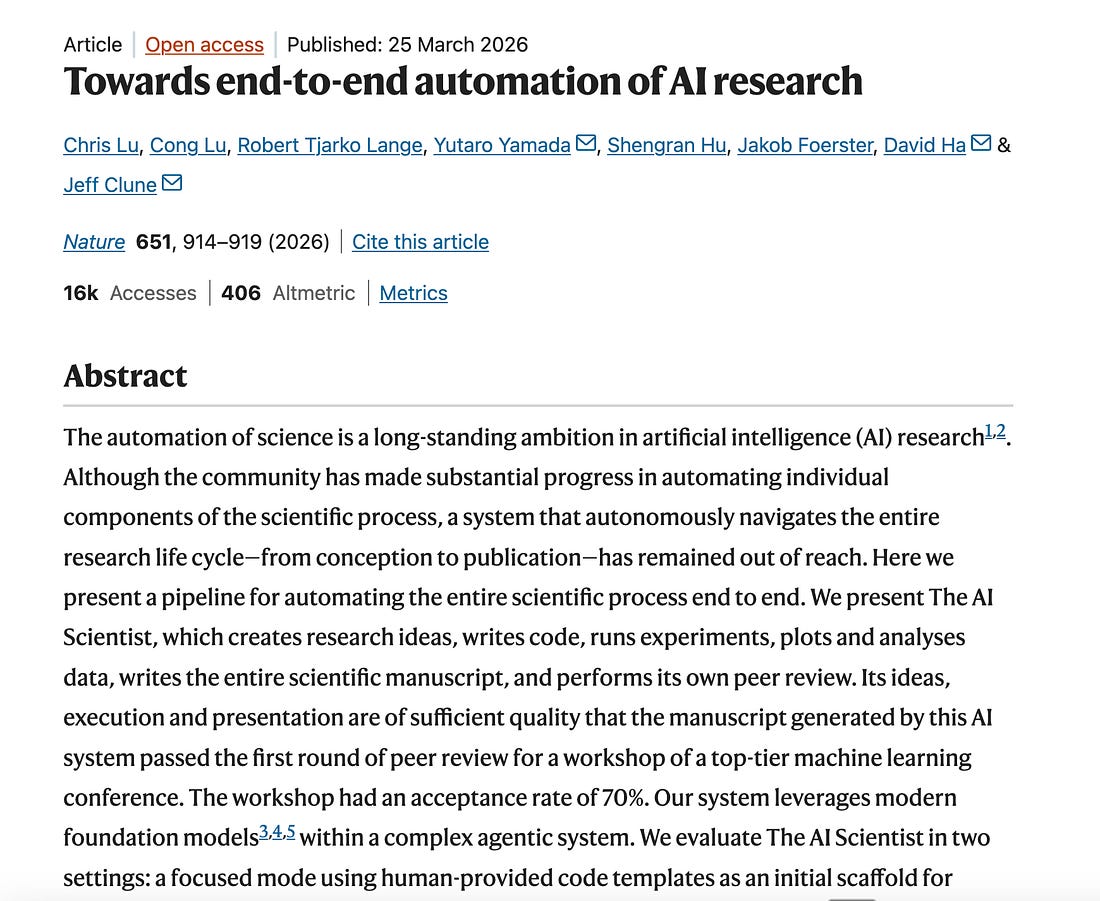
🧠 Zero-sum thinking and the roots of US political differences In 2016, high zero-sum thinking strongly correlated with support for Trump, including among typically Democratic voters. 📉 A year-old paper punished memory stocks Google resurfaced an April 2025 arXiv paper and markets responded as if it were breaking news. AI, a lab partnerBy one estimate, only 2% of scientists are actively using AI agents. That number will look quaint in three years. A year ago, we wrote about Sakana AI’s AI Scientist, a system that ran the full research loop end-to-end without human intervention. At the time, I noted that it was early in the cycle.
The paper about the system has now been published in Nature. One of the system’s outputs passed the first round of peer review at an ICLR workshop in 2025, without the reviewers knowing it had been authored by AI¹.
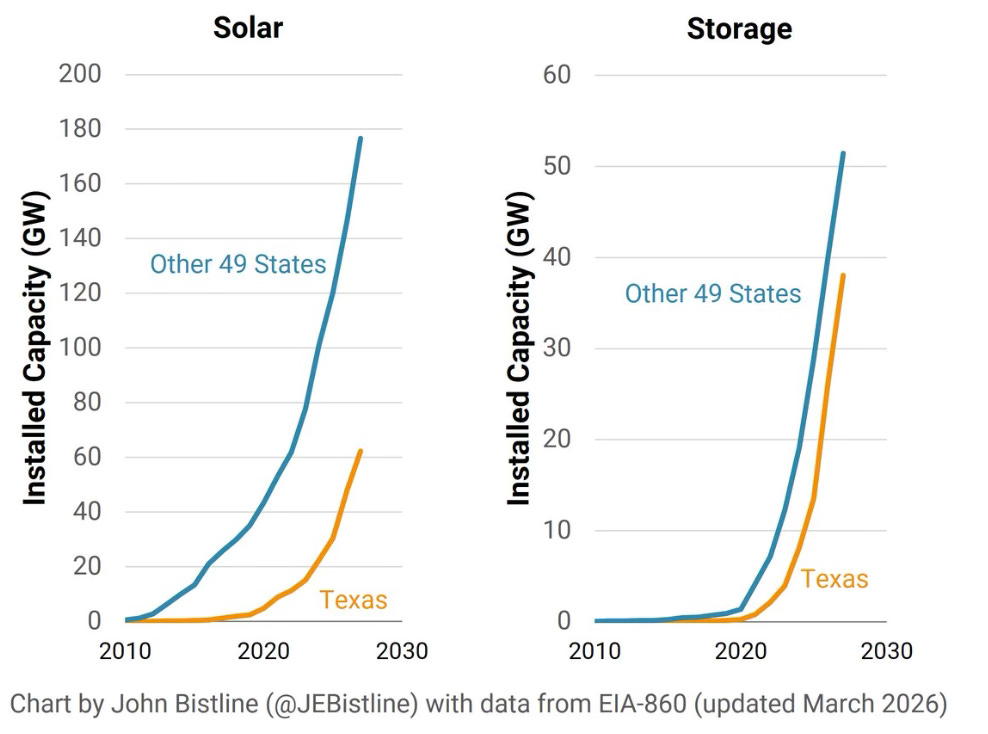
That was the alpha. This is the beta: Claude helped co-author a physics paper with Harvard physicist Matthew Schwartz. A human sat alongside, supervising the process and stepping in when the reasoning drifted. In another experiment, Claude rebuilt a Boltzmann solver, software that models how light and matter interact in the early universe; it worked over several days with only minimal human oversight. This required holding together quantum mechanics, general relativity and numerical mathematics simultaneously and making judgment calls at each step that ripple through everything else. The human’s work was to check results, not to micromanage the intermediate steps – yes, it’s the validation and verification role I discussed above. A University of Florida researcher built a system that used LLMs and evolutionary search to discover economic theories, taking an empirical puzzle as input, generating hundreds of candidate explanations and verifying and calibrating them against data, all autonomously. The total cost was about $25. One of its candidate theories independently matched an explanation that the authors of the original puzzle added in a later revision of their paper. Right now, AI is a powerful tool for search. A recent NBER working paper by Agrawal, McHale and Oettl shows that in data-rich fields like biology, AI compounds fast. In fields where a novel result is the rare exception – such as physics or cosmology – it has less to grip. What’s still missing is understanding. These systems find things that work without knowing why they work. The hope is that world models change this (a brilliant write-up on the topic by Packy McCormick.) Causal understanding might just be around the corner. 🎮 Pokémon Go is giving delivery robots an inch-perfect view of the world. 30 billion AR game images, which are accurate to the centimeter, are being crowdsourced from people playing Pokémon Go to build a world model. 🧠 Agentic AI and the next intelligence explosion Evans, Bratton, and Agüera y Arcas argue the intelligence explosion is already social and plural: DeepSeek-R1’s gains came from internal “societies of thought.” See also, SNL#566 on what happens when agents build societies. 🔬 Why there is no ‘AlphaFold for materials’? Materials discovery is structurally harder than protein folding. (H/T Latent.Space) Other morsels🫂 A human stranger is still better for curing loneliness than an AI chatbot. 🎬 China’s AI microdrama factories ByteDance and Kuaishou users are using AI video tools to scale 90-second vertical drama formats. (H/T Grace Shao) 💪🏼 Texas is adding almost as much energy storage as the rest of the US combined.
🏗️ Did status signaling ruin architecture? Why buildings built before 1930 are almost universally more beautiful than those built after: ornament, taste and procurement incentives. (H/T Works in Progress ) 🎬 Hollywood crosses a line Val Kilmer is appearing in a new posthumously via AI. This may be the first step toward treating actors as monetizable IP assets (H/T Erik Barmack) 🏛️ Why Florence started the Renaissance Geographic luck, network effects, Brunelleschi reverse-engineering lost Roman techniques. A useful corrective to the idea that innovation clusters can be designed from scratch. (H/T Tomas Pueyo) 🐟 Sizing up the sexes Across a wide range of animal taxa, including insects, spiders, fish and birds of prey, females are larger. (H/T Steve Stewart-Williams) Thanks for reading! — Azeem P.S. During my Friday Live on the Karpathy Loop, I mentioned that I’d love to share how I’ve been using autoresearch. Keep an eye on your inboxes as I’ll be sending along the GitHub repo I’ve been working with, which I’ve called AutoWolf. 1 Sakana then withdrew the paper, as they had always planned to: the point was to see whether the system could pass peer review, not to enter the scientific record. Forward this to a friend.
|
🔮 Exponential View #567: The rewiring of work; Development 2.0; Texas storage, AI microdrama, Hollywood++
Saturday, 28 March 2026




Subscribe to:
Post Comments (Atom)


No comments:
Post a Comment