
Meet the team that raised $34m from Khosla to build AI agents for accountantsWhat it’s like to work at Basis
✨ Hey there this is a free edition of next play’s newsletter, where we share under-the-radar opportunities to help you figure out what’s next in your journey. Join our private Slack community here and access $1000s of dollars of product discounts here. TL;DRIf you only have a minute or two, here’s what you should know about Basis.
There is an ancient myth that our world is carried on the back of an enormous turtle. If you found yourself in conversation with someone who believed this, you would naturally ask: “What is underneath the turtle?” And they would naturally reply: “It’s turtles all the way down.” Talk to the team at Basis and they may tell you it is not turtles that are supporting our world, but accounting. They do not believe that to be an exaggeration. “One of the first things [the founders] Matt and Mitch sold me on is the idea that accounting is the bedrock of our economy,” Luke Bradley (a generalist at Basis) told me. “Accounting is how we compress real-world complexity in financial data, which underpins all decision-making. If LLMs progress unlocks accounting in the way the early Basis team expects, it could lead to an enormous improvement in the overall quality of decision-making.” The world, or at least the financial decision-making part of it, is accounting all the way down. Every company understands this, which is why internal accounting departments are so important and why accounting services generated $145B in revenue in the U.S. last year. But accounting is not always an easy job, and common complaints have gone mostly unfixed for years:
(*Except, maybe, the team at Basis.) As accounting has simultaneously become more complex and more important over the past decades, interest in the profession has waned. Fewer people than ever are taking CPA exams. Senior accountants are retiring with nobody to replace them. Companies and firms are outsourcing to other countries (like India) when they can’t find domestic talent. Quality, in some cases, is decreasing. To solve this problem, founders Matt Harpe and Mitch Troyanovsky started Basis to build AI agents for accounting. If accounting is at the center of decision-making, then improving accounting can unlock a substantially better world. So far, they seem to be making some inroads. Basis:
I wanted to learn more about what Basis is building, why, and what it might be like to work there. So I chatted with the team and will do my best to present my learnings below. If all you want to know is whether or not you should join, you can skip to that part here. But I’d recommend reading the rest first: Basis is approaching company building in a way that is worth learning about. Building useful tools—not just more software—for accountants What if every accountant had a team of 100 junior accountants that could work 24/7? The answer is obvious: they could be insanely productive. Accounting is experiencing some real tension (more complexity and fewer people to handle it!), but an innovation like this could completely transform the industry. It could make each individual accountant much more effective. It could improve the quality and speed of accounting overall, which could improve the quality and speed of all decision-making. So, in 2023, Matthew Harpe and Mitchell Troyanovsky went about making this happen. Their $3.6M seed round was led by Better Tomorrow Ventures, and their $34M Series A—just a year later!—was led by Khosla Ventures with participation from Keith Rabois, Nat Friedman, and others. The goal at Basis is not to give accountants more software. “Every accountant already has dozens of software tools,” the Basis team writes. What accountants really need is useful tools. “Tools that can understand accounting, learn specific client needs, work independently, and take real actions.” This approach is working, and many of the top 100 accounting firms in the United States are already seeing results with Basis. All of this information is exciting. But one of the more interesting things I learned when talking to Basis is that they take AI very seriously; the team is not just building AI agents for accounting, but for themselves. Fighting the consensus to build a truly AI-first companyPlenty of companies today claim to be AI-first. But when you dig deeper, that tends to be a hollow phrase: sure, some employees use ChatGPT and the engineers use Cursor, but these days that is the consensus. There is nothing particularly impressive anymore about having AI involved in your workflows. Basis is one of those rare companies that has thought deeply (from “first principles,” they told me) about what it means to build a company for the “AGI era” and has made some non-consensus choices. Perhaps the most unique decision? There is an entire internal team at Basis, called Atlas, who have one mandate: make every employee at the company 100x more productive. Matthew Busel, the Product Lead for Atlas, describes the team as follows: “AI is already incredibly smart and only getting smarter on the road to AGI. So why can’t it do much of any work within a company? The reason is that it doesn’t know anything about your business - aka it doesn’t have the right context. The Atlas team is solving that problem to make Basis the most AI-native company in the world where hundreds of agents can work alongside our team as we try to scale as fast as any company ever has. Building an “internal agent team” (another way to describe Atlas) is not the standard now, but according to Basis, it will increasingly become so as we approach AGI. In the PC era, someone had to create the first IT team. In the internet era, someone had to create the first data team. Atlas, if it is a successful bet, could be one of the first internal agent teams in a world that will eventually be full of them. “The fact that my team even exists,” Matthew said, “is a great example of the uniqueness of this company. It’s one thing to tweet about how you think an AI-first company should operate. It’s another to actually do something about it. Matt and Mitch are funding a team to build a future AI-native organization way earlier than you’d see at any other companies.” Matthew is correct: it is strange to see a Series A startup investing deeply in an internal AI agent team; in people who are not building the customer-facing, but building products for people who build the product. If the bet pays off, Basis will in 20 years be the sort of company people write about in essays on the ways companies changed during the AI era. And if Basis achieves even a fraction of that “100X more productive” number internally and for their customers, it would be hard to understate the impact they might have on accounting and on the world. A generational mission comes with generational responsibilityThe Basis team works five days a week in their NYC office. They describe working there as carrying “enormous responsibility.” The company pays for (non-mandatory) dinners at the office for everyone from Monday to Thursday. Matt and Mitch, the founders, are “the first ones in and the last ones out every single day.” There is “no such thing” as a normal day at Basis.
This is a startup that sees an enormous opportunity over the next 18-48 months and enjoys working with ambitious people who take that opportunity seriously. People who recognize the responsibility that comes with that sort of mission. There is endless theorycrafting we could do here, but the best thing to do is hear straight from the people who actually work at Basis. So I asked around:
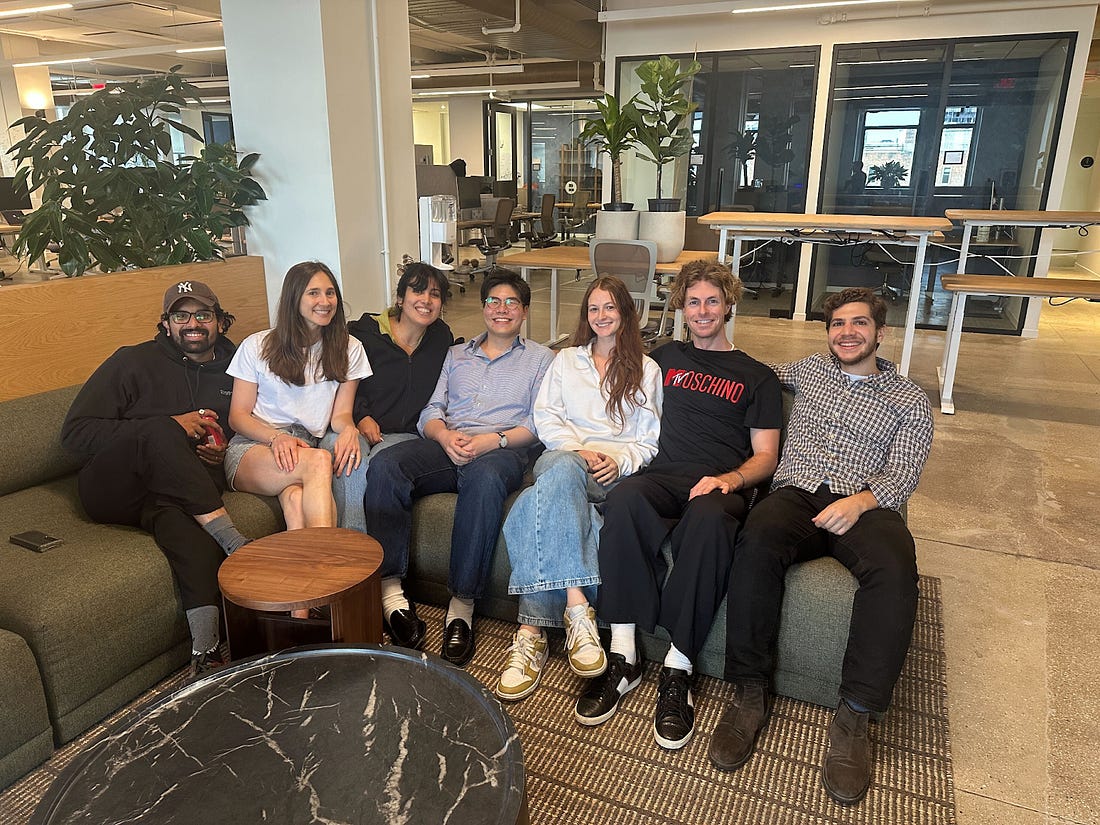
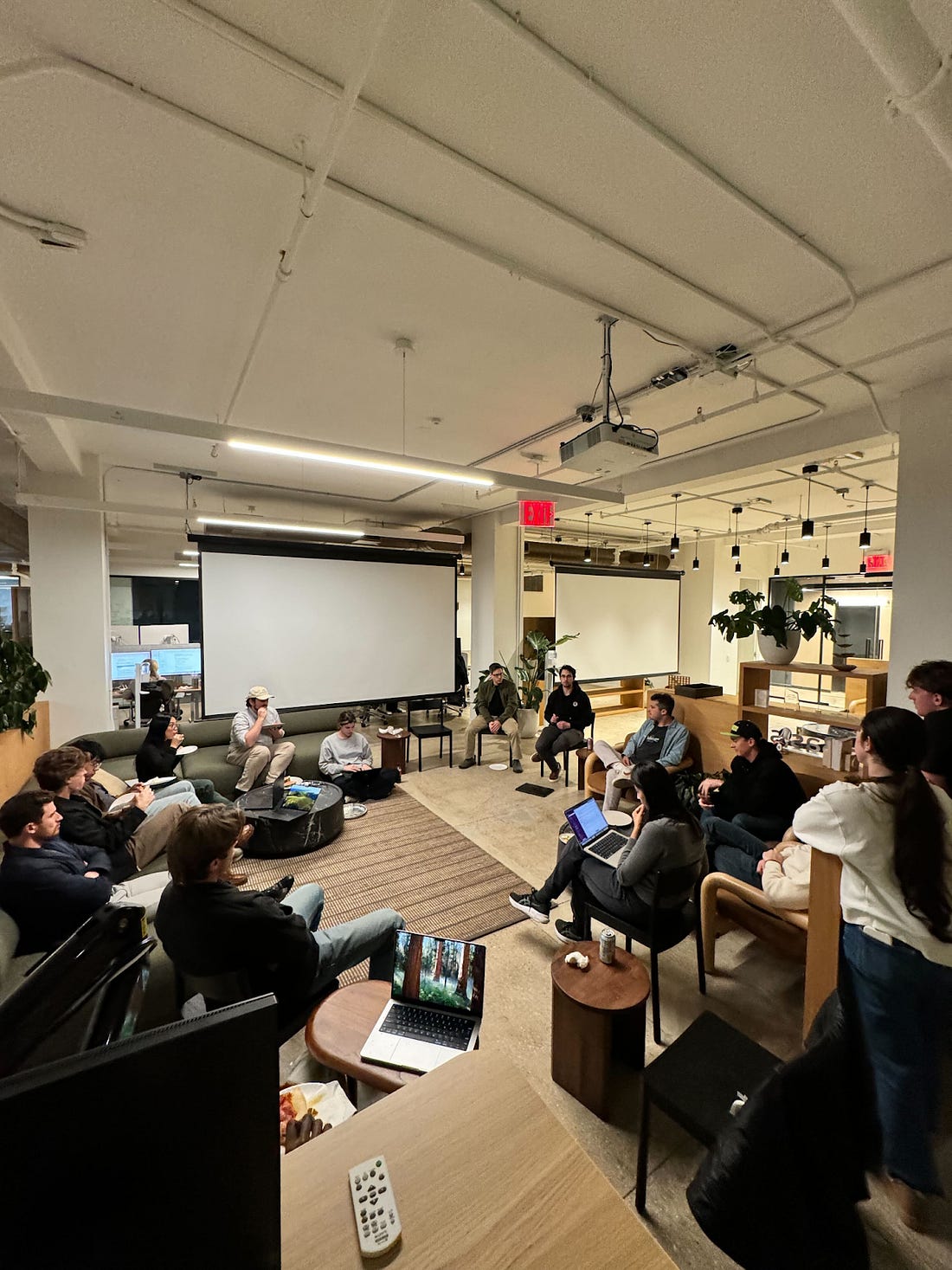
Talking with Basis, the impression I got was that the people who work there work hard, sometimes work long (dinners in the office imply longer-than-usual time at work!), and have a hell of a lot of fun doing it.
Should you join Basis?There are truisms that most every startup feels that they have to say when they talk about the people they are looking for. Hard-working, high-agency, low ego, collaborative. You would be hard-pressed to find many startup job descriptions today that do not contain at least some of those words. But phrases like very intense and enormous responsibility are a bit more rare; they are intentionally dramatic.
I have not worked at Basis and so I cannot say with certainty whether those phrases are true, but I can say that using them signals something about Basis. This is, according to co-founder Matt, “a small group of ambitious people who believe there’s a unique opportunity at this moment in time with AI. We want to build great things, which requires intensity but is also really fun.”
People who are good fits at Basis “do not want a typical 9-to-5” and “do not care about status or title, but instead raw impact.” Working at Basis means buying into what they are building and truly caring, not “viewing work as a flywheel for life.” When you apply, you can expect “a fairly unique interview process,” I was told. “We do our best to do away with the interviewer/interviewee power dynamic and instead try to collaborate directly on problems and see what it would be like to work together.” Someone else told me that interviews “put an emphasis on solving real problems faced in the office.” Interviewing with Basis is “comfortable,” someone else said, and feels “more like showing up at work and not like you are in an interview.” So, if you would like to join a (truly) AI-first company transforming accounting, how should you apply?You could start by looking at the Careers page and applying through traditional channels: Basis is currently hiring across product, marketing, accounting (of course!) and more. In addition to a formal application, you could send a short, useful email to the person hiring for your role explaining the value you think you can add. And if you want to try extra hard or get creative, you could stand out by trying ideas from a list like this. Thanks to Basis for interviewing with us and for supporting Next Play. You're currently a free subscriber to next play. For the full experience, upgrade your subscription.
|
Meet the team that raised $34m from Khosla to build AI agents for accountants
Thursday, 4 December 2025







Subscribe to:
Post Comments (Atom)


No comments:
Post a Comment