
This is Brad DeLong's Grasping Reality—my attempt to make myself, and all of you out there in SubStackLand, smarter by writing where I have Value Above Replacement and shutting up where I do not… Tuesday Economic Growth Blogging: The Pre‑Modern Treadmill Was Real on Necessities, Not on Technology, or Luxuries, or Culture, or Means of DominationGreg Clark’s “Farewell to Alms” still tempts with one big, clean story: pre‑modern humanity stuck on a Malthusian treadmill until cultural-bio selection on “bourgeois” traits breaks the chains, and...
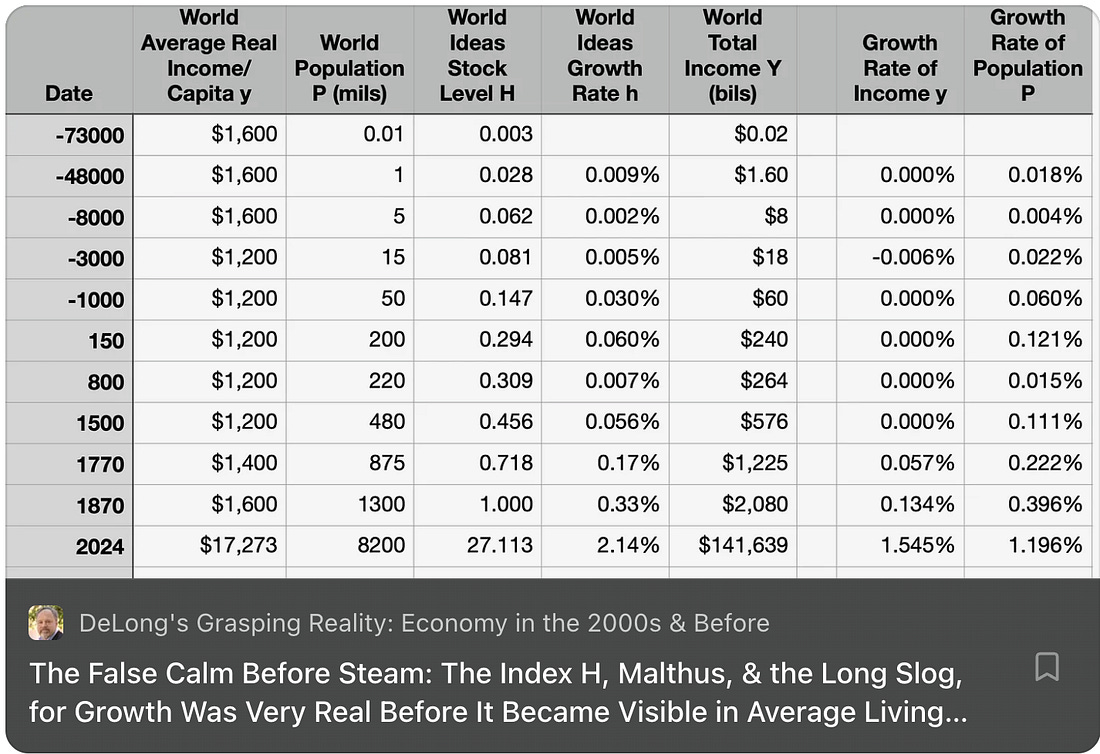
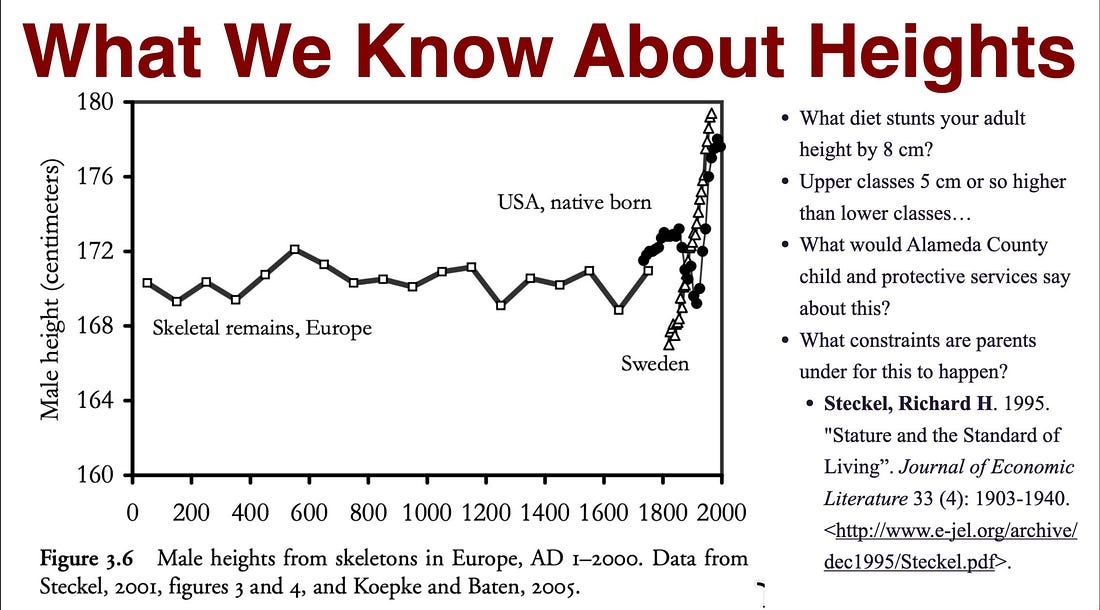
Greg Clark’s “Farewell to Alms” still tempts with one big, clean story: pre‑modern humanity stuck on a Malthusian treadmill until cultural-bio selection on “bourgeois” traits breaks the chains, and growth escapes. Tempting—and partly right. But, I think, substantially wrong. However, today let me talk pretty much only about the parts in which it is right…Living standards from -3000 up to close to +1900 were indeed close to flat with respect to necessities and conveniences that map to reproductive fitness. World population crawls from ~15 million to ~500 million: an average ~0.08%/year. An unstressed pre‑industrial patriarchy does ~1.4%/year; we plainly weren’t there. Skeletons report four inches of stunting. That’s dire poverty speaking. And dire biophysical poverty without any substantial upward trend. But biophysical reproductive fitness is not wealth. And biophysical reproductive fitness is not technology, but, rather, technology balanced against resource scarcity. Angus Bylsma has a very nice review of Greg Clark’s now-nearly twenty-years old A Farewell to Alms. A key paragraph or so in Angus’s review:
And then Angus gives a call-out to me:
So what do I think? I think that there are two big issues:
Let me reserve the second for some future date. And let me focus on the first. There I see four further subparts: (i) In terms of the production and consumption of necessities and conveniences that affect reproductive fitness, the argument that the world between -3000 and 1900 (the beginning of the population explosion) was near-subsistence—that argument is, I think, rock solid. Almost nothing else is. Briefly: there are three other things in play here:
Valuing, in any sense, (ii), (iii), and (iv), and balancing them—well, I quail. And I am not yet ready to put out any numbers whatsoever. So let me drop those for some future date, especially as I am not sure I can distinguish them properly yet. Luxuries-consumption shades into cultural-participation. Culture is both a source of entertainment, value, and meaning and also a brainwashing machine. Consider The Man Who Saw the Abyss…, usually called The Epic of Gilgamesh. Starting at line 45 we have:
Is it a good thing to have a culture that tells you to stay in your subservient place? in The Magnificent Seven the bandit chief Calvera says of the farmers: “If God didn’t want them sheared, He would not have made them sheep.” But it was not God but men, men using bronze, writing, bureaucracy, and cultural ideology, who made them think and calculate that they had no good option other than to accept being sheared. And are we trying to calculate the value of (ii), (iii), and (iv) in the sense of providing humanity with powers to command nature to do our bidding and to organize ourselves productively and cooperatively (were we to choose to do so)? Or are we trying to calculate the value of (ii), (iii), and (iv) in the sense of enabling humanity to live wisely and well? So I postpone these as well to some future date. However (i) is, very roughly, and with heroic guesswork and assumptions, knowable. Thus we know:
So that takes care of (i). If you are willing—as I am—to guess that resource-scarcity is half as salient as technology to command nature and organize humans (at a constant capital-output ratio) in fueling productivity, you can back out a level of technology-in-necessities-production as roughly proportional to potential necessities consumption per capita times the square-root of population. That gives us a level of our index H for Human Technological Competence of 27 today, 1 in 1870, 0.3 at the peak efflorescence of the Han-Parthian-Roman ekumene around 150, and 0.08 back in the year -3000 at the start of the Bronze Age. That is a 12.5-fold multiplication of human technological capabilities from -3000 up to 1870, and a 27-fold multiplication since. But this is measured along the necessities-and-conveniences dimension only. There are also the luxuries, cultural, and domination dimensions. Where once again I quail. References:
If reading this gets you Value Above Replacement, then become a free subscriber to this newsletter. And forward it! And if your VAR from this newsletter is in the three digits or more each year, please become a paid subscriber! I am trying to make you readers—and myself—smarter. Please tell me if I succeed, or how I fail…#enlarging-the-bounds-of-human-empire |




| ||||||||||


No comments:
Post a Comment