
This is Brad DeLong's Grasping Reality—my attempt to make myself, and all of you out there in SubStackLand, smarter by writing where I have Value Above Replacement and shutting up where I do not… Thursday State of the SubStacks: Walking the Tightrope Over the Attention-Economy AbyssAs app‑first feeds and social ephemera threaten the email/blog/tip‑jar core, VC incentives collide with public reason, the brittle economics of “#discoverability” make themselves felt, and it turns...
As app‑first feeds and social ephemera threaten the email/blog/tip‑jar core, VC incentives collide with public reason, the brittle economics of “#discoverability” make themselves felt, and it turns out the hard part is the mechanics of the business finding the sweet spot…Is this thing a serious and sustainable platform business, individual business model, and hence public-reason community? On the plate we have:
vs.:
And:
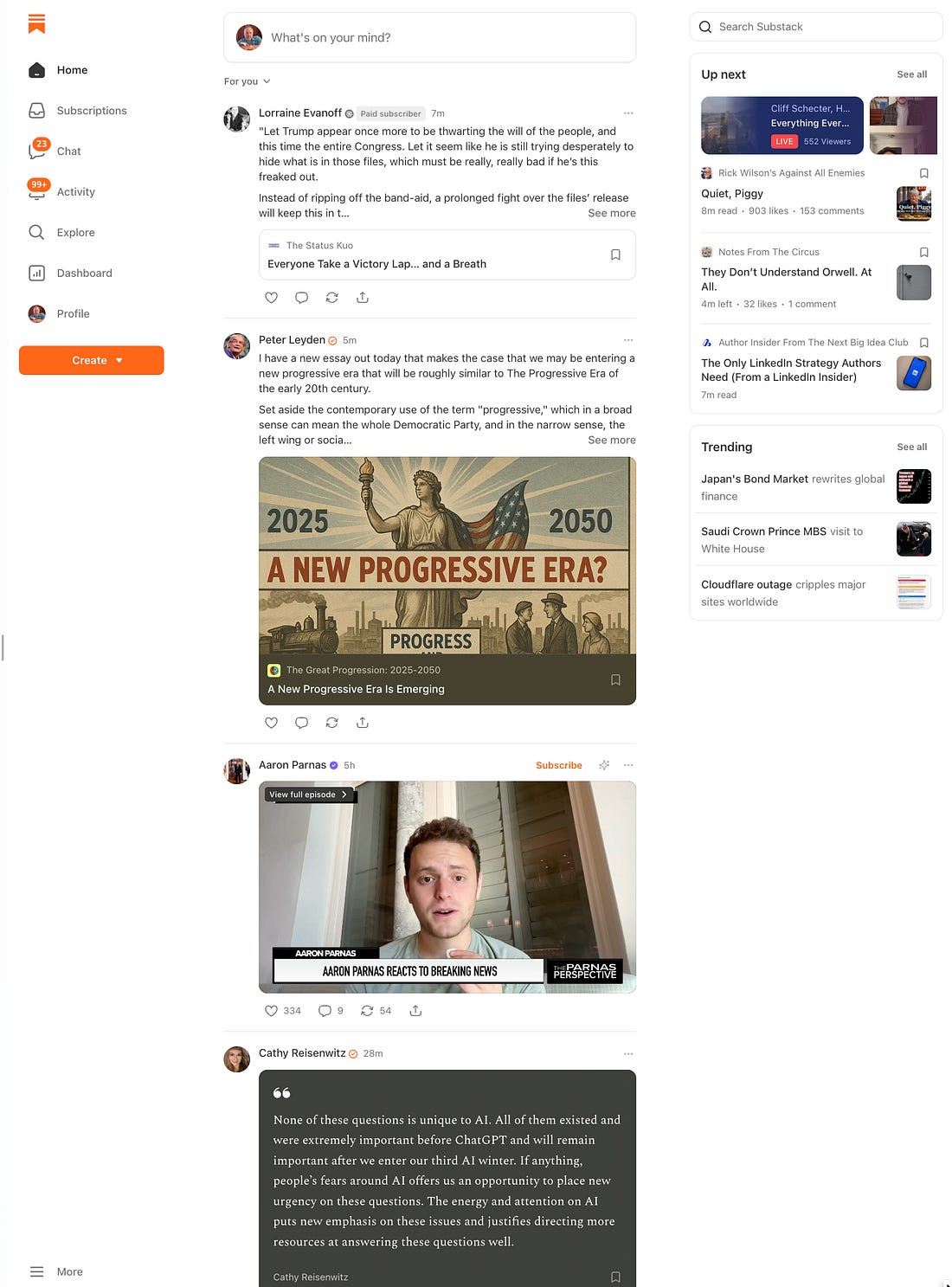
With a key red flag now appearing to be SubStack Notes <https://substack.com/home> and its associated chonky swol twitter-like feed:
And also on the plate is a note from Mills Baker about what the SubStack team is actually intending SubStack Notes, considered as a social-media feed, to be—a principal channel pushing discoverability:
As I understand it, the key to SubStack’s “Notes” algorithm is that it needs to be one that (i) does not maximize time-on-platform and leaves a bad taste afterwards in the mouths of those who engaged, but (ii) does maximize paid subscriptions to newsletters, and also (iii) leaves readers of “Notes” feeling informed, entertained, and having spent there time learning about interesting things to read. The “how this works” and how you create this New Model Algorithm remains mysterious to me. It is a social network, but not: SubStack has an app. Substack spends a lot of its team’s energy and time getting people to download and then use the app. The app is anchored by its feed. But SubStack is trying as hard as it can to hack the brains of those it attract in a different way. Mark Zuckerberg’s team tries to hack your brain so that you spend as much time as possible on-app, so your glued eyeballs can be sold to attention-seeking advertisers. The SubStack team is trying to optimize for the chain: download → view → discover → subscribe → pay. The desired end result for SubStack is a paid subscriber to somebody’s newsletter/ podcast. And there seeking that requires a substantially different feed than the eyeball-gluing maximize time in-app standard social-media feed. But how, exactly? In spite of attempts, enthusiastic attempts, by the Masters of SubStack to explain it to me, it remains opaque and mysterious. The key here is #discoverability. I have written about this before:
In the first, I argued that SubStack had a triple tension: to survive as a platform that people would wish to be on, it had to balance writers seeking income/control, readers wanting access/trust, and yet its funding investors wanting growth; with stability requiring resisting the ad-supported attention casino, while (somehow) still being trapped by the fact that it is not (yet) profitable without larger scale. My suggestion was: model mix of teaserage (samples), patronage (normalized tip jar), and premiumage (adjacent perks), treating them all as adjustable dials, not dogma. And somehow building a successful #discoverability layer as well. The hope was that SubStack could both prosper and enhance public reason by making it easier for thoughtful work to find and keep its audience. The fears were many, and—well—obvious. In the second, I noted the critics arguing the platform’s branding and discovery layer were a mirage, pushing writers toward walled‑garden, attention‑harvesting behaviors, and yet somehow there is no large-scale exit. Alternatives lack features, reach, or marketing, making migration costly and—unless subsidized—uneconomic. Unwilling former SubStacker Ana Marie Cox <https://newsletter.anamariecox.com/archive/substack-did-not-see-that-coming/> says that she “do[es] not judge” those who feel “constrained by the lack of infrastructure or certainty offered by other options” and yet calls for some to “make some demand” so that then the “alternatives will expand with demand”. What do I have to add now? Well, first, as Hamish noted above those expanding alternatives are expanding by pushing themselves to become more like SubStack—#discoverability layer, “spending big bucks to lure some Substack writers” to try to get the network flywheel going, and the dreaded #social-media features. Now do not get me wrong: I grok where natasha and others are coming from. And while I must admit that I am somewhat cynically amused at Patreon’s offering successful SubStackers subsidies and trying to build a #discoverability layer of its own, while still positioning itself as the crunchy (and much lower fee) alternative; I feel the gravitational pull as they do. What they want is a decentralized system of individual writers writing for occasions semi-regularly on their own websites, all linked together by discovering and referring and boosting one another as they argue and inform, and perhaps it will be a side-hustle for some and a source of resources to keep body-and-soul together for others. Well, so do I. I want that too. But this is not our first rodeo:
And as unwilling former SubStacker Ana Marie Cox wrote <https://newsletter.anamariecox.com/archive/substack-did-not-see-that-coming/>: “Substack is still the easiest option for creating a newsletter, especially for creators without the time, tools, or tech fluency to self-host…” She then goes on to (a) call for a functional discoverability layer, (b) while rejecting the one we have, and (c) being not fully conscious of the tension here:
Behind all this, of course, is the perception and the reality of the “Nazi Bar” problem. I accept that if you add any discovery layer to Substack—to any internet network—that is more than a simple reliance on individual writer shout-outs, and you will very quickly run into a problem. Given: (a) The honchos of SubStack have a very different view of where the Overton Window should properly be than I do, (b) my view of where it should be is substantially to the right of the average writer’s, (c) the extraordinary variance of human opinion, and (d) the internet brings the far-away and extreme to your face immediately. Then: The attempt to cast a broad net, as far as recommendations for what people should read, winds up, remarkably quickly, in two places at once:
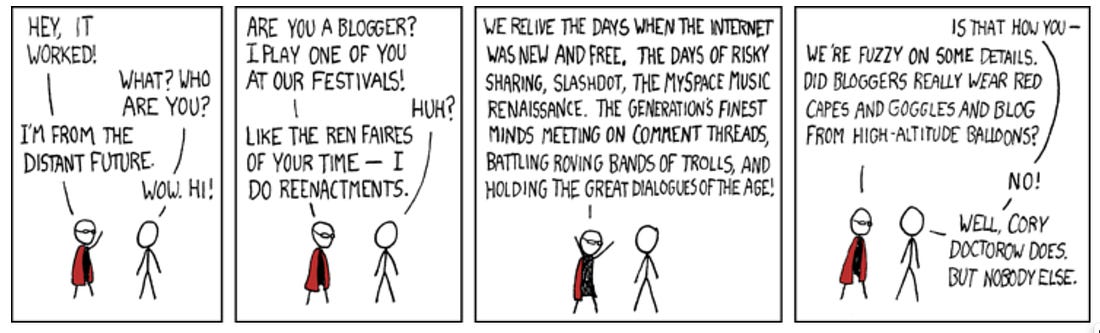
I find that the “Nazi Bar” problem is much worse than the “two-minute hate for small-scale trespass problem”, both because it is a much bigger problem in American discourse today, and because the right-wing lean of the SubStack honchos makes them vulnerable to it. One of their big backers is, after all, on record as telling Rick Perlstein that “I’m glad there’s OxyContin and video games to keep those people quiet…”, they are already deep under the water. But remember when the web was open roads—or, rather, a place where we did not even need roads—and not tollbooths?
However, I do not see any realistic hope other than the path SubStack is trying to be on. Treat paywalls, prices, and perks as adjustable dials, not doctrine. Use teaserage to provide samples of work, patronage to fund a large commons of freely available valuable information, and premiumage to nudge high‑value readers to pony up. Accept that wide‑net discovery is brittle; invest instead in writer‑to‑writer recommendations, guest posts, and reader networks. And avoid being influenced by venture capital. With product discipline and a commitment to public reason, Substack might be able to remain on its tightrope above the attention‑economy abyss, sustaining thoughtful work and a better form of public reason. I would like to see a lot more of what SubStack is doing with its 10% of the money made public. I want them to tell us:
If reading this gets you Value Above Replacement, then become a free subscriber to this newsletter. And forward it! And if your VAR from this newsletter is in the three digits or more each year, please become a paid subscriber! I am trying to make you readers—and myself—smarter. Please tell me if I succeed, or how I fail…#discoverability |





| ||||||||||


No comments:
Post a Comment