

The Ancient Courts & The Infinite Scroll: MONDAY MAMLMSWho Gets to Think in the Age of MAMLMs?: Parasocial Minds, Deep Reading, & c.; Part I of “The Infinite DoomScroll, The Ancient Courts, & The House of Intellect”...
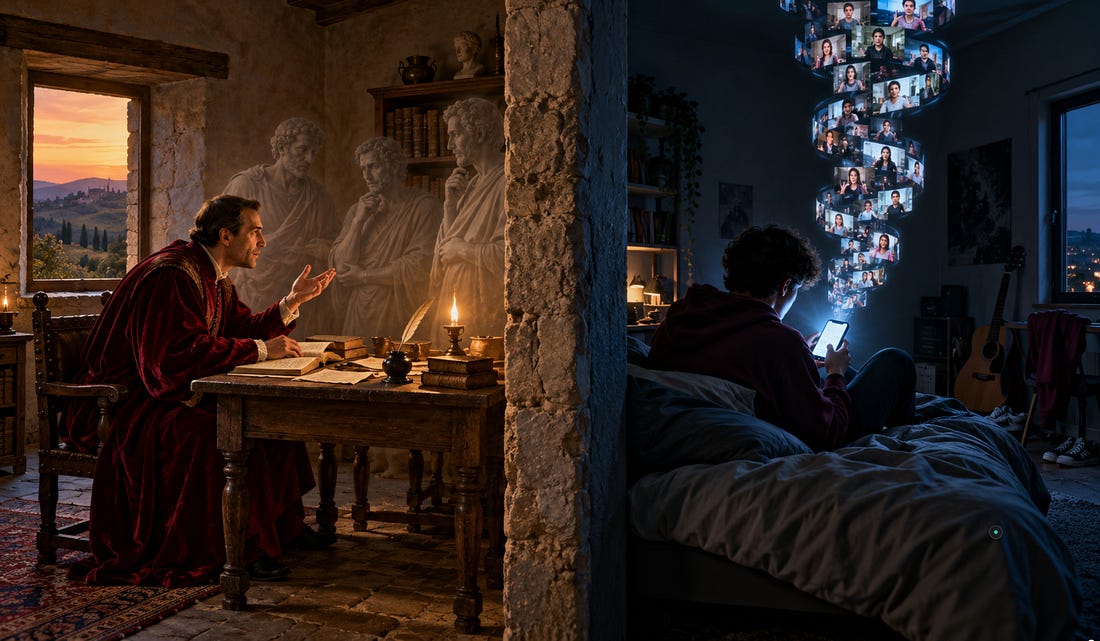
The introduction to my latest, unfinished, attempt to think through what ChatBots will mean for human intellect; largely behind the paywall because, as I said, profoundly unfinished:Two RoomsIn the evenings five-hundred years ago a man named Niccolò Machiavelli would walk into a small study—a writing room. He had just had a very bad year and a half: fired from his longtime senior civil service job, imprisoned, tortured, then released broke and broken, and told to consider himself under house arrest in the countryside where he would be, politically, out of contact and of no account. As he described his routine in a letter to his friend Francesco Vettori:
In the evenings these days, almost anywhere, almost any evening this year, young occupant of perhaps fifteen sits or lies in their room. The phone is on. On its screen, in succession, an endless succession of faces speak directly to whoever is holding it. They confide. They joke. They are outraged. They are intimate. Each occupies the screen for fifteen or forty seconds, and then gives way to the next. This occupant, too, has in a sense entered not the ancient courts of ancient men but the modern courts of influencers making short-form video. This occupant, too, is being received with what looks like affection (but is, mostly, a greedy hope that their eyeballs can be rented out to advertisers). This occupant, too, may well spend four hours of an evening in the process.
What is the difference? It is not that one is “social” and the other “parasocial”. Both are parasocial, profoundly overwhelmingly so. None of the people who matter most to Niccolò Machiavelli that evening are in the writing room in his rural Tuscan Percussina farmhouse, a farmhouse that is so far from luxury that he calls it “the dump”. They are more than a millennium and more dead, with names like Titus Livius Patavinus, Publius Cornelius Tacitus, and Polybios Lykorta Megalopolítes. Similarly none of the people who the fifteen-year-old sees on short-form video are there or are even aware of his existence, even though they are alive. There is a difference in that in one room there are speaking and gesturing faces and bodies on a screen; and in the other room there are simply black marks on a page. Out of his four-hour nightly séances with the honored dead in the ancient courts of ancient men, Machiavelli thinks deeply and profoundly and writes what he calls the “little work, De principatibus” that we call The Prince. Out of their four-hour nightly video scrolling fests, the fifteen-year-old does—what? The key difference, I think, is this: in the first room, it is the man, Niccolò Machiavelli, who does all of the talking. either in his principal voice or in his mind’s eye as he uses his own wetware to breathe life into his interlocutor. Look at the verbs. Machiavelli “make[s] bold to speak” in the ancient courts of ancient men, to “ask them the reasons for their actions”. The ancients do indeed answer in his mind’s eye, but they answer only because he has asked. And they can answer only in the voice of the subturing instantiation of their minds that Machiavelli, the reader, spins-up for them out of what they wrote. Every bit of that dialogue that is not on the page, Niccolò supplies himself. That is hard work. It is why he needs the robes. That is why, a little further on in his letter, he quotes Dante Alighieri’s warning that no one understands anything unless he retains what he has understood. That is why he tells Vettori that he has been writing things down. In the second room, nobody asks the occupant anything, except, implicitly, to keep watching. The faces talk. The thumb flicks. The feed has been engineered by some of the best-paid people on the planet, so that its viewer never has to supply any voice at all. Your Own WeekNow think about your own week. How many of the minds that could have shaped what you have had the opportunity to learn over the past month did you actually talk to, really talk to? I have done this census for myself. There is my wife, my mother-in-law, a few colleagues a day, a few more students a day (I am off the teaching rotation this summer), and my family on the phone. Everybody else who has influenced my mind in what I think is on the other side of a one-way mirror. They include historians I have met three times, or never. They include economists a century dead. They include novelists, and characters who never lived on any earth. Neither Jane Austen nor Eliza Bennet is my friend. I suspect the same holds for you. If you are the kind of person who reads essays like this one, it almost surely does. So the interesting question is not whether most of our relationships with other humans are really parasocial. They are. They have been for intellectuals since long before Gutenberg, and for nearly everybody since radio. The interesting questions are three:
That third room might turn out to be the Young Lady’s Illustrated Primer: Neal Stephenson’s dream of a book that teaches by talking, delivered to every child on earth. That third room might might turn out to be the ultimate attention-harvesting infinite doomscroll, so that, as Andrej Karpathy and others fear, you can outsource your thinking without ever acquiring your understanding. Which of these it becomes is, I will argue, not a question of technology. It is a question of design, and of political economy. And it is, I think, the most important question about these machines that few indeed are asking. My Personal House of IntellectLet me make the confession concrete, because I think the abstraction lets us off too easily. Take David A. Bell, the Princeton historian of France. He was a year behind me at Harvard. I think I have seen him in person three times. I cannot remember a single word I said to him, or he to me, in any of those encounters. et I have read, with attention, his:
I figure that over my career I have spent a full workweek, some sixty hours, doing a thing that would seem deeply strange to our ancestors back in the environment of evolutionary adaptation. I look at black squiggles on a page. From them I spin up a sub-Turing instantiation of the mind of David A. Bell. I run it inside my own head, on my own wetware, in a sandbox. And then I argue with it. That shadow-Bell has changed what I think. It is from him that I learned that “public opinion”, the sovereign before which every modern politician kneels, was not found lying around in the state of nature. It was invented, in specific rooms, by eighteenth-century Paris barristers who needed a tribunal higher than the king’s judges. It is from him that I learned that the charismatic strongman is not a fossil left over from the age of kings, but that rather he is democracy’s twin: Caesarism and popular sovereignty came into the world holding hands, with Louis Napoleon and Andrew Jackson if not with Napoleon the Great. That is a real intellectual relationship between me and him. I am one of his students. He is one of my teachers. Yet it is also entirely one-way. I doubt that the real David Bell is aware that I exist. And he certainly knows nothing of what I have said to the suhturing ‘bot instantiation of his mind that I have spun-up in my mind’s eye. As Cory Doctorow reports and reflects on how author Neal Stephenson deals with readers who confuse parasocial with social:
On the sliding scale, consider my relationships with economist Richard Thaler and Robert Shiller. I have met them, talked to them, listened to them, been in their audiences and have had (I think) them be in mine. Yet add up all the time I have spent in the physical presence of each where I notice that he is in the room and he notices that I am, and it comes, perhaps, to eight hours. Yet their voices have lived in my head, rent-free, as people I sometimes argue with in the shower for decades. They argue with me about human rationality. They argue with me about what asset prices mean (if they mean anything). Shiller, I know, was surprised to learn how much time I feel I have spent in his virtual presence. Even my friends among economists and historians: unless they are the very closest ones, I have spent more time having a parasocial relationship with the subturing instantiations I spin-up from black marks on a page than I have spent time having a social relationship with them in the flesh. And I do not think I am unusual for the here-and-now. Is Eliza Bennet Your Friend?Now push the point one step further. Author Jane Austen has been dead since 1817. Her character in Pride & Prejudice Elizabeth Bennet never lived at all. Neither of them is your friend. Neither will ever learn your name. And yet, for two centuries now, a great many people have spent a great many hours learning from Lizzy Bennet how to read other people’s motives. They have learned from her how to tell charm from character, and how to survive being wrong about both. They have learned how to hold an ironic distance from one’s own first impressions. “What would Eliza Bennet do?” is not an idle adolescent question. For many readers it is a working principle for navigating moral life. People‚ including me, have relationships with Eliza Bennet. Those relationships are not fake even though they are one-sided. Those are very different things. The learning is real. It happens in you. It is carried out by you, using materials that long-dead author Jane Austen arranged with extraordinary care. I suspect, though I hold this as a hypothesis and not as settled science, that the literary from of the novel has served for two hundred years as a rehearsal space for social cognition. It is a place where a reader can practice modeling other minds at low stakes, and then carry the skill back into rooms full of real people. We have always thought with such fictive agents: saints, philosophers, mentors, great-great-grandmothers, heroines. For most of us, most of the time, they are the scaffolding of thought, not a symptom of its breakdown. People have conversed with saints and imagined correspondents, from Augustine’s addresses to God to Austen’s readers’ long evenings with Lizzy, and have remained recognizably sane. However, I see these parasocial relationships as being of two kinds. Call one kind generative parasociality. Call the other kind extractive parasociality.
It is the same psychological software and wetware machinery of the East African Plains Ape in play in both cases. But with different implications. for tracking who is speaking to us and whether they like us. But the two balance sheets are opposite. Hold on to that. We will need it when we get to the feed. The Machiavellian SingularityBack up: Why does Machiavelli make such a ceremony of opening a book? The stripping off of the muddy clothes, the donning of garments regal and courtly, the crossing of a threshold into “the ancient courts of ancient men”? A man who had lived his whole intellectual life inside books would never dramatize the act of opening one. He would simply open it, the way you and I open a laptop: without ceremony, because it is Monday. You do not narrate the water to a fish. The ceremony is the tell. What it tells us is that for Niccolò the thing was new. For fourteen years, as Second Chancellor and the Republic’s roving pair of eyes, he had run his intelligence at least half on faces. There was the calculated menace of Cesare Borgia, whom he shadowed through the Romagna in the winter of 1502, all the way to Cesare’s kisses and soft words to his rebellious condottieri before he strangled them all at Senigallia. There was the flicker across the face of Louis XII Valois, King of France. There was the mood of a council on the morning after bad news. His raw material was men and events, in the flesh and in real time. Exile amputated all of that and left him only his bookshelf. Machiavelli, you see, stood on the seam between two cognitive worlds. On one side was an embodied, largely face-to-face world, essentially continuous with Thucydides’ and Cicero’s, amplified by personal letters and by a few scrolls or codices. On the other was the new world of print. That new world had just been made possible by a fifty-fold fall in the price of books. A generation or two earlier, the ancient courts Machiavelli entered each evening would have been locked behind the cost and scarcity of manuscript. They were open only to the monk attached to a great library or to the obscenely rich. Print blew that lock off. Machiavelli is in the first generation in which people who were neither monks nor magnates could and did have bookshelves, could have libraries. He was thus an immigrant to parasocial print-culture. And immigrants notice what natives do not. So here is where I plant my flag. The real Singularity in modes of human cognition has already happened: the genuine discontinuity, the moment after which the rules governing what a single mind could do became different in kind. It came shortly after Gutenberg. Machiavelli’s study is where we first see it clearly. After it, an ordinary literate person could, cheaply and at will, summon the recorded reasoning of the greatest minds who had ever lived. They could interrogate it, and think alongside it. The mind plus its library became a single cognitive system, far larger than the skull that anchors it. Machiavelli’s library is not a storehouse he consults. It is a set of colleagues he collaborates with. He asks; they answer. Simething new, The Prince, comes out of the pairing. Now print was not the first such break. It was a superinflationary episode, true. But there were things older. Before writing, before -3000, human cognition was the anthology intelligence of those who could speak face-to-face, limited by the bandwidth of the voice and the length of a lifespan. With writing it became something more. Human memory and reasoning could then span the whole world, anywhere a written message could be carried and read. And they could reach forward through all of time, as long as what had been written was preserved and recopied. That is what I call the real ASI: not the Artificial Super-Intelligence of some grifter dreaming of a fortune, or of some self-grifter TechBro deluded and high on his own supply, but the now-five-thousand-year-old, global-scale Anthology Super-Intelligence of the collective human mind since the founding of the city of Uruk. Gutenberg did not create it. But Gutenberg did superinflate it. Which brings us back to the census. For us intellectuals, there are now four ways of being in relationship with another mind:
The true intellectual Singularity came when an intellectual’s predominant relationships shifted from (1) to (2). That happened half a millennium ago. The true intellectual Singularity is unlikely to be some future shift from (2) to (4). First, that shift from (2) to (4) may never come: we may get stuck in (3), which is, I believe, a definite regress. Second, for properly trained professionals, the book plus the properly trained deep-reader’s brain may turn out, in the end, to be the sweet spot among cognition technologies. But note the condition I just slipped in: properly trained. Machiavelli could make the ancients answer him. That was a skill, not a gift of the medium. And the number of teenagers who spent four hours a day reading books, which is roughly what it takes to acquire that skill, was never a large proportion of the population. The Machiavellian Singularity was real. But it was always a Singularity for a highly literate minority of people who routinely and automatically undertook what we today call deep reading. If reading this gets you Value Above Replacement, then become a free subscriber to this newsletter. And forward it! And if your VAR from this newsletter is in the three digits or more each year, please become a paid subscriber! I am trying to make you readers—and myself—smarter. Please tell me if I succeed, or how I fail…##the-ancient-courts-the-infinite-scroll-monday-mamlms
|



|
||||||||||




No comments:
Post a Comment