

Breaking into venture capital without a founder or finance backgroundhow a guy from southern Georgia tweeted his way into venture capital
Hey there - today’s post is a guest essay from Jack Raines, and this is a free edition of next play’s newsletter. We hope free posts like this are helpful - but we think the best way for you to get value from next play is to join Friends of Next Play. It’s a really useful way to discover what’s next: you get a private Slack community with 2,000+ people, private meetups, a great job search tool, interesting project and company ideas, a directory of people to meet, $1000s in discounts on products you really use, and more. All are things we believe will be useful for your life and career over the long run. If that sounds valuable, come join us. I’m Jack Raines, an investor at Slow Ventures, a seed stage venture capital fund with offices in San Francisco and New York. I also recently published my first book, Young Money: A Field Guide to Wealth and Purpose in Your Twenties, and I write a regular Substack newsletter also called Young Money. I took an unconventional path into venture that didn’t involve studying CS at Stanford, working on a TMT banking desk in San Francisco, or founding an AI company when I was 14. I’m some guy from South Georgia with no prior ties to the tech ecosystem who broke into venture thanks to Twitter, Substack, and bit of luck, and I’ve spent the last couple of years between San Francisco and New York working in VC. When Ben and the Next Play team reached out, I was excited to share my story and my thoughts on how other outsiders can break into VC as well. We’ll start with my background, and why I wanted to get into venture, then I’ll discuss my path and how it applies to venture-curious folks today.
A Brief Backstory:I grew up in Southwest Georgia and played football at Mercer University, where I graduated with degrees in finance and Spanish in December 2019. I didn’t really know what I wanted to do with my life at ~22 (most 22-year-olds don’t!), but I realized I didn’t want to spend the rest of my life in the Southeast. Mercer wasn’t a target school for big tech or Wall Street, so I figured I could use graduate school to course correct. In my senior year of college, I took the GMAT and applied to a few MBA programs, and I was fortunate to get accepted to Columbia Business School through their 2+2 deferred enrollment program (apply your senior year of college, then work 2-5 years before matriculating). After ~18 months working in corporate finance (read: editing slides and Excel files from my apartment during Covid), I quit my corporate finance job in August 2021 to work for a financial media startup, Litquidity. I also started writing my own Substack, which has since grown to ~60,000 subscribers. I spent the next year as a digital nomad in Europe and Argentina managing a financial newsletter, selling ads, and writing my own financial markets newsletter and travel blog, before moving to NYC for graduate school in August 2022. In business school, I was torn between wanting to double down on “media” and pursuing a career in “investing,” so I explored both. While still working for Litquidity, I made a couple of angel investments, including in newsletter platform beehiiv, I interned for Redpoint Ventures, helping them with editorial strategy, I worked on a couple of consulting projects with other venture funds, and I kept building my own platform, before accepting a job offer from Robinhood to help them incubate a new media platform called Sherwood News. Six months in, I realized that I didn’t want to work in media. I loved writing, having a platform, and sharing my thoughts online, but I didn’t want to “sell content” for a living. I felt like I was too far removed from the action. I thought venture capital would be more interesting work than media because I wanted to spend my time working with founders building at the cutting edge of the tech scene, rather than writing about these investors and entrepreneurs from a distance. I also figured that my “edge” was distribution. My platform included ~200k followers across Twitter, Substack, and Linkedin. Instead of “writing for a living” for a media company, why not write on my own platforms and use that to help find and win deals instead? My problem was that I was 27 and on the backside of business school. I panicked that I had missed the boat to make this career jump. So How Did I Make the Jump to Venture Capital?Over the prior three years, I had tweeted ~15,000 times, published hundreds of blog posts, interned for or worked with a couple of venture capital funds, and met dozens of VCs and founders, pretty much all downstream of sharing my thoughts on markets and tech online. Starting with the firms I had worked with during graduate school (Redpoint Ventures and Lux Capital), I found more than a dozen firms in my network, and reached out to anyone I knew at those shops to 1) see if they were hiring, and 2) brainstorm the best way to break into the venture capital world as an outsider. Three issues that I kept running into:
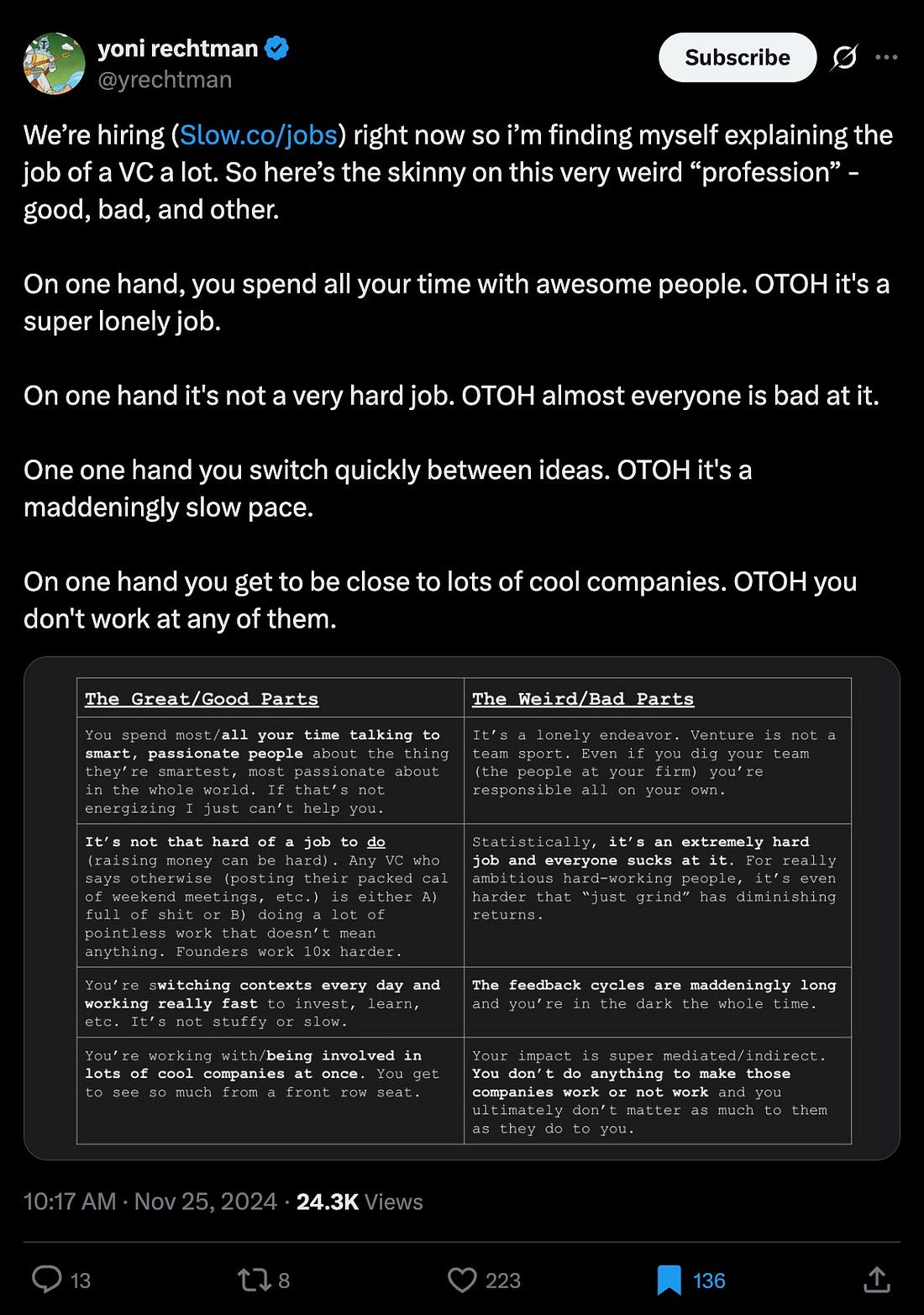
But what about a highly-curious writer with a Twitter addiction who could still work his way around a spreadsheet? The market appetite wasn’t quite as strong. Then one month into the job hunt, I got my first break when I chatted with Kyle Harrison, General Partner at Contrary Capital. He hired me part-time to help them both publish long-form research reports and diligence startups. I worked with them for ~two months, but ultimately they were looking for a full-time hire to focus on building their research platform, while I wanted to spend my time on the investing side, so it was back to the drawing board. And then I saw that Slow Ventures was hiring. In late November 2024, I was scrolling through Twitter when I saw this tweet from Slow’s partner in New York, Yoni Rechtman:
Three things stood out:
From the JD, emphasis mine:
Things I had going for me: college athlete background, recently signed book deal under my belt, and a backlog of ~15,000 tweets and hundreds of blog posts showing my thoughts on financial markets. This felt like a job opportunity I needed to get. This tweet also had hundreds of likes and bookmarks, I had no idea how long the job posting had been live, and I didn’t want to risk firing off an application into the portal without knowing if it would get read. I also had no idea if Yoni would even see my DM if I messaged him on Twitter, because he had 10,000+ followers and he wasn’t following me. So I messaged him on BlueSky, the now-left-for-dead Twitter competitor. Keep in mind that this was November 2024: election season. Twitter, during this period, was just awful political slop 24/7, and a lot of folks, myself included, were testing out BlueSky. Yoni was also testing out BlueSky, where he only had 25 followers at the time. I figured the odds of getting a reply were higher on the nascent platform, as there was less competition for attention, so I DM’d him there and said I was applying for the job and wanted to chat. I also immediately moved that conversation to email, as I didn’t know how long the BlueSky experiment would last. (That was also the last week I logged into BlueSky). A few days later, Yoni and I hopped on a Zoom call. A week later, we grabbed lunch, then he introduced me to one of the firm’s founding partners, Sam Lessin. Sam and I chatted for an hour, he asked what I thought of San Francisco. Slow was hiring in NYC (where I lived) as well as San Francisco, and my preference at the time was, obviously, to stay in New York. But I told Sam that if he offered me the job in San Francisco, I’d move out there after the holidays. He invited me out to hang in person the following week, which was my first time visiting the Bay Area (and my first time riding in a Waymo), and a week later, I received the job offer. One month after that, I packed my bags and moved to San Francisco for all of 2025. Almost two years later, I’m still working for Slow back in NYC (though I still visit San Francisco ~monthly), and I can confidently say that making the jump to the venture capital world was the best move of my career. The caliber of people I’ve met and worked with over the last two years, both within my firm, at friends’ funds, and at different tech companies has been off the chart, and my personal rate of learning has 10x’d since taking this seat. But that’s enough about me, how do you break into the venture capital world? First, the easy way:There are a few “timeless” ways to get into venture capital:
Okay, cool. But what if, instead of being a unicorn individual who was early to OpenAI, or cofounded an “AI for gerbils” business, or dropped out of Stanford to start brokering bespoke data, you studied finance or economics at a good-but-not great school and you realized in your early 20s that, “Man, venture would be cool but I have no idea how to ‘get in’?” You, like me, have to get creative. The Only Thing That Matters: Deals, Deals, Deals.This was already true in 2024, but it’s even more true today: AI is rapidly commoditizing all aspects of “junior VC” except for sourcing. AI can make decks, build financial models, create competitive market maps, and scour the internet for any possible datapoint on any and every company faster and better than any “venture capital associate,” regardless of your background at Morgan Stanley or McKinsey. The only three variables that still matter for us meat proxies in 2026 is sourcing, investment judgement, and fundraising. And if you’re breaking in as a junior, the only way you’ll be able to move the needle is “sourcing.” If you, like me, are pretty extroverted but didn’t spend four years in the banking / private equity modeling dungeons, this plays to your advantage. Funds don’t need “modelers” in 2026, they need young folks who can introduce new founders to the fund that the fund wouldn’t have otherwise met. Want to get hired by a venture capital fund? Make them believe that you’ll bring them deals they would have missed. This is why so many venture funds hire young Stanford, Harvard, and MIT kids: their classmates tend to start an outsized percentage of successful venture-backed companies. Guess what? You don’t have to spend the years of 18-22 in Boston or Palo Alto to build out a valuable network. Interested in AI research? Start writing a blog about recent tech breakthroughs in the field. Hop on Twitter and join the conversation; every researcher at the big labs is scrolling on Twitter for five hours per day anyway. Like talking to the camera? Press “record” and share your thoughts on TikTok, Instagram, or Youtube. That’s how Claire Zau got hired by Lightspeed. In my case, my Twitter following (not so much the sheer number of followers as the quality of investors and founders in that following) combined with various essays I’d written over the last few years provided 1) “proof of thought” on how I viewed the world and 2) high signal that I could generate attention which, hopefully, could convert to finding new deals. The internet is full of communities and conversations waiting for your contributions if you have something novel to say. Twitter, Reddit, Discord, Telegram, Substack, Signal, Instagram. If you can contribute useful additions to the conversation, you’ll find yourself building a network in these emerging spaces. Of course, you don’t have to just “talk about” what’s going on with tech. The nice thing about AI is that it democratized software creation. “Nontechnical” folks like me (and possibly you) can fine-tune open-source models, build our own software, and jailbreak an old iPhone to let an agent swarm run our dating apps and share the results in a Twitter thread, if we’d like. Build something cool and tell the world about it, you never know who’s going to see it. Even if these experiments don’t land you a job with a venture fund immediately, they will introduce you to folks starting and working at companies in and around the spaces where you’re spending time. Maybe you’ll get a job offer. If you join a hot company, it’s much easier to break into VC later. Maybe you’ll have an opportunity to angel invest. Even if you’re just writing ~$5,000 checks, building a track record that shows you have access to up-and-coming companies goes further than any thought-piece essay ever could. And if you introduce a few of these companies to a few VCs? Well, they’re going to want to hire you or they’ll risk you sourcing deals for a competitor. How can you position yourself to have access to up-and-coming founders and companies? Pull that off, you’re hirable. Pedigree be damned. I did it with a blog, an unhealthy Twitter addiction, and a propensity to talk anyone and everyone’s ear off whenever given the chance. Maybe you spend the next six months geeking out on AI biotech breakthroughs and start publishing YouTube videos with your findings. The internet + social media + LLMs have democratized so much of the investment game that was previously gatekept, use those tools to your advantage. What about credentialism?While some would disagree, “pedigree” is still useful in that it makes it easier for a new party to underwrite you. Most VCs are pattern-matching in their investments, so don’t be surprised that they’ll do the same when evaluating new hires. Going to a top school or working at either 1) a “hot” company or 2) a “proven winner” like Goldman Sachs improves your odds simply because it shows that you’re a winner, and it’s easier to pick someone who appears to be a winner than doing extra work to decide if someone is a winner. An acceptance letter to Harvard means you were smart enough to get into Harvard, which is one less thing the firm has to figure out when interviewing you. If you went to Wichita State? Even if you might be smarter than the next kid, how is a potential hirer supposed to know that? Of course, the right school or starter job won’t get you hired on its own, but a couple of pedigree stamps reduce the risk that you’ll be totally ignored. But that’s where the value of credentialism starts and ends: it gives you a chance to pitch yourself for an opportunity, but you still need to have some substance (ability to find deals). Is Business School a Good Way to Break Into VC?Probably not, unless you went to Stanford GSB. I think, 10-20 years ago, the MBA-to-venture capitalist pipeline was robust, but the venture world has grown increasingly tech, product, and network focused, not “spreadsheet and financial brain.” I went to a very good business school (Columbia). Columbia even has a competitive Venture Fellows program that you apply for access to in your first year of school (I was rejected!) that provides for priority registration in VC classes, opportunities to work with top venture funds on developing investment theses, and experience diligencing student and alumni-led startups. There were ~16 folks in my class (Spring 2024) who were in the Venture Fellows Program. I think 2 (?) of them had VC jobs right out of school. Most venture funds don’t prioritize MBAs in 2026. Columbia did, of course, give me a much-needed pedigree boost that likely helped my application, but I landed my job by hustling online. If you want to break into venture, you can’t rely on a hiring pipeline out of your university program. And frankly, even if there is one, it’s probably insanely competitive because venture is a desirable field. The easier (and more fun) path is building out your own network and leveraging that instead. But also if you want to do VC, there’s probably something cooler to do instead.This is a controversial take as a venture capitalist, but the truth is that venture is a weird job where you spend all of your time meeting with companies, saying “no” 99% of the time, occasionally investing, and then… waiting. Yes, of course, you can still help with getting a key hire across a finish line, being a sounding board for a founder, or prepping them for a new fundraise, but you’re not “building” or “selling” products like when you work for a company. I enjoy venture. I think it’s a cool job, and it was, particularly for someone coming from the media world, 100% the right career move for me. But I think a lot of folks who “want to do venture” would crush it joining a fast-growing company, and, ironically, doing that for a couple of years would likely make them a better investor, too. Everything that I said about “how do you break into VC?” applies to “how do you break into tech” as well. Spend some time learning about where your favorite new tech shift is going. Share your thoughts online. Build something yourself, and tell the world about it. Simply “doing the thing” and telling the internet about it differentiates you from 99% of people, whether you want to be an investor, founder, or operator. But for the venture capital game to keep working, we do need more people building killer companies. If you want to break into VC, build a network, and prove that you can find deals. But if you’re that good at finding deals, it’s worth considering if you should work for one of those companies as well. - Jack To follow along or read more of Jack’s work, you can find him on X, Linkedin, and Substack. And you could also check out his new book: Young Money: A Field Guide to Wealth and Purpose in Your Twenties.
You're currently a free subscriber to next play. For the full experience, upgrade your subscription.
|







No comments:
Post a Comment