

Should you join: Rampart CommunicationsInside the ultra-secretive deep tech startup building a new future for wireless
✨ Hey there - this is a free edition of next play’s newsletter. This is a Spotlight, part of a series where we go behind the scenes on interesting companies. What makes their business work? What is the culture like? What is the long-term strategy? How do they get their customers? And more. There’s so much noise out there; our goal is that these deep dives should be actually useful for you. You can join our private Slack community here and access $1000s of dollars of product discounts here. In the summer of 2024, Ukraine controlled a territory in Kursk that relied on a single logistical route from a city called Sumy (in Ukraine) to a city called Sudzha (in Russia). It was against this bottleneck that Russia began to test a drone technology that has since become a defining weapon on both sides of the war: fiber-optic tethered drones. Ukraine and Russia have since increased adoption of fiber-optic drones because they have one advantage that traditional drones do not: they don’t rely on wireless communication. Why? What’s the deal with wireless? Two things, which go far beyond drones.
In warfare, for instance, the mere act of transmitting wirelessly—even with encryption—is what enables a company like CX2 to track down and engage drone operators. And it’s what has driven the Russian and Ukrainian militaries, among others, to purchase fiber-optic tethered drones. But this goes way beyond the battlefield. Any time information travels wirelessly (hospital records, self-driving cars, satellite feeds, infrastructure controls), the signal itself is a vulnerability. And, as we’ll cover, current encryption is not capable of fixing that. Enter Rampart, the company we are covering today. Its team, which includes ex-NSA PhD scientists, mathematicians and engineers, has developed a brand new technology that makes wireless signals look the same as the background noise. If signals can’t be identified, they can’t be intercepted or jammed. This is revolutionizing the future of wireless communications.
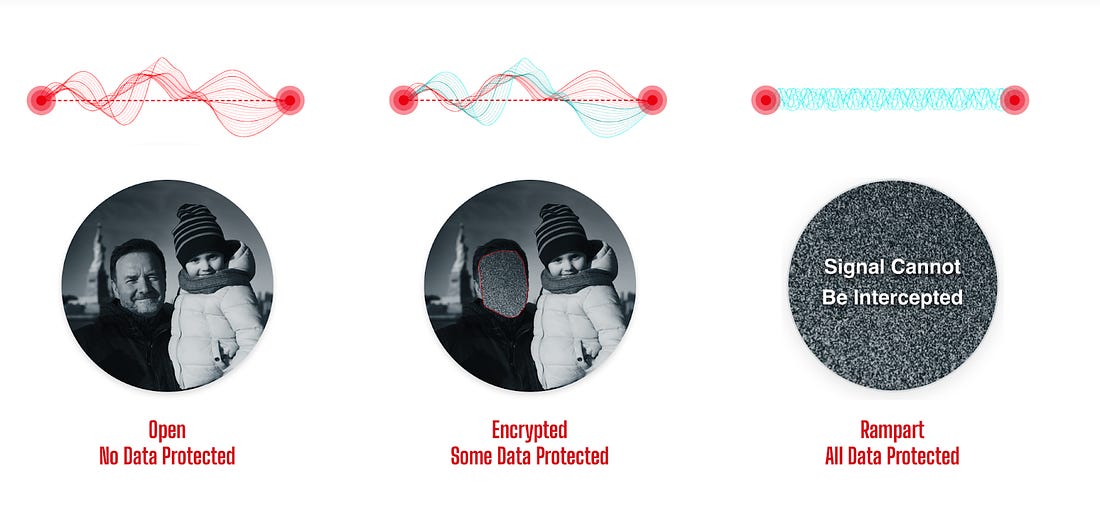
So, what exactly is Rampart working on? What is it like to work there? Why should you consider joining them? I sat down with the team to get answers to those questions and more. The productImagine it is a sunny Friday afternoon and you are sitting down at a neighborhood café with a friend. The conversation turns to a subject you aren’t comfortable speaking about in public. So you suggest to your friend that the two of you start speaking in Spanish, a language you are both fluent in. You hope nobody around you speaks Spanish. The Spanish-speaking approach is a rough (but useful) analog for modern wireless encryption. The message gets scrambled into something that is hopefully unintelligible. But everyone around you can still see that you’re talking. They can see who you are, who you’re talking to, when the conversation started, and how long it’s lasted. If they wanted to, they could come over and disrupt the conversation. They could even follow you home. What if you didn’t want people to know you were talking at all? Then you’d need to figure out some sort of communication system that was undetectable. A way of speaking to each other that made your sounds just like the background noise in the café, a way of speaking that only the two of you could possibly understand. Our hypothetical now fails us, because it seems impossible. And yet it is what Rampart is building. The core innovation behind Rampart’s products is called UBDM and a related technology known as RSW. These technologies scramble the entire wireless signal so it looks exactly like random background noise. UBDM hides what you say (and then some), and RSW hides that you are saying anything at all. In both cases, there is no chance for an eavesdropper to intercept (recover the data in the signal). This is a helpful visual:
In other words, with Rampart, your wireless communications are pure background noise to everyone except for you and the person (or device) on the other end of the comms. Right now, this technology plays out in two distinct products. UBDM Core is the raw innovation itself, sold as a licensable IP block. It’s a piece of logic that can be dropped into any radio platform; the engine that other people build into their own radios and systems. The second is the StrataWave UAS (Unmanned Aircraft System) Radio. Rampart’s two products both use the UBDM and RSW in different ways. UBDM Core enhances almost any existing system, preventing interception and providing persistent and secure connectivity without needing cables. StrataWave is a drone radio engineered for military UASs operating in contested airspace; it makes drones extremely difficult to detect or jam. Rampart’s products, to date, have been sold for military applications. Talk to anyone at the company, though, and you will learn that the vision is far more ambitious than the battlefield. The strategyWarfare is not the only application for Rampart’s technology. Because, as I mentioned earlier, wireless connectivity is required for most things in the world to work. Hospitals, financial institutions, satellites, power grids, water systems—these are a few other examples of areas where Rampart’s technology could have a big impact. “Rampart is framing a new field of discovery at the intersection of Physics and Information Theory,” Matt Robinson, Rampart’s founder and Chief Scientist told me. “We are poised for total leadership from the physical layer up, for defining the frontier of communication technology, and for being the global standard for all network engineering,
In this new version of the world where standard wireless and standard encryption is not enough, you can envision Rampart being useful for all wireless communications; perhaps starting with the most sensitive (as they have with the military) and working backwards from there. One belief driving Rampart’s approach to the business is that “we’ve largely reached the end of easy wins. The low-hanging fruit is picked over, and even most of the medium-sized problems are quickly being solved. What’s left are the ‘hard’ problems - the ones that won’t yield to patchwork solutions or half-measures.” “If we want the next great leap in history, we have to stop chasing shortcuts and start reinvesting in the hard, slow, substantive work of fundamental engineering, science, and mathematics. Real progress requires real thought, not just harder sprints.” “We have a fundamentally novel and powerful approach to the next generation of wireless communications,” Rampart’s VP of Growth, Dzu Do, said. “This is the culmination of years of research and development applied towards solving real world problems in both the defense and commercial industries.” The growthIf the tech startup world is a stereotypical high school classroom, Rampart is not one of the kids raising their hand every two seconds. They are not one of the kids playing video games in the corner. They are not one of the kids scrolling Instagram or debating politics with the professor. No, Rampart feels a little more like the nerdy smart kid sitting quietly in the back, taking notes.
The company doesn’t try much to market to the general public. Their official X account has 0 posts. There are no splashy Series A announcements or big VC names. Rampart has instead raised money behind the scenes through a combination of grants and funding from angel investors; a path more common among defense companies than ‘hot’ software startups. Rampart’s distribution so far has been mostly through defense ecosystem relationships: SBIR contracts, partnerships with companies like Lockheed Martin, Comtech, and Thales Defense and Security, and direct Pentagon engagement. The company hosted former Under Secretary of Defense Heidi Shyu (the third-highest-ranking civilian in the DoD), Dr. Tom Rondeau (Principal Director for FutureG) and Alex Lovett (recently retired Director of Prototypes and Experiments for Mission Capabilities) at their facility, which is a strong sign of DoD interest in Rampart at the highest levels. The culture and teamThere is one stereotype of startup culture that focuses on MVPs, on pushing to production as fast as possible, on spending as little on development as possible. That is not Rampart. I talked to Jay Patel, Rampart’s EVP of Product and Engineering, who previously worked on some of the first mobile phones at Motorola and led product teams at Avaya and Vonage. “We invest heavily in true research,” he said. “This is rare to see as many startups focus more on… [just] trying to get a product to market.” The R&D-first ethos is so strong that Rampart’s CEO, Omar Javaid, thinks it might even be controversial. “We have some of the best mathematicians and physicists on the planet! It’s unpopular because it’s a heavy, long-term investment and most people think short term.” The team “is unique. They have a deep technical background, were successful academics, and - crucially - applied their research interests at the NSA and in the field with actual operators.” (The R&D claim isn’t just fluff; Rampart holds 130+ patents!) You might reasonably assume that working at Rampart alongside some of the ‘best mathematicians and physicists on the planet’ is probably not an easy job. That would be correct. “It’s really challenging to work on fundamental technology where the timing is uncertain. Some people are attracted to uncertainty but find that environment difficult to actually work in.” The biggest driver of talent to Rampart is the novelty of the technology. It is an opportunity for PhDs to work on revolutionary technology. Also, a common theme amongst all employees is the fundamental goal to keep our servicemembers safe when they are working in contested areas. Rampart is based in Linthicum Heights, Maryland, and the team works in-person.
Should you join Rampart?The word “inventor” often sounds like an old-fashioned thing that does not apply to the work people do today. It can feel like lots of tech startups are just building slightly better versions of things that already exist, step-changes that might be useful but are not very exciting. Rampart is inventing things in the old-school sense of the word. They have “made advances that were previously considered impossible.” Their goal is to become the gravity well for a new era of wireless. If you are a smart person interested in working on a big problem, this probably ranks within the top decile (or higher) or projects you might want to consider. Matt Robinson, Rampart’s founder, told me that he wants the company to be the place that people “send their best PhD students and professors on sabbatical because this is where the most exciting and groundbreaking work happens.” The first value Rampart lists on their general job application is: “Privacy is a right.” If you are interested in building a more secure, more private version of wireless for the future, and if you would like to do that alongside some extremely smart and hardworking people, you may want to consider joining Rampart. You can see their open roles here. Thanks to Rampart for supporting Next Play and making this Spotlight possible You're currently a free subscriber to next play. For the full experience, upgrade your subscription.
|






No comments:
Post a Comment