
Should you join: Eight SleepThe fast-growing startup that reinvented how people sleep is pushing onto their next frontier: preventative, AI-driven health optimization.
✨ Hey there - this is a free edition of next play’s newsletter. You are reading a Spotlight, part of a series where we go behind the scenes on interesting companies. What makes their business work? What is the culture like? What is the long-term strategy? How do they get their customers? And more. There’s so much noise out there—our goal is that these deep dives are actually useful for you. You can join our private Slack community here and access $1000s of dollars of product discounts here. There’s a temptation to believe that just because something can exist, it does exist. Humans went to the Moon (and are going again). We landed robots on Mars. We have quantum computers. We built the Large Hadron Collider. Inventing miraculous technology is our default. Surely, then, we must have solved one of the most important things in the world—sleep? But we haven’t. Or, at least before Eight Sleep, we hadn’t. Sleep is one of the highest-leverage pillars of health, and yet as Eight Sleep’s co-founder and CEO Matteo Franceschetti points out, most of us spend a third of our lives “on a dumb piece of foam.”
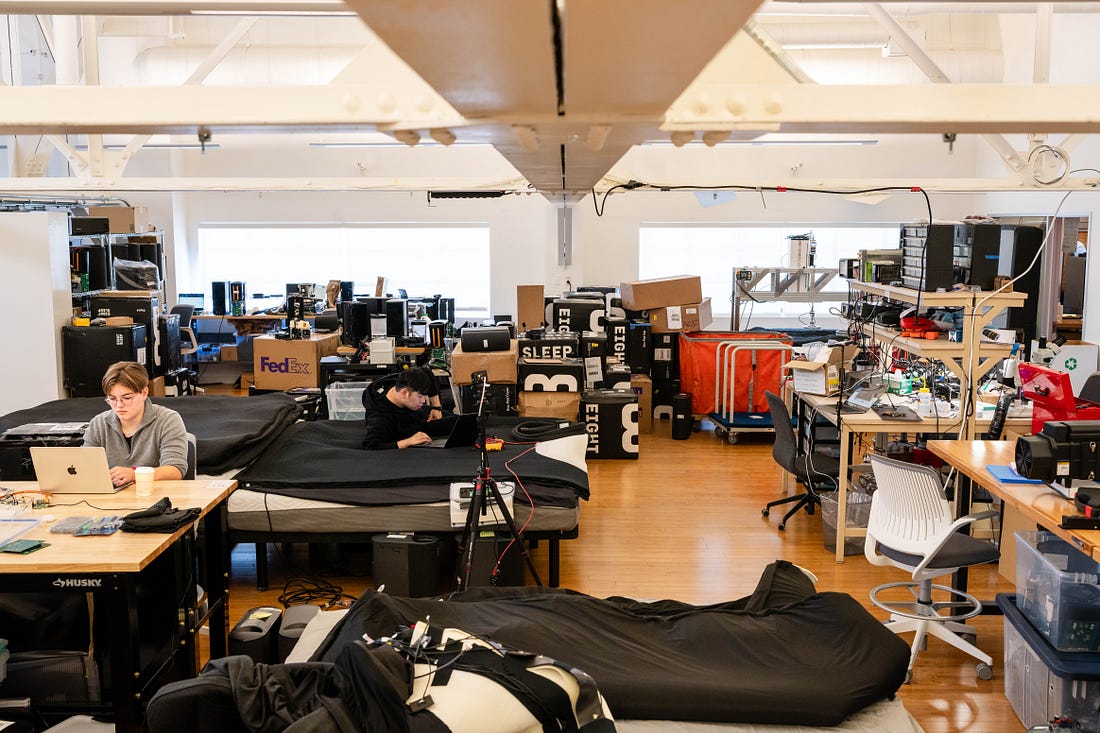
Turns out, there was a lot of space to innovate. In the 11 years since their 2015 Indiegogo Launch, Eight Sleep has built one of the most impactful sleep products in the world. They are now a unicorn, sell in 35 countries, and are the sleep system of choice for everyday people to professional athletes (like Charles Leclerc) and tech execs (like Mark Zuckerberg). Their success so far is impressive. But the vision, Eight Sleep’s co-founder Max Bassi told me, is even bigger than sleep: “Eight Sleep will be the health company of the future.” I was curious: what does that mean, exactly, and how is Eight Sleep going to get there? What is the product like today? What is the long-term vision? And who should consider joining? The productThe way I’ve described Eight Sleep so far might imply that their core product is a mattress. But it isn’t. Eight Sleep’s main product, the Pod, is basically everything but the mattress. It’s a sleep system that works with your existing bed to improve your sleep. Building the Pod meant solving problems no one had solved before: how do you track biometric data accurately without skin contact or a wearable? How do you adjust temperature independently on two sides of a bed, in real time, without waking anyone up? How do you do all of this without changing the comfort of a mattress? The result is a system of highly technical components that works so invisibly most people just call it “the thing that changed my sleep.”
The nice thing is that it actually works. Eight Sleep has conducted over 75 clinical studies to date with their internal research team. Their most recent peer-reviewed research shows that sleeping on the Pod clinically improves deep sleep, REM sleep, resting heart rate, and heart rate variability. And if any of your friends or coworkers are Eight Sleep customers you undoubtedly know about it; not because you asked but because they, unsolicited, will have told you all about how well they sleep. There are few products in the tech startup world that receive customer feedback with such conviction. It helps to think of the product’s benefits in two buckets: (1) sleep and (2) health more broadly. The former is the reason most people spend so much money on the Eight Sleep Pod. They want to sleep better. People want this because it is obviously good (sleeping is nice) and also because they know it will have other downstream benefits to their life and health. The latter—health—is where things get even more interesting. What becomes possible when you sleep on a device that can track important health metrics, like HRV, respiratory rate, sleep stages, and more? What becomes possible when you have a clear picture of these metrics every single night for years on end? These are the questions that Eight Sleep’s broader vision is aiming to answer. The strategyEight Sleep is already cash flow positive. People love their product and pay plenty of money for it. If they wanted, they could stop at The Pod. The company could survive, even thrive, without another world-changing goal. Better sleep could be world-changing enough. But the Eight Sleep vision is broader than a mattress upgrade. “Eight Sleep will be the health company of the future,” Max Bassi, co-founder and CTO, told me. “Today we optimize your sleep. In 20 years, we cover you 24/7 - predicting changes in your body and health, and taking action automatically to help you achieve your goals, keep you healthy, and keep you well rested.” The Pod, Max said, is the easiest entry point to getting the data you need to achieve this goal. People spend (hopefully!) 7 or 8 hours a day in bed, around the same time of day, every single day. They don’t move too much. Their body is relaxed. It is the perfect place and time to track all sorts of important health metrics; numbers that have wide-reaching consequences. From this foundation, “we build outward - more sensors, more data, more interventions,” Max said. “Adjusting your temperature, changing your sleep schedule, alerting you before a problem becomes serious. The more nights of data we collect, the smarter the system gets, the more we can do for you. That’s the 20-year bet.” You may have a separate question: how does Eight Sleep beat all of the other companies that want to play in this space? But the answer is more or less the same: the moat for Eight Sleep is the product they sell today. It is owning the bedroom, the best place to start with tracking many of the metrics that are important for preventative health. The other differentiator may be Eight Sleep’s AI-powered products. One example is Autopilot, an algorithm that learns your sleeping patterns and proactively prevents sleep disruption. Another idea is AI-driven health guidance based on data that only Eight Sleep has. And perhaps it is this grand vision that helps explain why Eight Sleep has raised $150M over the past year. Not only as a sleep system, but as a preventative health company.
The growthThe first version of Eight Sleep was a mattress pad on IndieGogo that they launched not long before being accepted into Y Combinator. The founders (Matteo, Alexandra, and Max) enabled the campaign at 2AM just to test that everything worked. A few minutes later, an order came in. “We assume it was one of our test transactions,” Max said. “But then we looked at the shipping address. It was in France. A real person, on the other side of the world, had found us and bought our product.” The company has done rather well for itself in the 11 years since. People like Mark Zuckerberg and Elon Musk have, organically and unprompted, talked about how they love the product. Athletes have purchased the product on their own, and then come to Eight Sleep wanting to promote it. “We don’t have to convince people to say they like it,” Max said. “They already do.” Eight Sleep sells in 35 countries. They have hundreds of thousands of customers. They have collected over a billion hours of biometric sleep data. They are cash flow positive. All the kinds of things that most tech companies dream of. As you might expect, VCs have been happy to fund Eight Sleep along the way. But the past 12 months have been the most dramatic flurry of fundraising in the company’s history. In August of 2025 the company raised a $100M Series D, led by HSG. And in March this year, they raised an additional $50M, this time at a $1.5B valuation, in a strategic round led by Tether Investments. Why all of this fundraising, why now? I would bet that investor confidence is powered by a couple of things. One of them is financial fundamentals; Eight Sleep has built a winning product in the (notoriously difficult) consumer hardware space, which has done a lot to de-risk the business. But likely the bigger reason that investors are excited right now is to help Eight Sleep accelerate towards their big goal: becoming the most important health company of the decade. The teamWhat’s it like to work at Eight Sleep? It became clear through my conversations that Eight Sleep operates with a focus on discipline, effectiveness, and ownership.
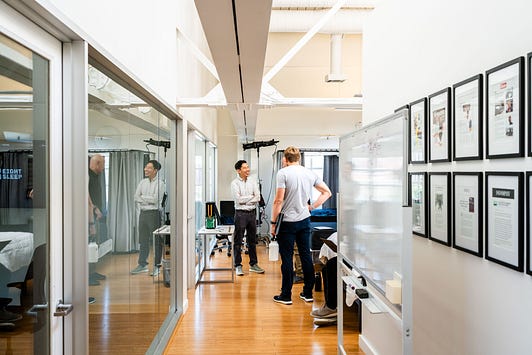
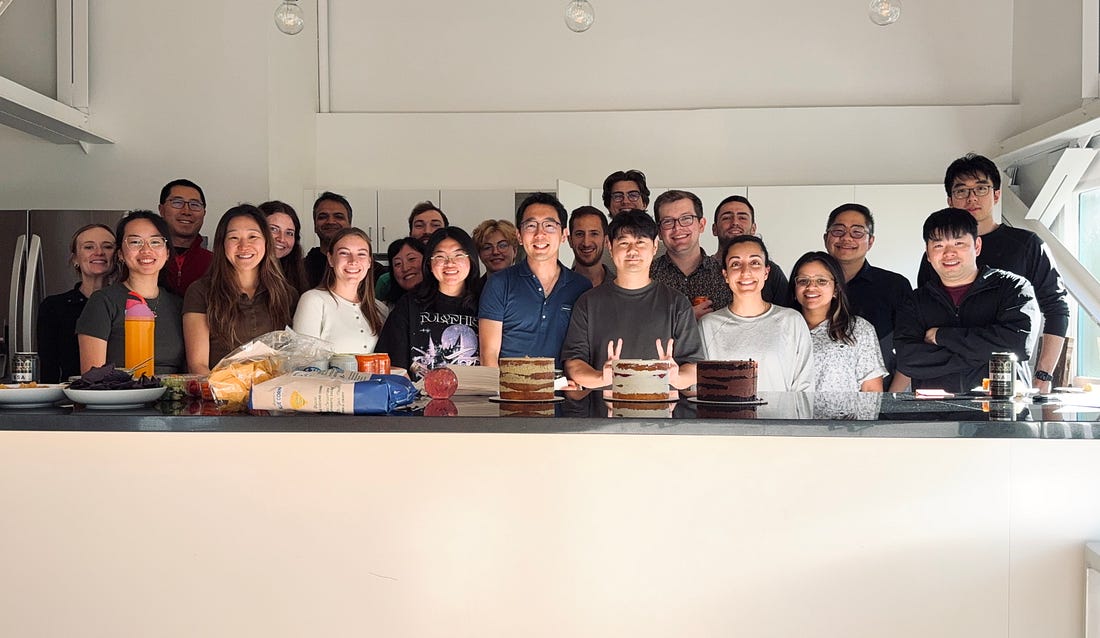
Among others, I talked to Sam Kang, Eight Sleep’s Chief Product Officer who in the past worked on the Tesla Roadster and Sonos speakers. “There are three things I care about in a job,” he said. “The first is impact. The second is learning and solving interesting problems. The last thing is team… It was clear that the team was very passionate and smart, but I didn’t detect any ego.” Meetings are scarce and the culture is “very written,” Sam said. “People add comments on agendas and then have discussions in meetings. Rarely are meetings just one-way presentations of information. One saying from our CEO captures it well: a good meeting is one that ends early, and a better meeting is one that does not take place.” The culture is deeply focused on ownership of outcomes and accountability for your work. Vanity metrics, and the people who like them, don’t tend to do well. Nor do people who need a lot of structure or need to be told what to do. It’s hard work and the hours are long sometimes. Importantly, you need to know what your actual job is. In other words: what result am I being hired to produce? If you’d prefer to be handed a to-do list, Eight Sleep is not your company.
“The good is the company is full of extraordinary people, the mission is real and the product has the potential to improve the lives of millions of people,” Sam said. “On the flip side, expectations are high and the intensity is not for everyone.” One other thing that sets Eight Sleep apart from other companies, David Q. Sun, VP of AI/ML (ex-Apple) told me, is “how relentless we are in asking, ‘What can be better?’ There is very little complacency, even when something is already working well.” Should you join Eight Sleep?There was one theme repeated by everyone I talked to: impact. “You’re working on a physical product,” Max said. “Something you can actually touch, something you and your friends use every day. That’s rare in software. Most engineers spend their careers building things that live behind a screen. Here, your code changes how someone sleeps tonight.”
It’s true that in tech you do not get many opportunities to work on products that physically exist. It’s even rarer that one of those products is making an obvious, tangibly positive impact on people’s lives every day. Better sleep and better health are two clear positives. You might also consider that now is a unique time to join Eight Sleep, because the company’s ceiling is not simply sleep optimization. Their goal is to become the most impactful health technology company of the decade, and The Pod is a useful foundation to help them do that. Joining now means building towards a vision with a higher ceiling than “sleep optimization” might at first imply. If you do want to get hired, Eight Sleep’s CTO told me that he’d “be impressed by someone who sends me a project they built on the Eight Sleep API. It shows they understand the product, they can ship, and they care enough to do the work before anyone asked them to. That tells me more than any resume.” This advice likely applies across all departments at the company; show you can be valuable instead of telling. The Eight Sleep team works both in-person at their San Francisco, New York, Boston and most recently, Milan, Italy offices as well as remote, depending on the position. See their open roles here. Thanks to Eight Sleep for supporting Next Play and making this Spotlight possible. You're currently a free subscriber to next play. For the full experience, upgrade your subscription.
|
Should you join: Eight Sleep
Thursday, 2 April 2026




Subscribe to:
Post Comments (Atom)


No comments:
Post a Comment