Ex ante, I would have said that it would be very difficult for the United States to lose a war with Iran. Yet Trump—somehow—seems to have managed. A postwar state of affairs that is vastly worse than Obama’s JCPOA that he broke seems to be the best kind of Pyrrhic victory he can hope form and even that is unlikely. Dan Drezner righly calls it a “strategic defeat of the United States.” And foreign‑policy establishment figures that short months ago assured us Trump “won Davos” are busy spinning. Connecting the dots from the island of Melos to the Strait of Hormuz, foreign-policy macho irrealism usually delivers catastrophe…
It is definitely what is happening. Mind you, that Trump is losing his Pearl-Harbor-in-reverse war with Iran does not mean that Iran is winning its war over Trump: both sides are and can be losers. And I would argue that Israel is a loser too: the odds that Tel Aviv becomes radioactive glass in half a century are definitely up. The winners are Bibi Netanyahu as an individual—his likely tenure in office is longer, and his chances of escaping jail are greater—and Iran’s IRGC as an institution, because their ability to say “we told you so” gives them overwhelming strength within the Iranian government for the forseeable future, and their newly-promoted honchos have more power, status, authority, and wealth if they wanted it than they ever expected, albeit at some additional personal risk.
The very sharp Dan Drezner has a piece this morning giving the state-of-play:
Dan Drezner: The Trump Administration Is a Loser in Iran <https://danieldrezner.substack.com/p/the-trump-administration-is-a-loser>: ‘If you squint real hard, there is a way to view the Trump administration’s pressure on Iran trending in a positive direction. As Bobby Ghosh pointed out in Foreign Policy, Iran has lost an awful lot of capabilities…. As crazy and illegal as the Trump administration’s decision to impose their own blockade in the Strait of Hormuz might sound, it also might be something the U.S. Navy could actually accomplish with its current capabilities…. There is a scenario in the Persian Gulf in which the U.S. finds itself in a stronger position than Iran in the coming weeks.…
But… the costs of the collateral damage of the war to the United States are rising…. Russia has provided intelligence to Iran. China has aided Iran’s missile program…. Both countries… [can] ratchet up their assistance…. Iran is… regenerat[ing] its ballistic missile forces program'“… An even more radical regime [is] cementing its power in Tehran…. As residents across the world feel the economic pain, they are likely to blame the countries that instigated this particular round of the conflict—which happen to be the United States and Israel…. The best-case outcome for the United States is many, many more months of economic and geopolitical pain, and continued evidence of the rest of the world pushing back aggressively against the Trump administration…. This does not look like winning…
If you squint real hard, there is a way to view the Trump administration’s pressure on Iran trending in a positive direction. As Bobby Ghosh pointed out in Foreign Policy, Iran has lost an awful lot of capabilities during this war…
7 hours ago · 30 likes · 6 comments · Daniel W. Drezner
Share
American foreign policy is indeed, as Dan wrote last month, “being run by the dumbest motherfuckers alive” <https://danieldrezner.substack.com/p/american-foreign-policy-is-being>, and the result has been the profound self-inflicted “strategic defeat of the United States” <https://danieldrezner.substack.com/p/the-strategic-defeat-of-the-united>.
Back in 2017 I wrote a Washington Post column highlighting the first-term Trump administration’s myriad foreign policy fuck-ups, noting “I look at this president and his foreign policy team, and I just can’t stop laughing.” See if any of this next section has any ring of familiarity for 2025…
a year ago · 629 likes · 59 comments · Daniel W. Drezner
To understand the strategic disaster that is unfolding in the Persian Gulf, let’s take a gander at the last two columns of one of the war’s initial optimists: New York Times columnist Bret Stephens…
12 days ago · 406 likes · 50 comments · Daniel W. Drezner
And, meanwhile, a correspondent emails me a link to a proposal from Niall Ferguson and company about how to make things better, and asks me what I think:
Niall Ferguson, Richard Haass, & Philip Zelikow: How to Stop Iran From Winning the War <https://niallferguson.substack.com/p/how-to-stop-iran-from-winning-the>: ‘The Strait of Hormuz must reopen, but not on Iran’s terms…. The Iranian regime must not be allowed to turn the seven other states that border the Persian Gulf… into its vassals. Nor should the rest of the world submit to Iran’s extortions…. Iran must fail in its bid to become the master of Hormuz…. The U.S. and those who support the effort to reopen the strait must offer a positive vision for how commerce through the strait will be regulated in future—with incentives for all, including Iran, to keep it open….
Step one: Iran should be in no doubt about our readiness to force safe transit through the strait on our terms… insurance and compensation… military escorts, extensive deployments… counter-drone interceptors…with Ukrainian help… combined U.S.-Israeli efforts…. Transits from our allies may be limited and hazardous. But Iran would get none. This would flip the narrative: The strait should be open to all or closed to all…. Important roles for Arab, Asian, and European partners… without having to align themselves with ongoing Israeli or U.S. military action….
Step two: A back-channel understanding… that allows transits… while conversations proceed toward a formal public agreement. If the Iranians face a credible threat of a blockade of their oil exports, they will agree to this….
Step three:… A new Strait of Hormuz Company (SOHCO)… [with the] principal shareholders in the company… the eight coastal states, including Iran, plus the United States… [and] voting rights on the principle of majority rule. The company could administer a regulated fee system for passage… [with] funds would be held in a SOHCO trust to pay for collective goods such as mine clearance and navigational infrastructure…. Any violation of the Hormuz Convention could lead to exclusion of the offending country from use of the strait, on the basis of a two-thirds majority vote by SOHCO shareholders….
This three-step strategy to restore and govern open commerce through Hormuz does not depend on overthrowing the governing regime in Iran. It can work with whoever governs Iran…. It would be in the net interest of Iran…. It is designed to be done with Iran rather than to it…. [But] the crucial thing is that [Iran] cannot dictate the terms of peace…
This Saturday, delegations from the United States and Iran are slated to head to Pakistan to try to negotiate a lasting end to the war between them. Among the bones of contention will be the Strait of Hormuz: the crucial waterway through which one-fifth of the world’s oil and liquefied gas normally passes. Iran’s closure of the strait since the conflict…
5 hours ago · 27 likes · 1 comment · Niall Ferguson, Richard Haass, and Philip Zelikow
Give a gift subscription
Backing up: Turkey does not get to use the Dardanelles Strait as a major profit center because its not doing so pleases Russia (and Ukraine), removes potential threats to its territorial integrity, and has been part of its adherence to the post-WWII Western Alliance from which it has benefitted substantially via security guarantees and integration into the régime of open commerce. Panama does get to use the Panama Canal as a major profit center—half of Panama’s exports, if I recall correctly. Egypt gets 15% of its exports from Suez-Canal services, behind only worker remittances and tourism in export earnings.
In the past, it would have been very, very expensive indeed for Iran to try to tax the flow of commerce through the Strait of Hormuz. The Saudis would have been willing to pay for 600,000 Egyptian and Pakistani soldiers and military police to object to any such tax. They would have been backed up by the US military for the same reason that the US committed itself to the first Gulf War of 1991. Thus an Iranian régime would run immense potential losses by trying.
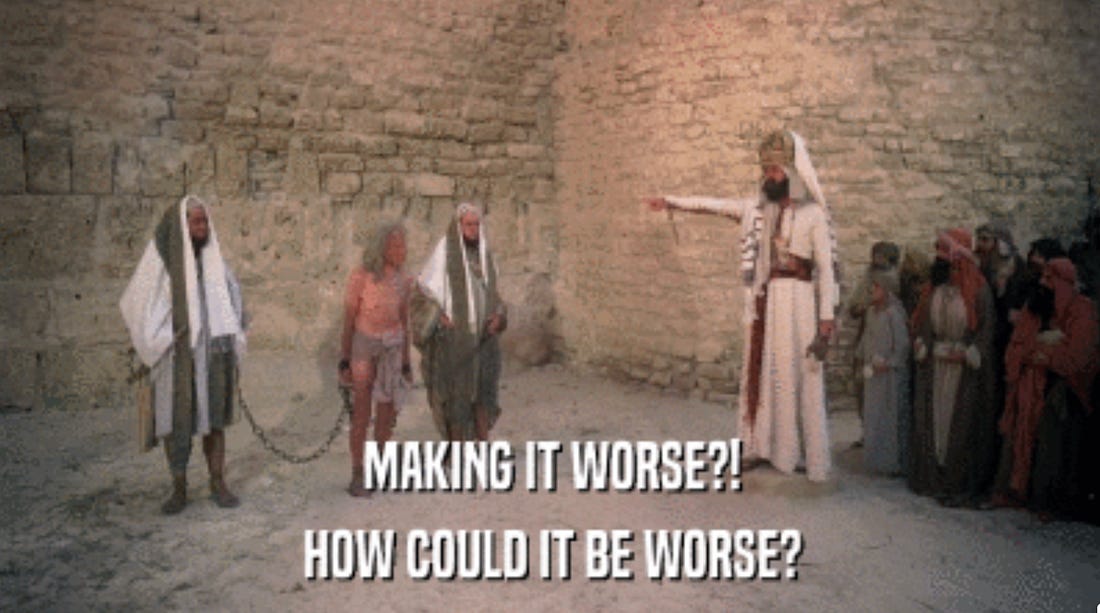
Now, however, the costs of having the U.S. Air Force undertake its gigantic fire dance across Iran have already been inflicted. Saudi willingness to spend the money needed to get Egyptian and Pakistani occupation forces into the theatre in order to pull Donald Trump’s out of the chestnuts out of the fire is limited, even though an Iran-provocation transit tax would have greatly solidified a broad and deep “freedom of the seas” international coalition with serious teeth. “We will do worse to you if you don’t reopen the Strait of Hormuz!” says Trump. “How could it be worse?” says the IRGC.
Get 75% off a group subscription
We have paid the costs of the war that any attempt by us to impose taxes on traffic through the Strait of Hormuz would have launched, the IRGC says. So, since we have paid the price, we might as well take the goods, the IRGC says.
And Ferguson & al., I think—agree with the IRGC here?:
This… does not depend on overthrowing the governing regime in Iran. It can work with whoever governs Iran…. It would be in the net interest of Iran…. It is designed to be done with Iran rather than to it…
Leave a comment
The natural reading of this is that: yes, henceforth Iran will collect transit tariffs; and our proposal for SOHCO is a way to whitewash that, and to negotiate over terms.
Look again at Ferguso & al. The focus is not on what will the state of things be going forward that will produce a ceasefire in this war? The focus is on:
Not on Iran’s terms… [Not] turn the seven other states… into its vassals. Nor should the rest of the world submit to Iran’s extortions… Iran must fail in its bid to become the master of Hormuz… Terms Iran does not set… A back-channel understanding… [that] need not depend on a political settlement… [Iran] cannot dictate the terms of peace…
and on how Iran is not the responder but the actor here:
Iran is attempting to claim the tollkeeper roll…
Refer a friend
Now I know and you know and Niall Ferguson knows and Richard Haass knows and Philip Zelikow knows that Iran did not set out to “claim” anything, and know as well that one side dictates the terms of peace only after complete conquest of the space at issue and either unconditional surrender or total withdrawal. Almost all of the time terms of peace are negotiated, not dictated. And it is so understood. So where does all the “Iran cannot dictate”, “terms Iran does not set”, “fail in its bid to become the master”, “[not] submit to Iran’s extortions”, “[not] vassals”, “not on Iran’s terms” language come from.
Well, as I read them, there are three possibilities:
This is Boob Bait for the MAGA Bubbas: yes, Trump should accept Iran’s terms for the transit tariffs it will collect in the future, but this needs to be whitewashed through the SOHCO so that Trump, Hegseth, Rubio, Vance, Bessent, and the others can claim that they deprived Iran of a victory.
This is willful self-delusion: Ferguson, Haass, and Zelikow can see where this is going, but they do not want to admit it to themselves—and do not want to admit to themselves how much Trump’s playing 11-dimensional chess involves using one of your pawns to take your own queen and remove it from the board.
Three—I don’t really see a third possibility. Do you?
My correspondent closed by asking me to take a look at this, from three short months ago:
Niall Ferguson: How Trump Won Davos <https://niallferguson.substack.com/p/how-trump-won-davos>: ‘I have never before seen a single individual so completely dominate this vast bazaar of the powerful, the wealthy, the famous, and the self-important…. Trump won Davos, hands down. And not only did he win it; he owned it…. Trump ever seriously meant to annex Greenland or to impose new tariffs on the Europeans. Why would he[?]… That Trump carries out only around half the threats he makes on social media is a feature, not a bug—and it’s certainly not a sign of weakness. It is a deliberate tactic designed to leave counterparties uncertain….
But why did he threaten it? Just for the lolz? Certainly, there was much hilarity among U.S. government staffers… [who] certainly were in on the joke. But… more… here than mere presidential trolling…. kKep European leaders from meddling in America’s Middle Eastern and Eastern European policy…. The USS Abraham Lincoln aircraft carrier and its strike group are currently in the Indian Ocean en route to the Persian Gulf and are preparing strike package options on Iran…. Witkoff expressed optimism that… peace between Russia and Ukraine… [was] “down to one issue”… likely… territorial cessions by Ukraine…
Donald Trump attends the signing ceremony of the Peace Charter for Gaza in Davos, Switzerland, on January 22, 2026. (Harun Ozalp/Anadolu via Getty Images…
3 months ago · 81 likes · 3 comments · Niall Ferguson
Share
Ah. I remember: I did see this, and commented on it at the time <https://braddelong.substack.com/p/do-those-dominating-a-situation-truly>.
IIRC, my major points were:
Ferguson’s “Trump was bluffing on purpose” framing functions as a Xanatos‑Gambit story: every outcome is spun as proof of Trump’s strategic genius.
Henry Farrell’s institutional, game‑theoretic reading (rituals, common knowledge, bargaining power) shows Europe had more leverage than it realized and used it.
Public meaning about events like Davos is shaped by such narratives; intellectuals like Ferguson are actively contesting how history will remember Trump’s power.
Trump did make his Greenland and tariff threats, got no concessions on anything, and those threats did then collapsed into retreat, undercutting the claim that he “won” or “dominated” Davos.
Most important:
Thoukydides’s Melian Dialogue is commonly misread as it is here by Ferguson.
Appeals to “realism” and dominance that celebrate raw power often miss that arrogant overreach can be strategically disastrous, as with Athens in the Peloponnesian War, as it willed into being a countervailing Grand Alliance against it.
Indeed, pointing out that might-overrides-right arrogance is the opposite of a realistic means-ends policy is the reason that Thoukydides put the Melian Dialogue into his book.
I would add one more: succumb to the temptation that Donald Trump has a long-run plan, that he is not an impulse chaos-monkey, and you had better hope that everyone who reads you has a short memory.
Leave a comment
If reading this gets you Value Above Replacement, then become a free subscriber to this newsletter. And forward it! And if your VAR from this newsletter is in the three digits or more each year, please become a paid subscriber! I am trying to make you readers—and myself—smarter. Please tell me if I succeed, or how I fail…
##how-is-donald-trump-managing-to-lose-a-war-with-iran-perhaps-the-most-important-thing-going-on-right-now
##neofascism
##perhaps-the-most-important-thing-going-on-right-now
#donald-trump
#donald-trump-managing-to-lose-a-war-with-iran
#chaos-monkey
#chaos-monkey-foreign-policy
#dan-drezner
#dan-drezner-is-smart
#strategic-defeat
#iran-war
#trump-foreign-policy
#pearl-harbor-in-reverse
#jcpoa
#strait-of-hormuz
#freedom-of-the-seas








No comments:
Post a Comment