
If you want me to brief your board or leadership team on these themes, and especially on AI in 2026 and beyond, please get in touch here.
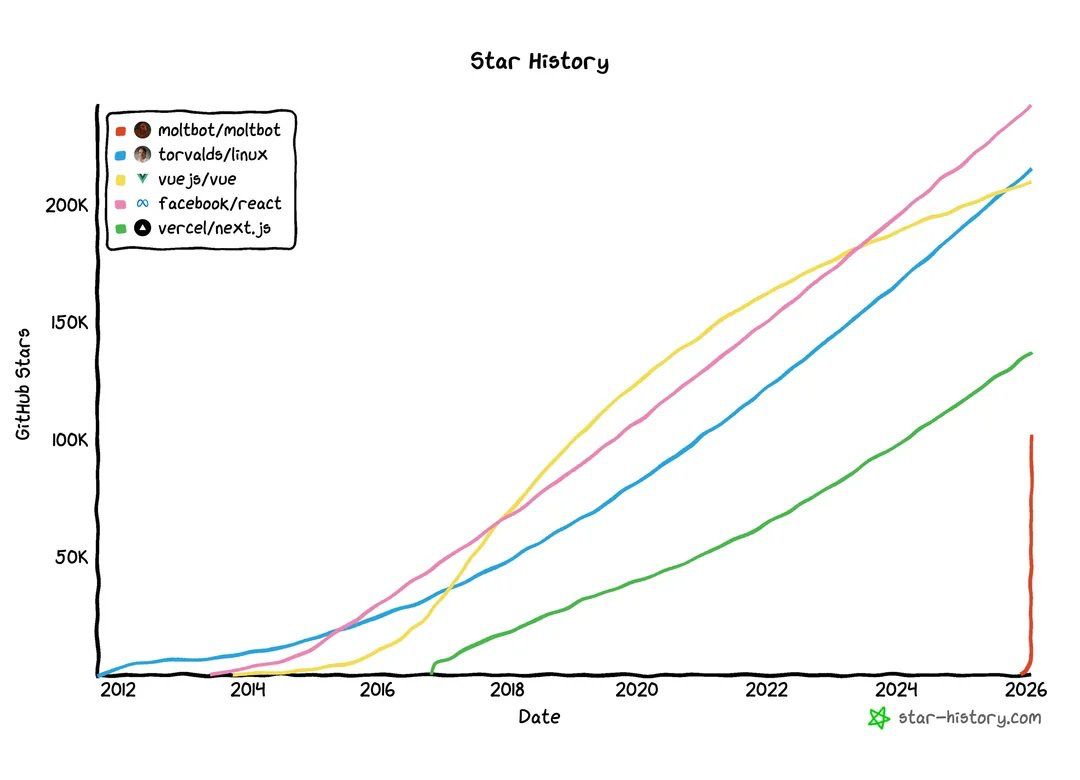
Hi all, I’ve been following AI publicly through this newsletter for a decade. I’ve never seen a week like this one. Agents work now. Not “work with caveats,” not “work if you’re technical.” They just work. And what happened next – tens of thousands of downloads, a social network for agents, infrastructure companies treating it as infrastructure – happened in days. Let’s walk through it. Clawgentic AI is hereClawdbot (now OpenClaw)¹ has moved so fast that even we didn’t get to write about it before it changed its name (twice). Created by a solo developer, this agent took one corner of the internet by storm with tens of thousands of downloads and people rushing to buy Mac Minis to house their little agents. It spawned a social network for agents (Moltbook, which I think is the most important thing happening on the Internet at the moment) and Cloudflare built tooling to run it serverlessly, all in one week.
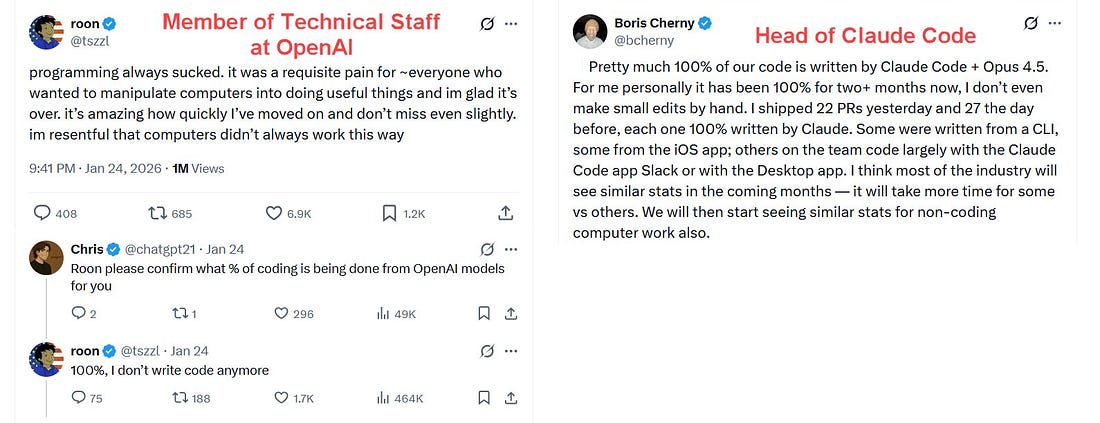
From a bare install, I was able to ask it to connect to my studio lights and CCTV. Clawdbot found the endpoints and created its own skill to control them. So I can now turn my lights on and off via WhatsApp. OpenClaw is the “AI Chief-of-Staff” we first described in 2024, now real-ish. “Mini Arnold”, my Moltbot agent, is now recieving my todos, random thoughts and other things into it via a range of channels. It’s been helpfulish so far, but whether it’s really helpful and additive to my current systems remains to be seen. “Mini Arnold” has public profiles on MoltX (a Twitter clone), Moltbook (but just a lurker) and a few other services. But OpenClaw is just the most visible change. My guess is its main contribution will be to understand design patterns for agent-to-agent behaviour and the considerations for how we build governance and management across the systems of these agents. But the headline is: agents now work. Back in October, I tried to build a flow that would analyze my public equity positions: pull the fundamentals, read the technicals, digest earnings transcripts, read the news, review my proprietary insight, and help me check my thesis. It was wildly above my dev capabilities, and I failed. In January, I did it in one evening using Claude Code, all while nursing a stinking headache.
In a way, this is why the Clawdbot/OpenClaw experiment is so important—a large scale experiment with agents much less capable than the ones of next year—to help us understand what dynamics emerge. See also:
A MESSAGE FROM OUR SPONSORStartups move faster on Framer
First impressions matter. With Framer, early-stage founders can launch a beautiful, production-ready site in hours — no dev team, no hassle. Pre-seed and seed-stage startups new to Framer will get:
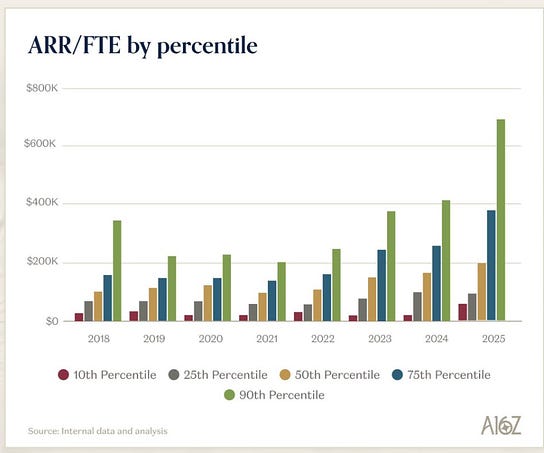
To sponsor Exponential View in Q2, reach out here.Hello software, goodbye SaaSThe public markets think SaaS is in trouble, with the Morgan Stanley software index falling some 45-ish% relative to the Nasdaq over the past year. The reason might be that AI users can build what they need. Dave Clark, former CEO of Amazon Worldwide Consumer, built a working CRM for his company in a weekend. SaaS was built on a knowledge asymmetry: vendors knew how to build, customers knew what they needed. But AI agents have collapsed that asymmetry by making domain knowledge the scarce resource and engineering capacity nearly free, rendering the entire vendor intermediation layer obsolete. Ok. It’s a bit provocative. But we’re starting to see the tendrils – Dave Clark isn’t the only person building exactly what he needs. We’re running more than a dozen custom apps and dozens of workflows, at Exponential View. Three of my top five apps, by usage, did not exist a month ago and were written by me. There’s talk of a shift from paying for access to paying for work. Instead of buying seats, you pay for outcomes. But the question this raises is uncomfortable for software companies: who has better domain knowledge, the vendor or the customer? In our case, I find it impossible to imagine buying an editorial research tool from someone else, unless, like Elicit, it sits on a trove of data we need. We’re the specialists in our domain. We know what we need. It’s easier to build bespoke than to adapt something generic. I tried to persuade one of the team that we might need to subscribe to a prompt management app last week. He told me, “Honestly, I can build what we need faster than it’ll take me to read the documentation.” We’ll see. Something is certainly happening. In the past four years, revenue per employee in the top quintile of software companies has tripled, breaking away from the median. These leaders are most likely AI-native firms, or those which have leant fully into the technology.
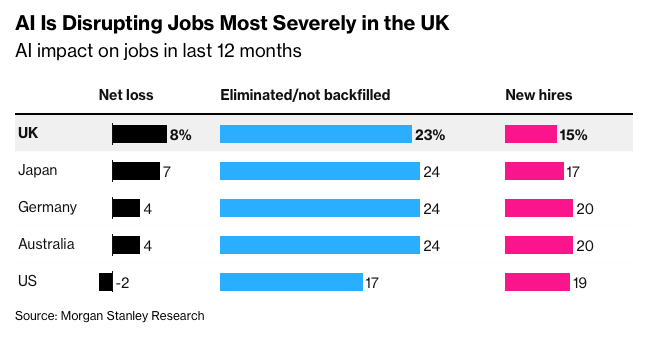
Of course, of course, existing firms meet compliance requirements, they have a data moat, customer relationships. They don’t disappear overnight. But then again, neither did Blackberry. Orchestrating the sorcerer’s apprenticesMorgan Stanley claims the UK experienced an 8% net job loss due to AI in the last twelve months among firms using the technology for at least a year. Japan: 7%. Germany and Australia: 4%. The US, the outlier with a 2% gain. Early-career roles go first, two to five years of experience.
Subscribe to Exponential View to unlock the rest.Become a paying subscriber of Exponential View to get access to this post and other subscriber-only content. A subscription gets you:
|
🔮 Exponential View #559: coherent agents; goodbye SaaS; orchestrators needed; space phages, immortality & Kimi's …
Saturday, 31 January 2026







Subscribe to:
Post Comments (Atom)


No comments:
Post a Comment