
This is Brad DeLong's Grasping Reality—my attempt to make myself, and all of you out there in SubStackLand, smarter by writing where I have Value Above Replacement and shutting up where I do not… Dan Davies Demonstrates for Immigrants: He Returns Home Worried About How Hopelessness Powers XenophobiaIs the real threat not open cruelty but a corrosive conviction that rich societies are too broken to solve solvable problems. Dan Davies describes Britain’s anti-immigrant protesters as people...
Is the real threat not open cruelty but a corrosive conviction that rich societies are too broken to solve solvable problems. Dan Davies describes Britain’s anti-immigrant protesters as people denying their own country’s capacity, not denying refugees’ humanity; they’re to do the right thing. That gives them the license to do the wrong thing. And those who raise Galbraith’s standard of leadership—facing a society’s core anxiety head‑on—have gone missing. Thus despair has become the right-reactionary grifters’ main resource…
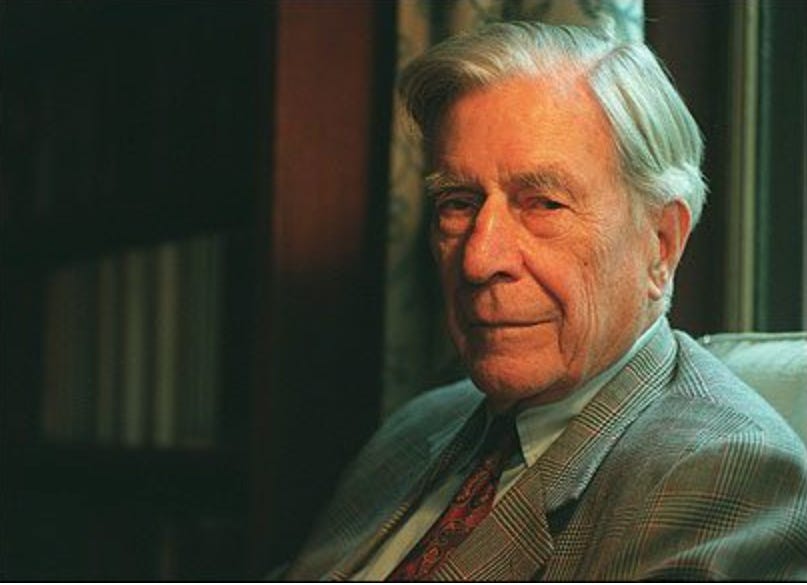
A very nice riff by Dan Davies on one of the (many) favorite John Kenneth Galbraith quotations. First, Galbraith:
Now Davies:
That is the key move of reactionary neofascism today: not “they are inhuman monsters who deny the humanity of refugees” but “they grant the humanity and the moral claim—and then stop there, convinced that nothing can be done”, at least not by us, because our resources are limited, and immigrants—and other bad guys—are coming to take some of what are rightly our resources and redirect them away from us by some form of trickery or loophole exploitation. That is a very different configuration of the political psyche than the neofascist one in the minds of us liberals and social democrats—the configuration we like to argue against. For the mass base of Trump’s supporters, in Davies’s assessment it is not so much cruelty—although there is plenty of cruelty by ICE and other minions, perhaps to show that Trump is not on the side of those taking from the good people. There is a lot of despair. And despair is a much more dangerous political fuel. Let me set out five points: Point one: Dan is describing mass psychological infrastructure, not a quirk of some bald men from Plymouth with rancid vibes, as the core of what we have taken to calling “reactionary” politics. In the taxonomy of reactionaryism—despair at the present, mythologized golden age in the past, loathing of existing elites, desire to blow up institutions—the emotional base layer is precisely that “nothing can get better from here; all we can do is try to roll back the clock.” That sensibility is not an ideology. That sensibility is not a rational conclusion from evidence. It is a mood. It is a stance toward the future. The rest—anti-immigration, ethno-nationalism, “burn it all down”—is built on top of that mood. Point two: This mood is structurally invisible to the people who actually run policy. As Dan rightly says: if you are in the business of making or advising on policy you are, by revealed preference, someone who believes that decisions matter and institutions can be bent in a better direction. You may be an optimist about the wrong things. You may be a technocrat with too much faith in spreadsheets. But either way you are an optimist about agency: you think levers exist and that it is worth arguing over how to pull them. This is new, at least in degree. Today a very large chunk of the electorate do not expect that their children’s lives can be bettered by something called “policy”; they suspect, with some justice, that any promise to the contrary is a grift. Point three: Despair is factually wrong. It is wrong about the material possibilities of rich societies. The fiscal space is there. The productive capacity is there. The historical experience with much larger shocks—postwar demobilization, the Marshall Plan, the Great Migration—shows that advanced economies can absorb and integrate very large movements of people and very large redistributions of resources without collapsing. The claim “we simply cannot afford to help” is not economics, it is metaphysics: a belief about the structure of the world masquerading as a budget constraint. And yet it does not feel metaphysical if you are the person whose real wage has been flat for twenty years, whose town lost its hospital, whose kids can’t get secure jobs, and who has been told in every election that growth is back and this time it will trickle down. There is an objective mismatch between capacity and use of capacity—between what we could do and what we in fact do. That mismatch is experienced from below as confirmation that nothing ever changes, that there is always “no money,” that promises are lies. From above, among the policy people, it is explained away as political constraints, coalition management, the median voter theorem, and so on. But the psychic effect is cumulative corrosion of what the psychologists call “agentive optimism”—the belief that effort aimed at the future will pay off. Point four, the uncomfortable one: Agency and optimism are not built by sermons alone. There is a strong temptation, especially among the well‑educated optimists who staff the policy world, to treat “hope” as a communications problem: better messaging, better narratives, better explanations of why we really are doing things. But Galbraithian leadership starts from the opposite end. The essence of leadership is to use the actual levers of policy in ways that are visible at human scale. It is to pick problems that can be solved in a few years, and solve them in public, and make sure the credit for the solving flows. Point five: Galbraith’s line about leadership is demanding. It is so much more demanding than the standard “vision” fluff in airport business books. To “confront unequivocally the major anxiety of their people in their time” is not to say “I feel your pain” and then pivot to what is “politically feasible.” It is to take that corrosive pessimism head‑on and argue that, first, the anxiety is real and valid, and second, the conclusion of hopelessness is wrong. Good leaders, in that sense, are in the business of manufacturing a justified sense of agency. The social‑science literature on optimism is, for once, comforting: people who expect that their efforts can move the dial—who have that generalized sense that problems are soluble—cope better with shocks, persist longer in the face of difficulty, and actually end up healthier and richer over the life course. That is true at the level of individuals; it is almost certainly true for polities as well. The hope is that once you have bracketed off the despair, there is very little left of the ideological core of xenophobic politics. The men on the other side were insisting that their own polity was too broken, too exhausted, too poor to live up to the obligation to be moral. So if we do not successfully do the hard, unglamorous work of giving people repeated, tangible reasons to believe that the problems of a rich society in the twenty‑first century are, in fact, soluble, what then happens? What then happens is what we see around us: a politics that defaults to grifters, cynics, and wreckers. If reading this gets you Value Above Replacement, then become a free subscriber to this newsletter. And forward it! And if your VAR from this newsletter is in the three digits or more each year, please become a paid subscriber! I am trying to make you readers—and myself—smarter. Please tell me if I succeed, or how I fail…##dan-davies-demonstrates-for-immigrants-he-returns-home-worried-about-how-hopelessness-powers-xenophobia |



| ||||||||||


No comments:
Post a Comment