
This is Brad DeLong's Grasping Reality—my attempt to make myself, and all of you out there in SubStackLand, smarter by writing where I have Value Above Replacement and shutting up where I do not… Apple's Trajectory: Achieving Twin Hyperextraordinary Triumphs, Four Slow-Motion Failures“It just works” no longer reliably working due to quality drift, but mastered chips and China-driven efficiency has allowed its massive success even though it has been free-riding on the fading...
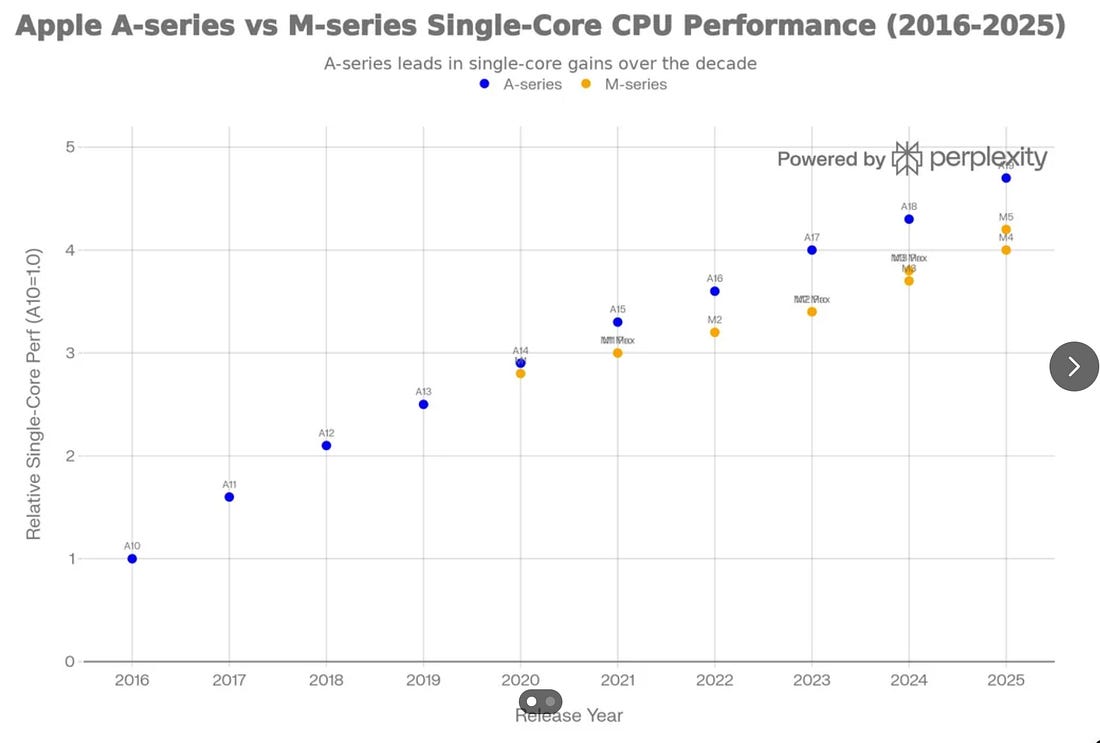
“It just works” no longer reliably working due to quality drift, but mastered chips and China-driven efficiency has allowed its massive success even though it has been free-riding on the fading “it just works” reputation. Treating Apple as a stock ticker with a logo attached, not as a social technology for making computing humane, is a large discourse blind spot. Thus the discourse largely misses how a decade of quality drift, Siri failure, visual-design missteps, and rent-extracting “services” are termites in the walls of the house…Too much of the focus on Apple Computer in THE DISCOURSE is about Apple Computer as a current profit-making and high stock-price operation; not enough on Apple as the “it just works” distributor of high-quality information technology and the translator of new information technology into a form that is actually useful to relatively normal people. Its run since Steve Jobs’s return to the firm is truly extraordinary. And even relative to the truly extraordinary, Apple Computer over the past decade has had two hyperextraordinary excellences of unbelievable accomplishment: its China-centered efficient supply value chain, and hardware in the form of Apple Silicon:
However, it has also has had four major deficiencies. about a couple of them here. Now comes M.G. Siegler to talk about a couple of them:
But there are more. Apple’s deficiencies are, I think, major enough that I believe that any of them would have been likely to sink pretty much any other company as a large profit-making institution, if not as a valuable and successful production network:
These, however, have not yet had a negative impact on the bottom line or—with the exception of “AI”—the stock price. The organization got the message with respect to (1) a while ago. Now—perhaps—the organization has got the message with respect to (2) and (3). But is moving senior executives’ responsibilities around really the right response? Are the movings giving the responsibilities for fixing things to people who can? And why is Apple leaving (4) still unaddressed? But it is not just with respect to “AI” that the shops under Federighi have also suffered from quality drift, with the associated user trust erosion. When you train hundreds of millions of people to expect “it just works,” then ship year after year of tiny regressions—more glitches around the edges, UIs that feel more ornamental than legible, features that land half‑baked and get rethought two releases later—you cash out that trust for short‑term roadmap theatrics as Federighi’s institution has shifted from “What problem are we solving?” to “What can we demo at WWDC?” Cumulative technical debt is generated by every compromise you ship—odd permissions edge cases, one‑off UI treatments, frameworks that aren’t quite ready—that then has to be carried forward. I am probably not the person to opine on Apple and (1) supply-chain robustness or (2) what Apple should be doing in “AI” or what executives can oversee it. But it is clear to me that a competent new player dealing with (3) is unlikely to do anything other than good, and that (4) needs a very important course correction that the current executive team is completely unable to see as needed—they think they really deserve their 30% app-store tax, plus all the other “services” revenue they can hoover up. Thus the summary recap: Looking past today’s stock price, try to evaluate Apple as an institution tasked with building the digital infrastructure of everyday life. On the plus side: two hyper-excellent achievements that any economic historian would call transformative—proprietary silicon and a ruthlessly efficient, China-centered manufacturing machine. On the minus side: strategic blindness on AI, cumulative quality drift in software design, dangerous political exposure in the supply chain, and a developer-relations model that resembles a monopsonist squeezing suppliers. Against the backdrop of M.G. Siegler’s “Twin Suns” on Federighi and Ternus, can executive reshuffles can fix structural failures the current leadership barely acknowledges? If reading this gets you Value Above Replacement, then become a free subscriber to this newsletter. And forward it! And if your VAR from this newsletter is in the three digits or more each year, please become a paid subscriber! I am trying to make you readers—and myself—smarter. Please tell me if I succeed, or how I fail…##apples-trajectory-achieving-twin-hyperextraordinary-triumphs-four slow-motion-failures |



| ||||||||||


No comments:
Post a Comment