
The AI startup for lawyers that launched 100 landing pages before finding PMFWhat it's like to work at Spellbook
✨ Hey there this is a free edition of next play’s newsletter, where we share under-the-radar opportunities to help you figure out what’s next in your journey. Join our private Slack community here and access $1000s of dollars of product discounts here. TL;DR:
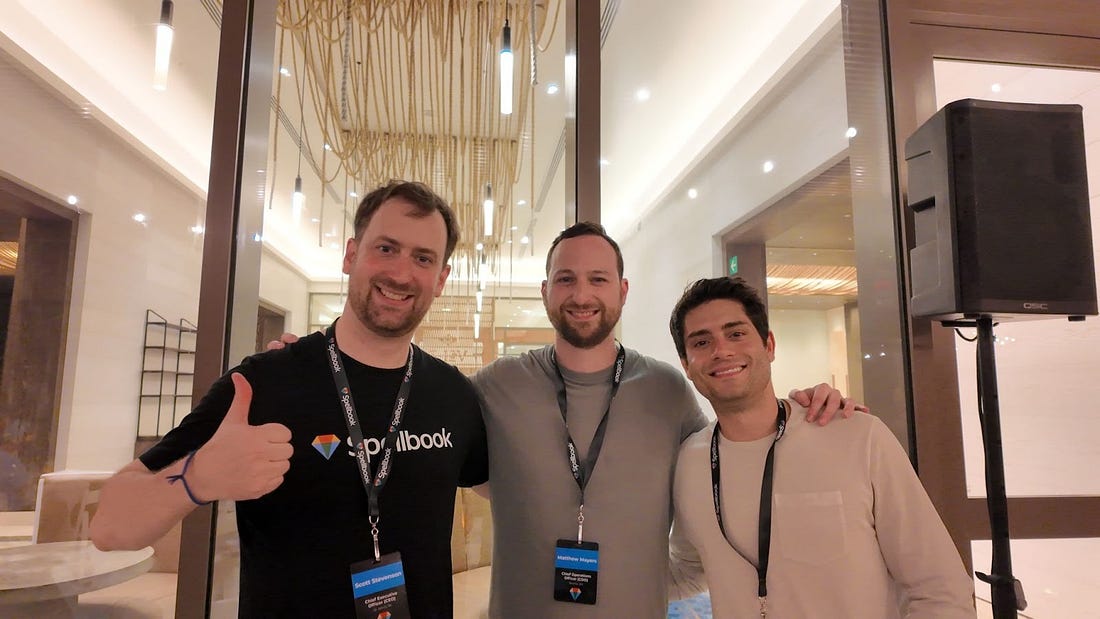
The legal billScott Stevenson’s first side project out of college was not an AI startup. It was an instrument. The sci-fi-esque object, called Mune, was a new way to perform electronic music. Scott spent long nights designing the product, coding the interface, getting the little details right. After a while he launched a Kickstarter, and raised a $20k angel check. When he felt the world was adequately ready, Scott did what he had been told every startup founder should do: he hired a lawyer to make things official. The list of legal tasks to handle was not long. Scott just needed to incorporate Mune as a company, bring on early employees, and protect IP via a design patent. But when the bill for this work arrived, Scott’s world—and the future of Mune—started to wobble. The fee was half of Mune’s bank account balance. While legal fees threatened Mune, they sparked in Scott a new ambition. Only a couple of years later, Scott met co-founders Daniel Di Maria and Matt Mayers, and the three of them founded Spellbook to make business legal work more efficient and less tedious. It took many pivots before they finally found product-market fit (PMF), but now they certainly have:
The underlying goal for Spellbook has been the same since day one. “We want to make legal work 10x more efficient,” Scott said. And if the lawyers who use the product are to be believed, Scott & co. are doing a pretty good job at achieving that goal. Their product today is an AI tool that helps lawyers draft and review contracts much faster, so they can get more done and focus on higher-leverage work. What is it like to work with the team at Spellbook? How effective is the product? Who is the right fit to join? I wanted the answers to these questions, and more, so I sat down with the team. Here is what I learned. The lawyer“Is this really what I went to law school for?” It was a cold 11 P.M. in Toronto and Daniel Di Maria was still staring at a contract in Word, the tiny text now stinging his eyes. Fresh out of law school Daniel had joined a local firm, full of hope that working in law might be like what he dreamed about as a kid. Instead, he was copying and pasting legalese in a corporate contract for a company he would probably never think about again. Daniel’s story is one that any commercial law professional would recognize: high hopes marred by boring contract work. Reviewing, revising, analyzing. Digging through thousands of words of text to find answers to important questions, to spot potential discrepancies, to mark potential risk factors. Sadly for the lawyers involved, contracts are important; they are perhaps the most important part of commercial law. “$100T runs through contracts every year,” Scott told me. “They touch entrepreneurs, HR, sales, procurement, real estate agents, lawyers – everyone. They’re a bottleneck that prevents us from working together efficiently.” It would be nice if there were a way to speed all of this up. When Daniel met co-founders Scott and Matt in 2016, the pieces snapped into place. Scott, stung by the Mune incident, was frustrated about how expensive legal work was. But Daniel knew first-hand that lawyers bill so many hours because the bureaucracy of law takes a lot of hours. It is not that lawyers would like to spend all of their productive hours reading minutiae in contracts; it is that they have to. The one way to fix both of these problems would be to make contract work significantly more efficient.
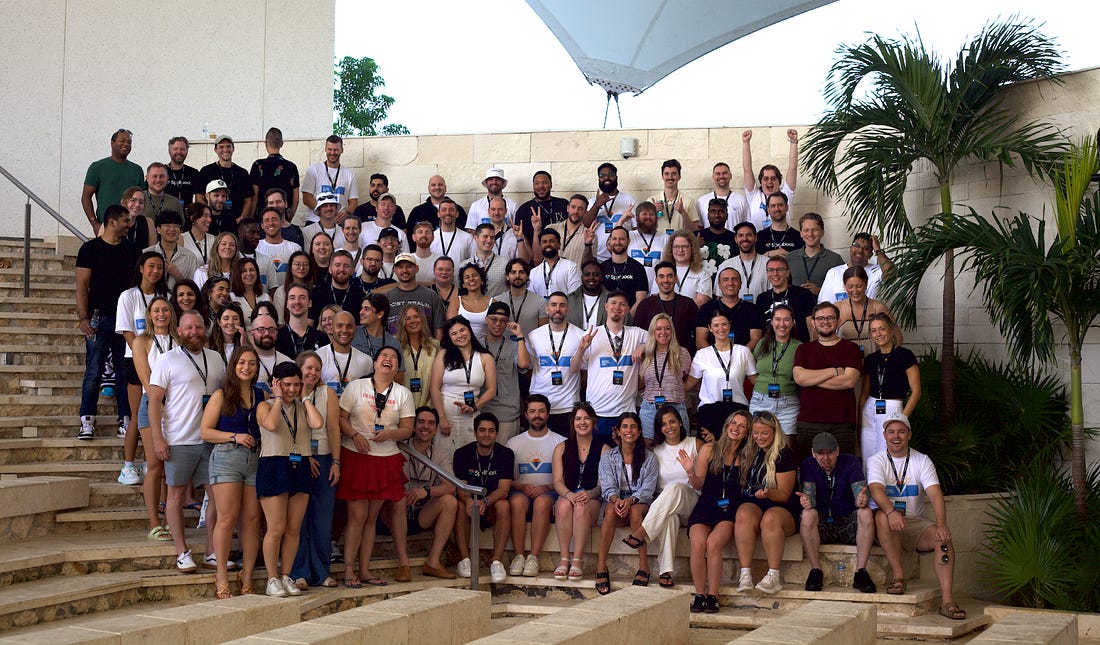
Contracts are the rational place for Spellbook to be building. Every company uses them, the market is huge, and they are ripe with low-hanging fruit to take care of; nobody wants to spend dozens of hours bogged down in drudgery and sentence-level detail. Spellbook’s AI, as it happens, is particularly great at handling this sort of work. Today’s AI models make right now a perfect time to be tackling this problem. “With generative AI, the legal field finally has a tool that will empower lawyers to make their services more accessible to clients,” Matt, co-founder, said. “This industry touches everyone on the planet.” The long roadThe headline on Spellbook’s website today is straightforward: Draft and review contracts 10x faster, just like magic. (Given the company’s name, this is perhaps the one time we will excuse a “like magic” headline.) But the path to landing on today’s version of Spellbook—now used by giants like eBay, Nestle, Crocs, Herzog, and more—was long and filled with pivots. The company was founded in 2017 under the name Rally, and most of their product revolved around document templating. This followed the same thesis that Spellbook still follows today (making legal work more efficient), but there was no AI in 2017. Templates were more rigid. Lawyers told Scott that Rally was a useful tool for junior lawyers, but that it did not capture all the nuance of high-level drafting. The company survived for years, but did not take off. It was only when the first GPT models were launched that Scott, Daniel, and Matt got a new idea, sparked by seeing Github Copilot’s success in 2021: What if we made an AI copilot for commercial lawyers? And so Spellbook was spun up as a side project for Rally. More than 100 landing pages and 200 growth experiments later, Spellbook took off in 2023. The waitlist surged past 30,000 lawyers in a matter of weeks, and it wasn’t long before massive commercial firms and in-house teams at Fortune 500 companies were coming on board. Scott, Daniel, and Matt had found product-market fit. One of the core values at Spellbook is to work with a “beginner’s mind,” Matt and Scott both said. “It’s important we don’t get into an ‘expert’s mindset’ where we close our minds to too many possibilities.” This idea, which comes from the Zen buddhist concept shoshin, is perhaps the only reason that Spellbook exists today as a company. I have personally known founders who have given up after a couple years of slow growth; who have called it quits after a few successful pivots. And yet, 8 years later, here is Spellbook: a company that has worn many faces and, now, wears a winning one. Shoshin. Today, more than 4,000 in-house and law firm teams use Spellbook to help them get contract work done faster. It was not particularly easy to get these people on board. “Lawyers are uniquely skeptical, detail-oriented, and protective of their time,” Matt told me. To address this, Spellbook is very customer-obsessed. “The people who perform best at Spellbook are the ones who tie their work directly to productive quality and customer trust,” Aman Samra, the company’s VP of finance, said. In other industries, shipping a ‘good-enough’ product with obvious flaws and bugs might get you early traction. In law, it might kill your momentum entirely. The StarCraft approachIt is after-hours, but the whole Spellbook team is still together. They have gathered for one purpose: to watch their CEO, Scott, play a game of StarCraft against a world professional. One measure of a player’s skill in StarCraft is their actions-per-minute. Issuing a lot of commands (actions) per minute means you are likely a high-level player. Issuing too few could mean you are too slow, and will likely lose the game—because advantages compound quickly in games where you can reinvest your profits. In this company-wide demonstration, Scott is unfortunately on the losing side. His 110 actions-per-minute are crushed by his opponent’s 200. “Scott is genuinely good at StarCraft, but it was hilariously fun to watch him get crushed by a pro,” Daniel said. After the game, Scott speaks briefly about the whole point of the exercise: we need to be a company that takes a lot of actions per minute. Companies that can do this will win. Companies that are too slow, who think too hard before doing anything, who wait too long to get things done—those companies will lose due to competitors out-compounding them.
The StarCraft approach seems to have been internalized through out the company. “Our culture is comically fast,” Chris Gardner (CSO) said. “That phrase is not a joke, it’s a real operating principle. We believe speed wins. While StarCraft’s APM is not literal at Spellbook, it’s a metaphor for moving through work with high output and momentum. Someone who can make a lot of good moves quickly will usually have more impact than someone who moves slower, and that impact compounds over time.” Work at Spellbook tends to get done asynchronously, when possible, and meetings are kept to a minimum outside of the company’s mandatory all-hands. Constant live sync and check-ins are not common, and Scott, the CEO, “prefers written updates and likes to respond on his own time, which forces better thinking and reduces noise.” This approach usually only works when there is a deep level of trust between everyone on the team—which seems to be true, in Spellbook’s case. The attitude toward mistakes, a normal side-effect of a high actions-per-minute mindset, is that “small mistakes are fine. They are recoverable. What matters is the average. If you are making many more right moves than wrong ones, you win in the long run.” Should you join Spellbook?There is an earnestness that comes through the bits and pieces I heard from the Spellbook team. This is a company where using a 1998 video game as a metaphor for how work should get done is taken seriously; a company that will list a Buddhist philosophy like shoshin as one of their most important values; a company that is not embarrassed to have fought for such a long time before reaching PMF. People who struggle at Spellbook, Chief Strategy Officer Chris Gardner said, usually just need a different kind of environment. “One mismatch is someone who needs everything to be fully defined before they start. Another is someone who equates speed with recklessness. Another is someone who prefers mature operating systems over creating new ones.” Spellbook defaults to doing things, not thinking about doing them. If that does not resonate, the company may not be a fit.
When I asked Scott who should join, he built out a rather clear framework:
If you check all of those boxes, great. If you check even one, though, or a few, it may be worth checking out Spellbook’s open roles. They are currently hiring across sales, product, operations, marketing, finance, engineering and more. Most of these roles are remote. My bet is that you can find something. If you do apply, consider getting creative about how you do it, and consider sending a cold email. The more you can do to show the Spellbook team how you will actually be valuable to the company, the better. Thank you to Spellbook for supporting Next Play and telling us what it’s like to work there. You're currently a free subscriber to next play. For the full experience, upgrade your subscription.
|
The AI startup for lawyers that launched 100 landing pages before finding PMF
Thursday, 11 December 2025






Subscribe to:
Post Comments (Atom)


No comments:
Post a Comment