
This is Brad DeLong's Grasping Reality—my attempt to make myself, and all of you out there in SubStackLand, smarter by writing where I have Value Above Replacement and shutting up where I do not… Genes Tag the Journey; Culture Does the Work: The Yamnaya Shock of 5000 Years AgoThe Indo-European spread as a cultural revolution—mobility, pathogens-by-accident, and male-line dominance—rather than biological transformation. The Yamnaya-expansion story is about institutions...
The Indo-European spread as a cultural revolution—mobility, pathogens-by-accident, and male-line dominance—rather than biological transformation. The Yamnaya-expansion story is about institutions, ecologies, and how patriarchy scaled. If you want genetic rewriting that matters a damn, go back 100 times as far into the past. And don’t overemphasize even that: my suspicion is that the late homines erecti might well have fit fine if dropped into modern society alongside we contemporary homines sapientes sapientes…
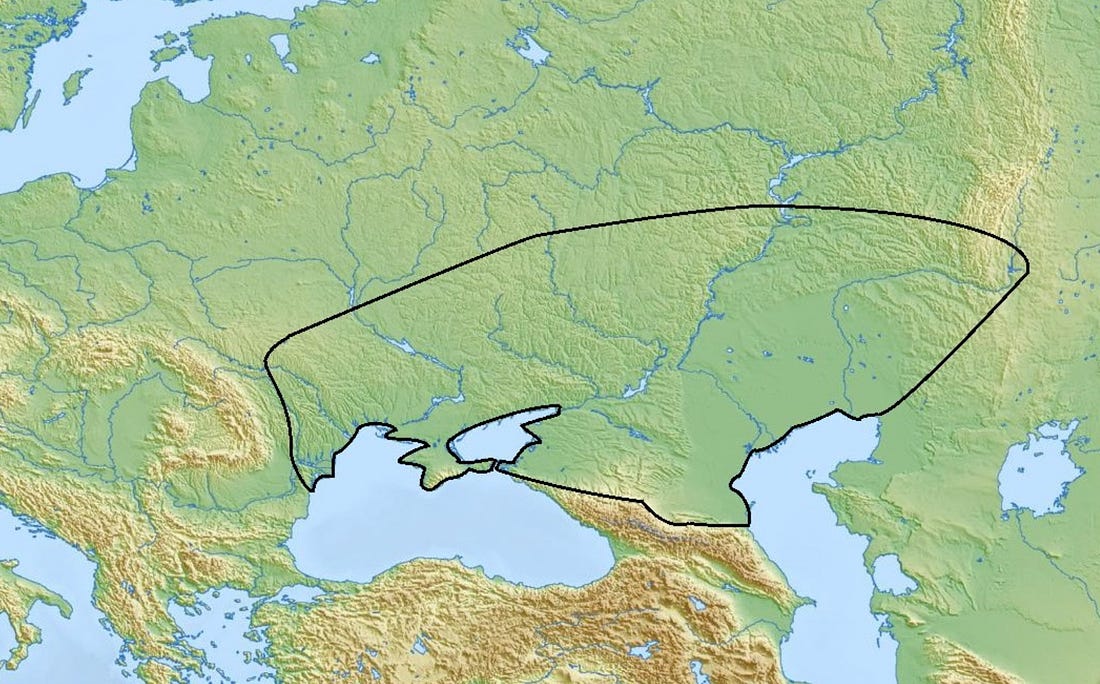
Is what I say here right? The quirky Razib Khan reports the guesticalculation that 1/12 of humanity’s genes today are, if we trace them back 5000 years ago, derived from 10,000 Yamnaya nomads on the Pontic Steppe, scattered on the grasslands between the Urals and the Carpathians:
He is right. But this “rewriting the genetic legacy” vibe stuff he adopts seems to me to be much too strong. I don’t see it making a damned bit of difference for you today whether your Yamnaya-descent fraction if 50% or 10%. Your genes do the same thing in either case. The story of the Yamnaya expansion to the point where 1/12 of the ancestry of humans today can be trace back to a group that was 1/1000 of the human race in the year -3000—that is a culture and a lineage story, not an evolution or a genetic change story. Razib makes rather too much of polygenic scores suggesting that the Yamnaya may have been “dark giants of the east”: “tall, dark, robust, maybe a bit plodding and prone to mentally instability…”. Yes, he is doing it in the service of declaring that the Yamnaya were:
But, still, these are very small possible biology-based differences in averages: in order for such claims to be accurate even as stereotypes we would have to compare groups not within the modern human race, but rather us homines sapientes sapientes to the homines sapientes neandertales or homines heidelbergenses of not five-thousand but of three hundred-thousand years ago. However, the Yamnaya descendants as they migrated and expanded did bring their culture, their cows, the disease burden of the steppe, their patriarchy—as it really does look like men who were not Yamnaya-descended have left very few descendents today. Of course, we do not know the degree to which the Yamnaya were conquerors rather than productive and rich hence high-status as bringers of valuable biotechnology. We do not know the mix of female choice, sexual enslavement, and rape in the human history that generated what we see as mass y-chromosome lineage extinction as the Yamnaya spread themselves, their language, and their cultural technology from the North Cape to Ceylon, from Mongolia to Cape Trafalgar. Yes, the gene people can identify genetic similarity and descent to an amazing degree. But the background is that the genes of the Yamnaya were pretty much the genes of everyone else. As I understand it, Looking across aligned segments of the genome, as I understand it, looking for single-nucleotide variations in the genome, within today’s human population:
Yes, this is getting much much too close to getting out the skull-measuring calipers. But the point is that these numbers are very, very small indeed. Look at the contrast with:
All of us homines sapientes sapientes, are, truly very close cousins indeed. You have to go further back, we do get the evolution and the genetic change story: It was nine million years ago, we think, that those whose descendants were to become the gorillas split off from the Darwinian lineage that was going to become us. It was, we think, six million years ago that the pan lineage that was to ancestor our closest living relatives, the chimpanzees, split off. After that there is, from the bush of evolving lineages, of those now surviving just us. First in the main current of the us-gene flow down the ages came ardepithecus, australopithecus garhi (perhaps; perhaps some other australopithecus), homo habilis, homo erectus, then—probably—homo heidelbergensis, and then homo sapiens, all of archaic, anatomically modern, and behaviorally modern. All the while throwing off species and subspecies and reabsorbing sparks from largely separated lineages back into our gene pool. Ardipithecus (5.0 Ma; brain-case size 350cc) sees upright posture and facultative bipedalism with sharply reduced canine sexual dimorphism; grasping big toe retained. Australopithecus garhi (2.5 Ma; 450cc) sees butchery and stone‑tool use, with limb proportions hinting at our longer stride. Homo habilis (2.0Ma; 640cc) sees a marked brain size increase and the Oldowan core‑and‑flake stone toolkit. Homo erectus (from 1.9 Ma down to their last survivals at 0.1 Ma; 1000cc) sees endurance travel; the Acheulean handaxe toolkit; clearly controlled fire, reduced sexual dimorphism, and smaller molars. Homo heidelbergensis (800–300 ka; 1200cc) conducted organized big‑game hunting with spears used complex prepared‑core toolmaking techniques. Then came archaic homo sapiens (from 300 ka; 1350cc) with their large near‑modern brain volumes, increasing regional technological complexity, and intermittent symbolic behaviors. Anatomically-modern homo sapiens sapiens (from 250 ka onward) had the globular skull, the reduced brow, the chin, the gracile skeleton; the expanded toolkit, and long‑distance mobility. And behaviorally-modern homo sapiens sapiens (from 100 ka) adds sustained and cumulative symbolic culture—cave art and engravings, personal ornaments, ritual burials, complex language‑supported planning, long‑distance exchange networks, composite tools (e.g., bone/antler, adhesives), tailored clothing and shelters. But I suspect there is little or no bio-cognitive difference in potential between behaviorally modern and the earlier homosapsaps plus the homines sapientes neandertales and the homines sapientes longines, and probably the homo heidelbergenses. And my suspicion is that the late homines erecti with their 1000cc brain-cases could—provided they did have the morphology for speech—have functioned fine if dropped into modern human society. Why do I think this? Because in northeastern Israel-Palestine there is a place called the Bridge of the Daughters of Jacob, Gesher Benot Yaa’qov, BGY. 750,000 years ago people we call homines erecti lived there for a while, as hand-in-hand, with wandering steps and slow, through the world took their gatherer-hunter way. Let me return to Joseph Henrich’s description of what happened there:
Indeed, we stand on the shoulders of giants in our symbolic culture of distributed cognition, socio-cultural inheritance of our technological toolkit, and specialized division of labor that together make the collective human mind the true ASI, the true Anthology Super-Intelligence. Look to the Yamnaya explosion as a key factor shaping that ASI, if you want to truly understand history. If reading this gets you Value Above Replacement, then become a free subscriber to this newsletter. And forward it! And if your VAR from this newsletter is in the three digits or more each year, please become a paid subscriber! I am trying to make you readers—and myself—smarter. Please tell me if I succeed, or how I fail…#on-humanity-as-an-anthology-intelligence-cognition-action-specialization-coordination |



| ||||||||||


No comments:
Post a Comment