
This is Brad DeLong's Grasping Reality—my attempt to make myself, and all of you out there in SubStackLand, smarter by writing where I have Value Above Replacement and shutting up where I do not… CROSSPOST: NOAH SMITH: The AI Bust Scenario That No One Is Talking AboutThink of airlines: very useful, very high-tech, immense user surplus, next to no profits. Even if AI works, and even if it gets adopted very fast, it might not make much in the way of profits for...
Think of airlines: very useful, very high-tech, immense user surplus, next to no profits. Even if AI works, and even if it gets adopted very fast, it might not make much in the way of profits for anyone. The part of Noah Smith’s post above his paywall...Very much worth reading, because, I think, highly likely to be correct. Noah sees three ways that the current AI-bubble and MAMLM-capex buildout could spectacularly crash:
This last is, I think, the most likely. And Noah thinks so too: The technology works. It diffuses. It becomes infrastructural. Yet the rents flow not to the operators, and in the long run not that many rents flow to the toolmakers and the suppliers. Instead, what rents there are flow to the downstream complementors. And the overwhelming bulk of value flows to customers in the form of user surplus. It is glorious (provided our AI can preserve our attention from being hacked to our detriment by Zuckerberg’s AI)! But it is not profitable for investors! And it is profitable for lucky entrepreneurs who keep their wits about them and understand that their trees will not grow to the sky. And it is profitable for only those VCs who understand that they are basically rerunning their crypto grift, and prioritize exit while the getting is still good and the crash has not yet come There is one very important feature of the situation that, I think, Noah misses. It is a very powerful, and I think likely decisive, factor that pushes us toward the (3) Airline Scenario. It is this: Google and Facebook and Amazon do not want anybody—anybody—to take their search and social-media profits away from them by providing front-end natural-language interfaces to exploring the internet and to connecting with friends and entertainment and to shopping. Apple does not want anybody—anybody—to take its iPhone hardware sales profits away from it by providing a better cloud-based natural-language software interface to cheap Android smartphones than the iPhone’s software suite provides. Microsoft does not want anybody—anybody—to take its office-work and cloud-enterprise profits away from it by providing better natural-language interfaces to smithing words and numbers and bureaucratic paperflow. All of these will do what Microsoft did to Netscape before they will let any of that happen. If it ever looks like OpenAI or anyone else is attaining platform-aggregator scale by selling AI-based services, Google or Facebook or Amazon or Apple or Microsoft—or probably all five at once—will stop that from happening by giving good-enough substitutes away for free. The AI bust scenario that no one is talking aboutEven if AI works, and even if it gets adopted very fast, it might not make profit.Noah SmithDec 08, 2025∙ Paid<https://www.noahpinion.blog/p/the-ai-bust-scenario-that-no-one>
I’ve actually already written a number of posts about the possibility of an AI bubble and bust. Back in August, I wondered if the financing of data centers with private credit could cause a financial crisis if there was a bust. I followed that up with a post about profitability, and suggested that the AI industry might be a lot more competitive than people expect. In October, I wrote about how AI is propping up the U.S. economy. But I feel like I need to write another post, because almost all of the discussion I see about an AI bubble seems to leave out one crucial scenario. Since I wrote those posts, popular belief that there’s an AI bubble and impending bust has only grown. A lot of prominent people in the industry are talking about it:
And:
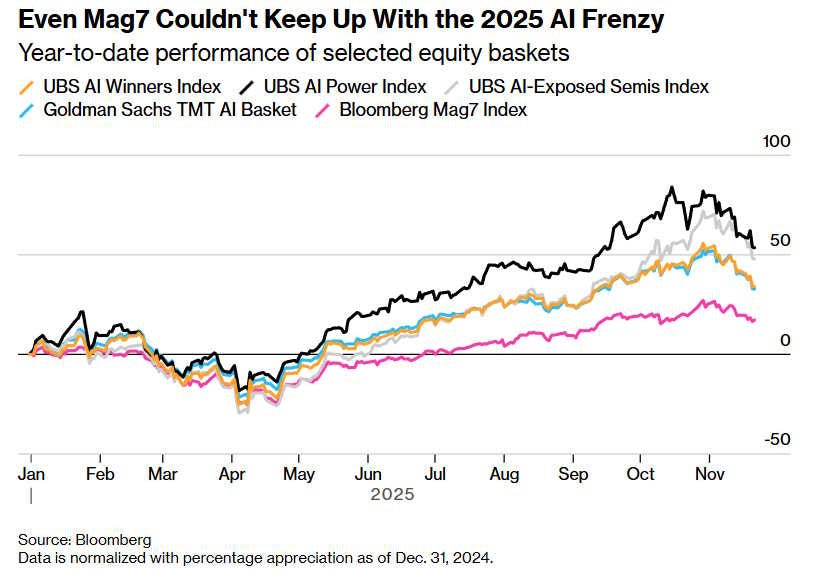
The market is also starting to get skeptical. Here’s a chart from Bloomberg:
Almost everyone I read is basically talking about two scenarios for an AI bust. I call these the Virtual Reality Scenario and the Railroad Scenario. I’ll go over these, and then talk about the third scenario The Virtual Reality ScenarioWhat I call the Virtual Reality Scenario is if AI, in its current form, turns out to just not be a very useful technology at all — or at least, not nearly useful enough to justify the amount of capital expenditures. This might happen because AI hallucinates too much, or because progress in AI comes to a halt. Bloomberg reports:
This is basically what happened to VR technology. Meta spent $77 billion on developing the virtual reality “Metaverse”, but outside of gaming and some niche entertainment applications, nobody really wanted VR for anything, no matter how good the headsets got. Meta is now throwing in the towel and pivoting away from the Metaverse.1 But I just don’t think this is going to happen to AI. Very few people use VR, even a decade after it started getting hyped. But AI is being adopted more rapidly than any technology in history. As far back as a year ago, 40% of people were already using AI at work:
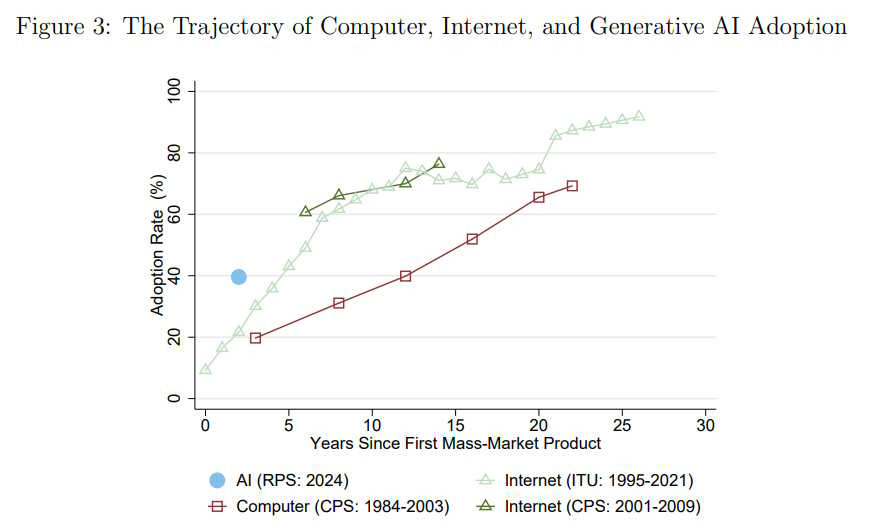
Household adoption is similarly rapid. Humans just know when a technology works. If AI weren’t useful, we’d see people trying it for a while and then setting it aside. But we don’t see that. Despite hallucinations and the other limitations of the technology, most people are finding some reason to keep using AI after they try it. Sorry, haters. This tech is for real. As for progress hitting a wall, I just don’t think that’s an important question anymore. The consensus in the industry2 seems to be that scaling up in terms of training AI models on more data has hit a wall, but that our ability to improve AI’s capabilities via inference scaling (basically, having it “think harder” before answering) is still going, and improvements in reinforcement learning and other algorithmic techniques are still coming. But I don’t think this is the right question to be asking, because “better chatbots” are only one of many ways that AI can create value. The world of AI applications, including “agents” (AI that does stuff on its own) is still in its infancy. Andrej Karpathy is good at talking about this; I recommend his interview with Dwarkesh Patel. 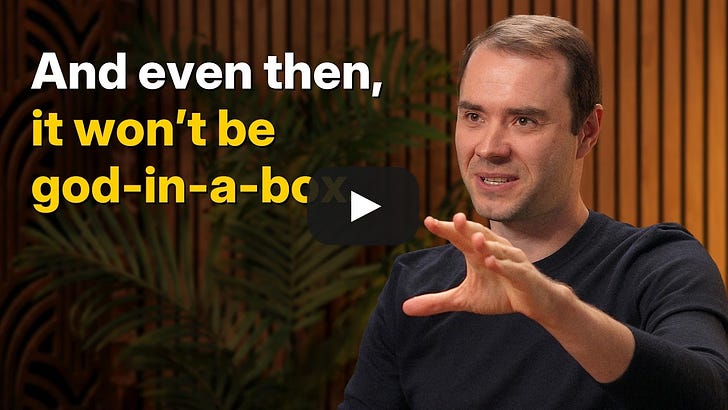 Essentially, we haven’t even begun to build AI yet. Anthropic sort of has — it’s focused on AI business applications, and it’s making some money doing this. But most of the actual technology we’re going to create with AI is still in the future. And there’s a chance that AI as it exists today will be able to provide the foundation for a whole bunch of incredibly useful applications, even without any continued improvement in capabilities. The typical pattern is for most of the useful (and lucrative) applications to manifest decades after a new general-purpose technology is introduced. The Railroad ScenarioWhich brings us to the second scenario: the Railroad Scenario. Railroads were even more economically useful and lucrative than their biggest boosters in the 1860s imagined. But there was still a huge bust in 1873, because those economic benefits didn’t show up before railroad companies’ debt came due. Here’s what I wrote about that back in October:
We don’t know how likely this scenario is, because we don’t know how fast AI value creation will increase. But we can get some basic idea of the risk of this scenario by looking at the financing side. If the companies building and operating the data centers (the main cost of AI) are spending less than they make, then everything is basically safe. Suppose you have a company that makes $50 billion in profit every year, and you spend $40 billion every year on data centers. Even if AI suffers a catastrophic crash and all your money is wasted, you’re safe; you just take a hit to your profit margins for a year, your stock price goes down, and then you just move on. This is true even if you borrowed the money to build the data centers; if things go bad you can afford to pay off the loans. If you’re spending $70 billion a year things get dicey; you might have to take a couple of years of losses to pay back the loans if there’s a bust. And there’s some level of borrowing and spending where you’re actually in danger of bankruptcy. There’s no hard and fast rule for when a certain amount of spending becomes dangerous; it’s just sort of a sliding scale of worry. Right now, much of the AI buildout is being done by big tech companies like Google, Microsoft, Amazon and Meta that make lots and lots of profit.3 Until recently, these “hyperscalers” have been making enough cash to cover their AI spending. But spending is rising, so that may not be true for much longer. If spending keeps increasing, some companies, like Amazon, may start to have to borrow against future cash flow soon. And Meta, which doesn’t have its own cloud business, and thus has to pay other companies to do its AI stuff, may be in greater danger. Meanwhile there are a bunch of other companies that are investing a ton of money in AI that don’t make enough profit to fund it out of their own pockets, but which have borrowed a bunch of money to invest in AI. These include the big model-making companies — OpenAI, Anthropic, and xAI. They also include some cloud providers like CoreWeave that aren’t attached to a big profitable business. And they include various construction companies and service providers. If AI takes 10 or more years to generate enough value to pay back all these debts, many of these companies could go bankrupt. Whatever financial institutions they’ve borrowed money from — private credit firms, banks, etc. — may fail or have to pull back significantly when their loans suddenly go bad. And that could touch off a financial crisis, even if AI continues to advance and companies continue to build data centers. That would be like what happened in 1873 with the railroads. AI itself would be fine, but the economy, the financial system, and a bunch of specific companies could be hurt. This scenario seems at least fairly likely, given that this is basically what happened with both the railroads and the telecoms in past industrial booms. Currently, many observers are highly skeptical that AI companies will be able to earn enough revenue to pay back their debts by 2030, even under optimistic assumptions. As I said, the typical pattern is for the economy to take a long time to figure out how to use each new general-purpose technology, and the financial system may not be able to wait around. But there’s also a third scenario, which relatively few people seem to be paying attention to. Even if AI works and manages to create value very quickly, that value may not be captured by the AI companies themselves. AI itself may turn out to be a commoditized, low-margin business, more like solar power…or airlines. The third scenario: The Airline ScenarioThe third scenario for an AI bust is that AI succeeds as a technology, but that the companies that make AI models — OpenAI, xAI, and so on — don’t manage to capture much of the value that AI creates… 1 You could also argue that something similar has partially happened to crypto. Crypto has certainly found plenty of application in the worlds of crime and corruption — ransomware, drug purchases, evading capital controls, and enabling illicit payments to and from corrupt politicians. But that’s all just regulatory arbitrage; in the world of above-board commerce, crypto hasn’t found any widespread application that couldn’t be handled by an Excel spreadsheet. 2 And at the risk of doing some real actual journalism, let me note that I do talk to a lot of people in the industry, and they agree with this. 3 Note that what people often talk about is not profit, but free cash flow. These tend to be pretty correlated. If reading this gets you Value Above Replacement, then become a free subscriber to this newsletter. And forward it! And if your VAR from this newsletter is in the three digits or more each year, please become a paid subscriber! I am trying to make you readers—and myself—smarter. Please tell me if I succeed, or how I fail…#noah-smith |





| ||||||||||


No comments:
Post a Comment