
What I am reading in 2025 (and how) 📚A refresher on my sources, workflows, and set of incentives to stay on track.
Hey, Luca here! This is a ✨ monthly free essay ✨ from Refactoring! To access all our articles, library, and community, subscribe to the full version: About two months ago, I got into a quest to completely revamp what I read, and how. Reading is a big deal for me. As a full-time writer, good reading enables good writing, and in turn, business altogether. This is not some kind of epiphany — I have known it for a long time and I am grateful to have developed disciplined routines over the years. I have also written about them at least a couple of times:
But while the output of my reading—articles—is very public and works as an accountability device to force me to think through things, reading itself is private, which means it is more fragile and it’s where I tend more easily to become sloppy. How do I know? Well, it’s easy. I mostly read articles through the Readwise Reader, where my highlights get synced on Notion. If I open my Notion list and see the proverbial rolling tumbleweed, it means I am not doing good. I have also found that less time spent reading strongly correlates with more time spent on social media, namely X. And I have a love-hate relationship with X: 90% of my feed is trash, but the remaining 10% feels genuinely useful. So, a net negative overall, but hard to let go completely. All in all, whenever there’s higher pressure at work, or in life, quality reading is one of the first habits to take a back seat. And that’s bad! So how could I get back on track? And in a way that works for the long run? That’s what I asked myself in September. Then I did a few things, and they are working very well. So let’s go through them! 🎯 GoalsWorking top-down, I asked myself what I wanted to achieve through an updated reading workflow. Here are my answers:
I quickly figured out that:
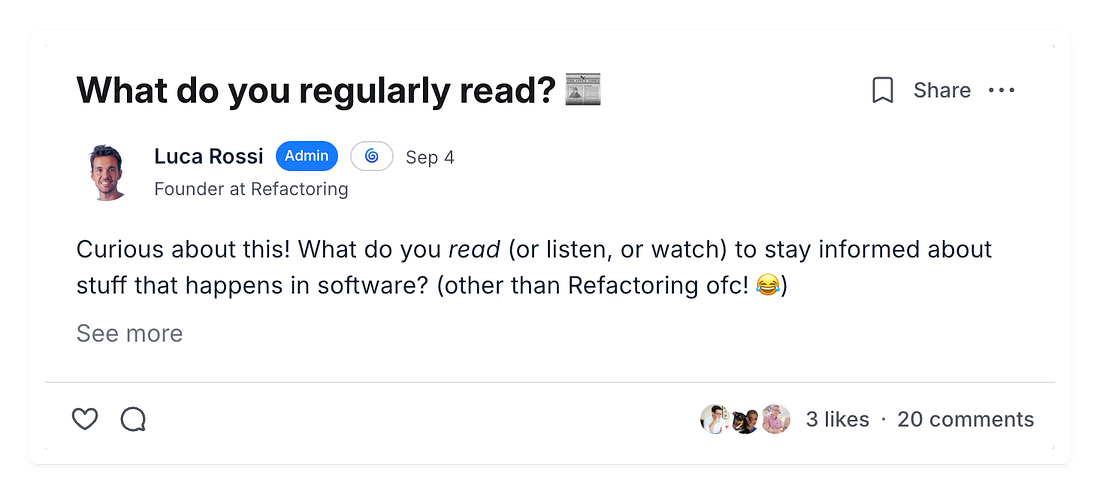
So, next, I polled the Refactoring community about their favorite readings, and got a treasure trove of sources (thank you so much folks 🙏).
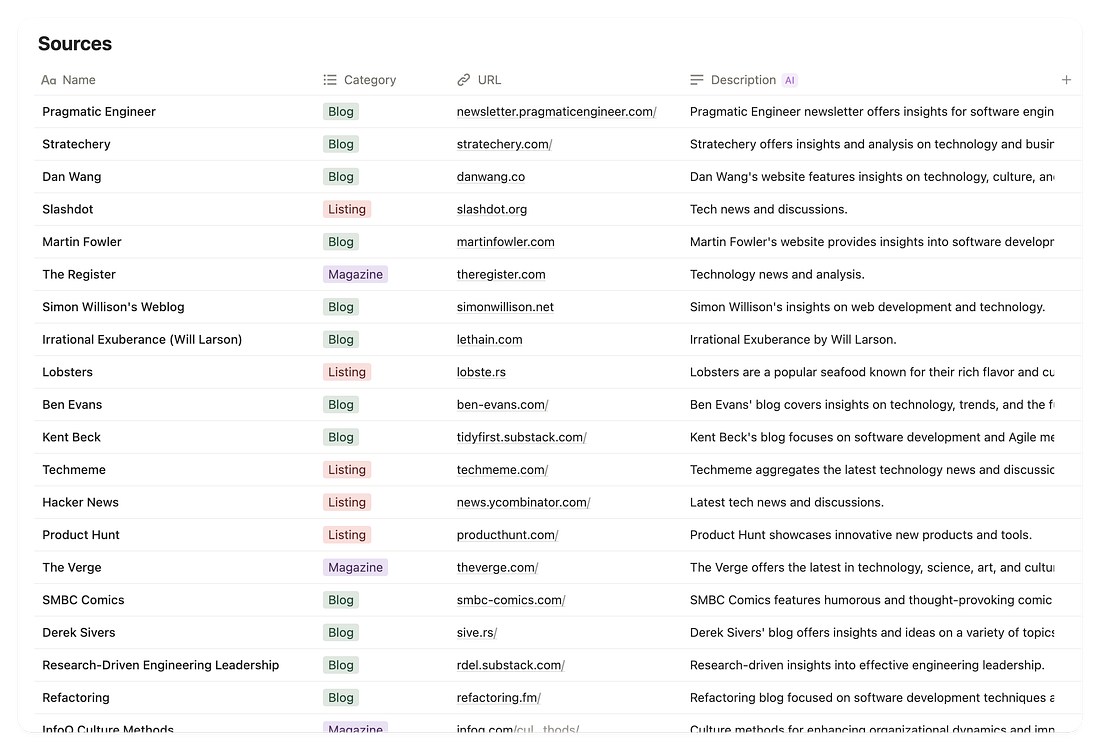
I put everything in a spreadsheet, and tried to organize stuff by category, which made me ask the following question: 👓 What do I need to read?When presented with this overwhelming list of stuff, I took a step back and reflected on what I truly care about. It turns out it’s three things:
This is a very basic categorization, but was already helpful to me in creating a balanced portfolio. Another way to categorize sources is by type of publication, rather than topic. I find there are three different types you can read:
These categories have some overlap with the others above, but it’s trickier than it seems:
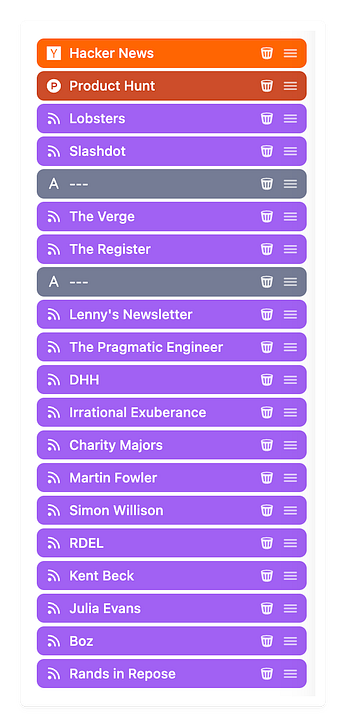
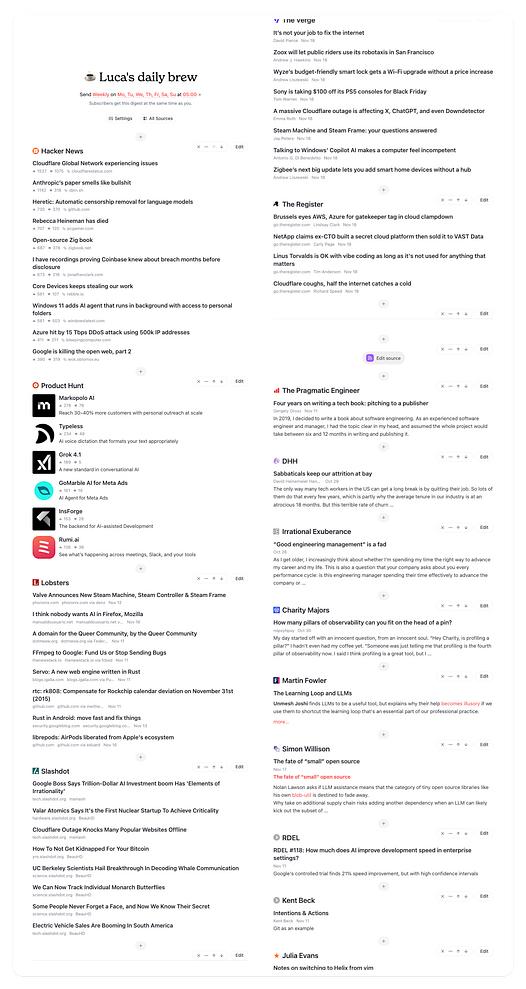
What about social media, you may ask? Well, in my experience, the vast majority of the valuable stuff that happens on social media gets eventually picked up anyway by listings like Hacker News, Techmeme, and so on. So you don’t miss a lot by staying away from it. And when you combine it with the 1) very low signal-to-noise ratio, and the 2) addictive effect, it’s very hard for it to be a net positive to your information diet. That’s not to say you should not use social media—YMMV and it’s up to you—but the idea that you have to use it in order to stay up to date is largely bullsh*t, and one that I have told myself for a long time. So once you have your reading list, how do you actually read? 🔧 How to read thingsThis is a part where my workflow hasn’t changed dramatically, but I have rather tightened some screws. Here are my steps: 1) Put everything on MailbrewI have put all the feeds on Mailbrew and I send to myself a daily digest of everything that those feeds have published. My digest is public so you can clone it or simply subscribe to it to read exactly the things that I read everyday. I tweak and add sources all the time so, if you are undecided, by subscribing to mine you also get that kind of maintenance for free.
I have to warn you, it’s a long digest! But I am surprised by how fast I can scan it. Also, mind you, I discard almost everything and end up reading only ~10% of what’s in there.
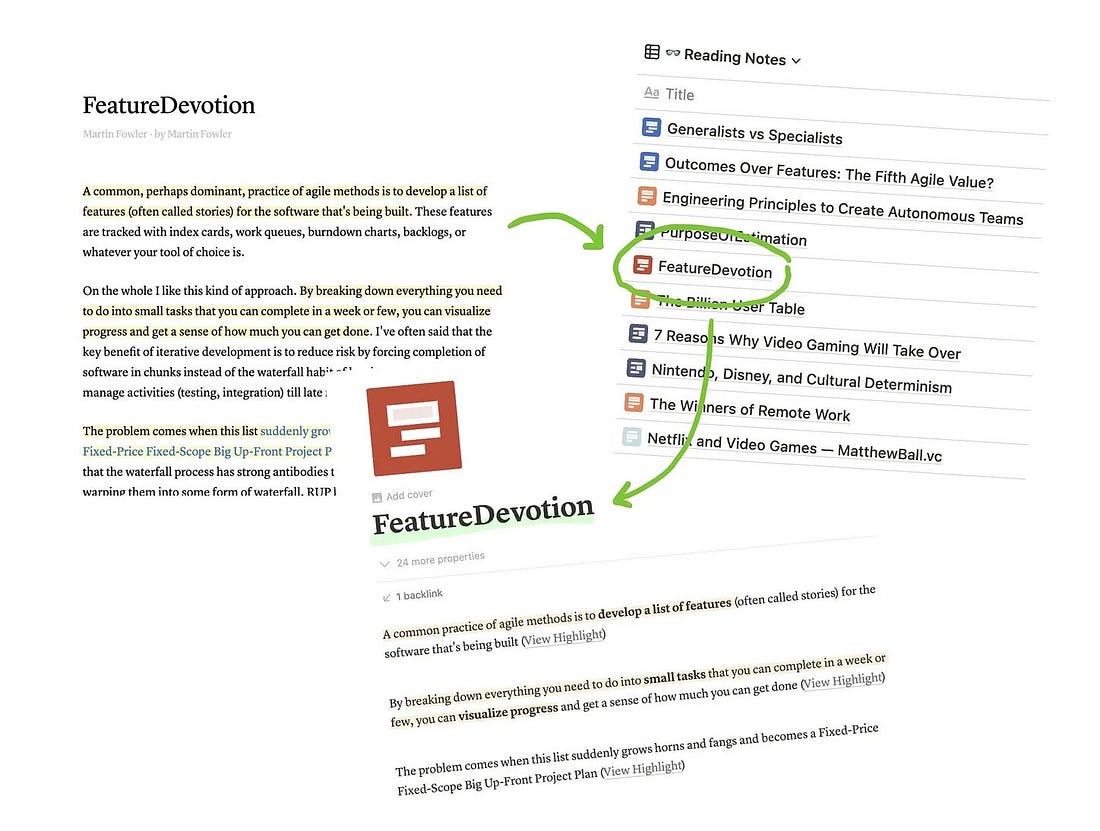
3) Save for later + highlightSo every day I go through the digest and decide what articles seem interesting, and I do one of two things: I either read them on the spot, or save them for later. In either case, I use the Readwise extension (or directly the Readwise app) to take highlights, which get automatically stored on my Notion.
4) Store what you readI believe it’s crucial to have a reliable place where to store bits of the things you read. I have this workflow with Readwise and Notion, but it could be as simple as a single note on Apple Notes where you copy/paste interesting quotes. My advice on this is to start simple and only complicate stuff when it becomes unmanageable. Avoid premature abstraction! Anyway, it’s important that you have this place, so you feel that you are reading with a purpose, and you are growing some knowledge repo that lives outside your brain. 5) Use what you readThe best incentive for reading is having to do something with that reading. If you are an engineer or a manager in tech, some ideas are:
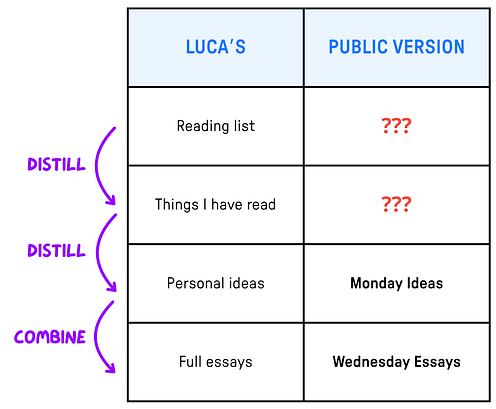
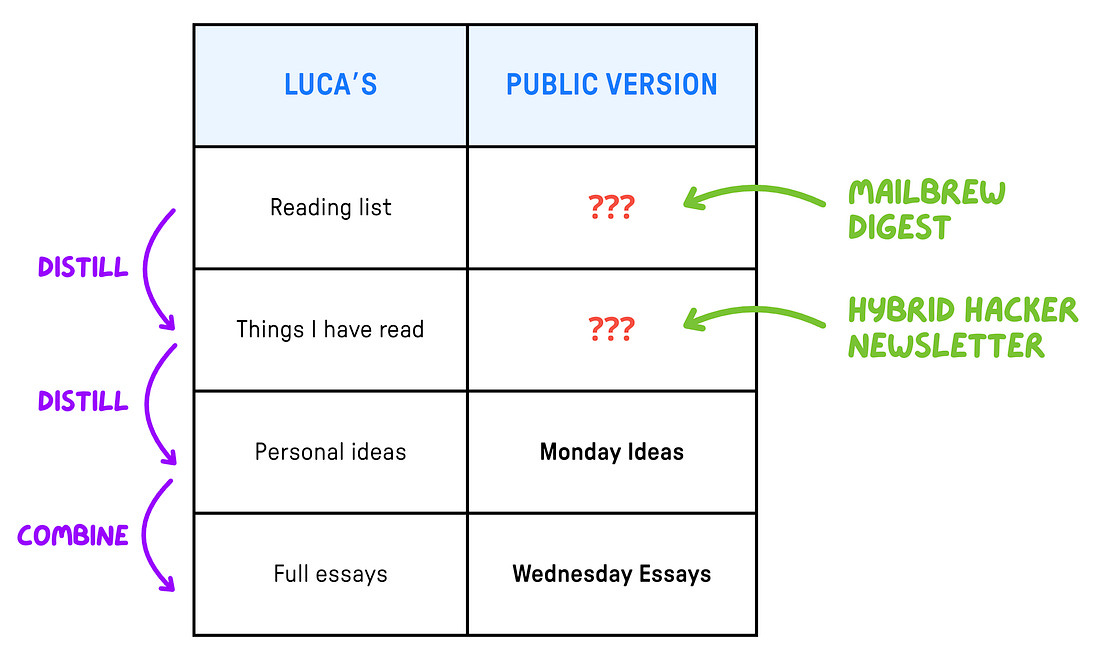
All in all, you might think reading is obviously valuable and will stick by itself. Well, in my experience, this is not the case. Reading well and regularly is hard, so if you are serious about it, try to create some practical flywheels for yourself. As a content creator, I am not immune to this either. Even if I need to write new articles every week, I may easily become sloppy and just recycle / recombine old ideas in slightly different ways. Which is why I am trying to create more granular incentives for myself 👇 🥇 Creating incentivesBy reviewing my workflow, at some point I had the obvious realization that the parts I struggle the most with are exactly those for which I don’t have a build-in-public version:
So I tried two things:
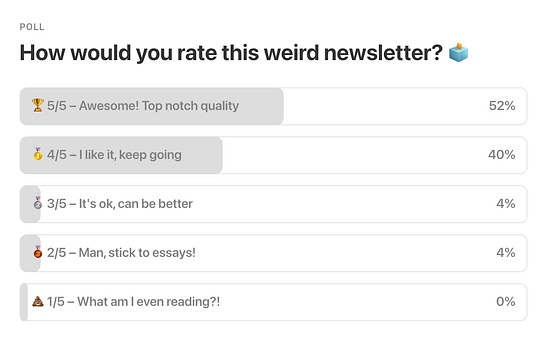
 Both experiments were a huge success. I shared my reading list on LinkedIn and on the community, and already got 30+ subscribers plus a lot of warm comments. This is not going to be a business whatsoever, so I am simply happy about it. I also asked Hybrid Hacker readers to rate the unusual newsletter they received, and the feedback was astounding:
Together, these gave me incredible energy and provided the missing incentives to keep the underlying habits tidy. Now I feel a strong need to:
So, these were experiments so far, and the jury is still out on whether to continue them or not, but we are off to a very promising start. 📚 What about books?Finally, what about books? I have a hard time reading non-fiction books regularly, which is why we have the book club — accountability, again! Thanks to the book club, over the past two years I have read on average one book every two months, which is the most I have ever read in my life. Currently we are reading The Phoenix Project, which I already read about 10 years ago, and was one of my inspirations for Refactoring! 📌 Bottom lineAnd that’s it for today! Here are the main takeaways:
See you next week! Sincerely 👋
|
What I am reading in 2025 (and how) 📚
Wednesday, 19 November 2025




Subscribe to:
Post Comments (Atom)


No comments:
Post a Comment