
Keep tabs on AI’s market pulse with our live Boom or Bubble tracker. Sign up here for ongoing insights. The blogger Ed Zitron has published some detailed extracts of OpenAI and Microsoft’s commercial arrangements. It is a brilliant piece of investigative journalism, also picked up by the Financial Times. It includes details of how much OpenAI paid to Microsoft for Azure hosting and as part of its revenue share with the firm, as well as the inference bill OpenAI faces.
Since so much of the US stock market hangs on what OpenAI’s revenues really are and how fast they are growing, this is a great insight. The market is jittery with the Nasdaq dropping 2% in a couple of days. Over the past month, infrastructure players Oracle and CoreWeave have seen their stock prices drop 27% and 42% respectively. These numbers matter. Some read them as a sign that the boom is rolling over. I’m not convinced. Interpreted properly, the leaks point to a very different picture. In this short note, I’ll dig into what the leaks might tell us about OpenAI’s sales. The dealWe already know some details of the deal between the two firms:
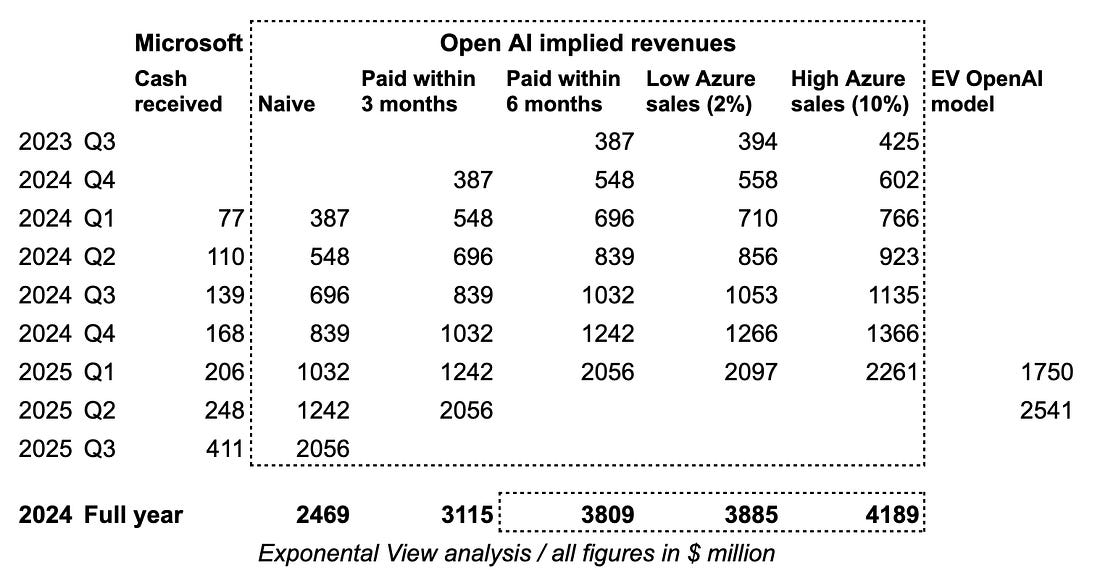
The leaked data Zitron received should allow us to estimate OpenAI’s revenues and sort out whether they are in line with leaks. I’ve not seen the documents, but Zitron points out that they show the “revenue share payments” Microsoft received at various quarters. That is, it’s a cash-basis number. The simplest reading would be to multiply those revenue share payments by five (the 20% revenue share) and conclude that is OpenAI’s revenue in that quarter. In reality, this would understate revenues. It is more likely that OpenAI has to reconcile a quarter’s revenues, agree the reconciliation with Microsoft, and then make a payment according to standard payment terms. We don’t know the exact details. But in large OEM / platform deals, it is common to have quarterly reconciliations and 30-90-day payment terms. It’s more plausible that reconciliation would mean a one-to-two quarter cash-lag. In other words, if Microsoft received a payment in the second quarter of 2025, it most likely reflects OpenAI’s revenues in the first quarter of 2025 or the fourth quarter of 2024, or some mix of both. In addition, the cross-payments from Microsoft selling OpenAI services via Azure, while small, will plausibly arrive with a similar, if not greater, delay. The objective here is to reconcile the cash payments that the Zitron leaks describe with the revenue that OpenAI can recognise in each month or quarter. Cash will follow revenue recognition with a delay. The five scenariosThe simple model below clarifies this. The sums Microsoft received from OpenAI are disclosed in the leak. We then impute OpenAI’s revenue based on five different scenarios. These provide potential floors for revenues in that period:
OpenAI’s revenues have been leaked at roughly $3.7 billion for 2024. In most scenarios, adjust for settlement lags, and full year revenues within reasonable estimate range of that number. Of course, the naive model leaves an enormous gap, but it seems unrealistic to assume instant settlement. Our revenue model for OpenAI, lives somewhere between the lower end of these models... Subscribe to Exponential View to unlock the rest.Become a paying subscriber of Exponential View to get access to this post and other subscriber-only content. A subscription gets you:
|
🤔 Unpicking OpenAI’s real revenues
Friday, 14 November 2025





Subscribe to:
Post Comments (Atom)


No comments:
Post a Comment