
Meet one of the fastest-growing AI startups in the worldChalk is building the future of AI / ML inference
✨ Hey there this is a free edition of next play’s newsletter, where we share under-the-radar opportunities to help you figure out what’s next in your journey. Join our private Slack community here and access $1000s of dollars of product discounts here. If you only have a minute or two, here’s what to know about Chalk:
We often write about how you might go about getting hired at a startup. There is a follow-up question here, though, that I sometimes get asked: How do I identify a startup that is actually good? We all know the stats. Most startups fail. There is risk! More than 15,000 startups were funded in 2024, and yet only about 20 companies per year end up eventually exiting for at least $1B. That puts your odds at about 1 in 750 to pick a company that is really going to matter. Over the course of my conversations with the team, I have recently begun to wonder whether Chalk—a data platform that powers AI/ML applications—may be one of those companies. On paper, Chalk is undeniably impressive. They’ve achieved product-market fit, with dozens of enterprise customer testimonials. They recently raised a $50 million Series A at a $500M valuation, led by Felicis (with participation from General Catalyst, who also co-led their seed round). And they are hiring for roles in SF in every department: engineering, marketing, sales, operations, and more. The culture, according to their founders and team, is relentless and high-velocity. “We’re finishing entire pilots before our competitors even complete their security reviews,” Andy told me. In this Next Play Spotlight, I try to learn more about Chalk. What do they do? Why have they grown so quickly? What is it like to work there, and should you consider joining? All that and more below.
AI is booming, but it needs a faster data layerIt is somewhat obvious to state that success looks kindly on companies that (successfully) build core infrastructure that is upstream of a lot of value in the world. AWS. Stripe. NVIDIA. In many ways, Chalk is angling to be that sort of foundational company—the kind that powers trillions of dollars of useful tools. So what does Chalk actually do? What is the market? Well, if you are a software engineer or work in AI, “the data platform for AI + ML,” as Chalk describes themselves on their homepage, may make immediate sense to you. However, if you are not in this space and that line does not make it clear to you what their product does, here is a short explainer. Imagine you work on transaction fraud and credit underwriting at Ramp. Your principal goal is to make effective decisions with data: every time a transaction occurs you want to make sure it’s legitimate, and every time someone applies for credit you want to make the right decision about how to proceed. You use machine learning models to do this. These models need data—lots of it—in order to work. The problem is that the data to power your fraud and underwriting models lives in two dozen different places; separate databases, live signals, API calls. Your model needs all of this data to make a decision, and it needs it in (literally) 10 milliseconds so that the customer has a good experience. Chalk is the data platform that instantly connects this data to your machine learning models, unlocking what’s known as “real-time inference.” In plain terms, Chalk’s data platform is what allows models to make smart decisions (inference) in real-time based on data. This is, as you might expect, quite a large market. And it’s growing fast. “Most of the friction in AI,” wrote Aydin Senkut of Felicis, who is now on Chalk’s board, “comes after training. Real-time inference is complex.” As AI/ML continues to grow, so will Chalk’s TAM. And the market is not AI hype. It’s solid. Chalk’s success does not rest on the kinds of things that AI skeptics often bring up (like whether Open AI is going to have the impact their valuation suggests). Instead, Chalk powers real, often straightforward tools used by real, profitable companies to add value.
Chalk benefits massively from the rise in AI/ML models, many of which need real-time inference (and thus Chalk) in order to be useful. But, it is not hamstrung by AI speculation or an AI bubble; Chalk’s business does not hinge on AGI being achieved, or whether chatbots are truly ‘the next internet.’ That’s refreshing. But, before I get ahead of myself—why was Chalk founded in the first place? The founding team behind ChalkPerhaps the best way to describe Marc Freed-Finnegan, Elliot Marx, and Andrew Moreland (Chalk’s co-founders) is to say that they are, and have always been, fantastic problem-solvers.
Marc spent many years at Google, where he helped to launch the first version of Google Wallet. He went on to start Index, which Stripe acquired as its in-store payment solution—now called Stripe Terminal. Elliot and Andy, meanwhile, met at Stanford. Elliot began his career at Affirm, where he built the early risk and credit data infrastructure (part of the inspiration for Chalk). And worked at Palantir on large government data infrastructure projects. In 2017, Elliot and Andy joined forces to found a company called Haven Money, which Credit Karma later acquired to power its banking products. If you asked me to write down a perfect-world version of what kind of people I’d want to start a company like Chalk, I would probably tell you I’d want people who (1) have all had successful exits and (2) have experience building quality data infrastructure. In Chalk’s case, that dream is reality. And so far, things seem to be working. Since raising their $10M seed round in December 2023, Chalk:
All the while, they’ve scaled their ambition, problem-solving, and velocity with a company culture that—at least from what I can tell as an outsider—seems quite effective. A low-ego culture driven by velocityAny self-respecting startup will tell you, at least in broad terms, that they like to work hard. That they like to get shit done. That it’s important to be a self-starter and work fast. That’s kind of the startup bible. Often, though, much of this falls apart upon closer inspection. Chatting with the Chalk team, I got the impression that everyone is dead serious about their values, particularly their problem-solving and velocity—and that the company would not exist without them.
There were a few themes that showed up when I talked to the Chalk team; below I’ll organize them, with quotes, so you can get a strong sense of what this company is all about. 1: Chalk is unusually obsessed with their customers. “I read almost every single customer message we’ve ever received,” Andy told me. “ Every morning, when I wake up, the first thing I think about is our customers. By the time [Databricks execs] finish their first meeting, I’ve gone through Slack messages from 30 customers.” 2: The whole company is driven by velocity. “We’re collaborative and low-ego,” Sai Atmakuri, a software engineer, told me, “which means we are able to plan and move really quickly. When a project that’s been in the backlog is suddenly needed to get a pilot over the line, or a customer encounters an issue, we figure out how to build that out ASAP.”
And according to Andy, Chalk is so fast that they “finish entire pilots before our competitors even complete their security reviews. Chalk customers ship to production faster because we refuse to be the rate-limiting step in their process.” At Chalk, you’re expected to ship no matter what. “One of our core values is incrementalism,” Elliot said. “Just do something that makes forward progress and ship it, even if it doesn’t do everything or even if you’re not going to use it yet. You’ve got to get the door out consistently.” Elliot recognized that incrementalism has “a dirty name, not just in engineering. But everything should be incremental. Our whole world should be incremental. Take a small step in a direction, then observe and see if you like it or don’t like it. You need to be honest with yourself about when you’re wrong and when you’re right.”
3: Everyone at Chalk is a self-starter. Caroline Parker, a sales development representative, told us that, “You need to be the type of person who’s hungry and willing to learn, do a ton of reading, and immerse yourself in material. You need to be willing to dive right in. If you have an extra five minutes, you might ask ‘How can I help?’ ‘Where can I be useful?’. You should always have something to do, and you shouldn’t always have to ask. You should just pick it up.” This was echoed by everyone we talked to. Melanie Chen, a forward-deployed engineer, said that when problems come up, “we wear many hats and just solve them. That’s a Core chalk trait. You can’t expect everyone else to solve your problems for you.”
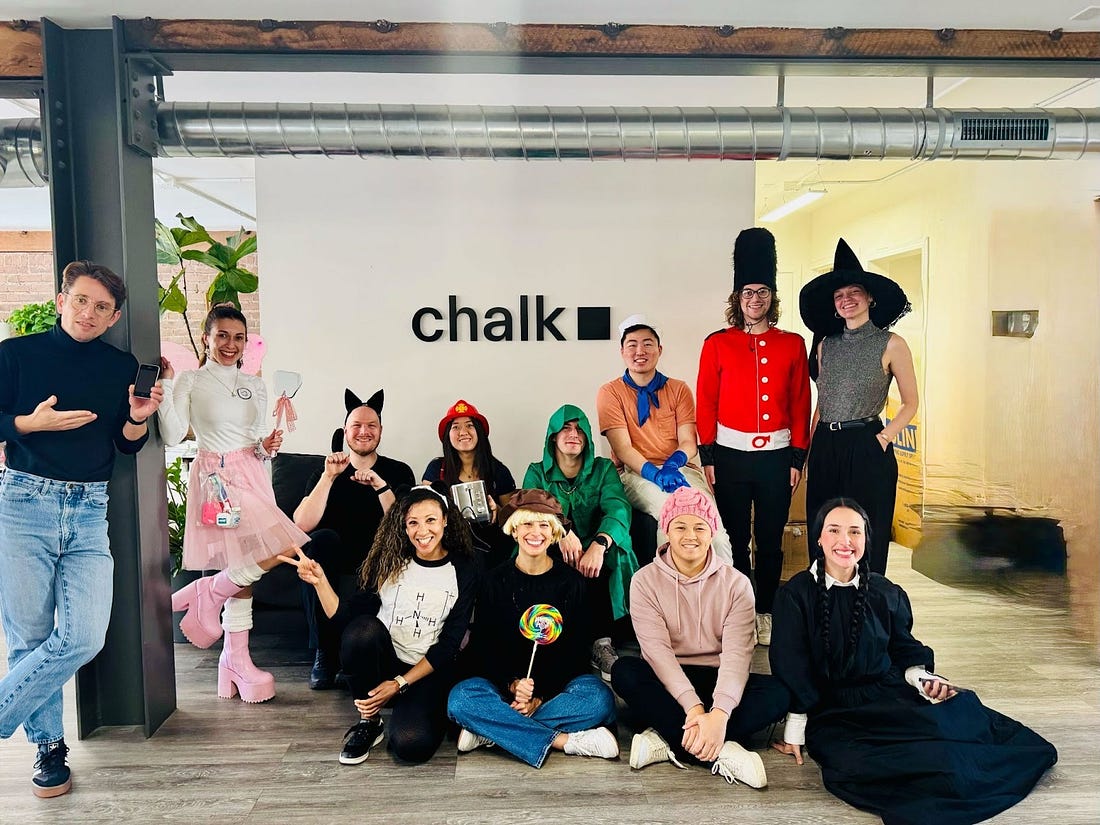
Brian Sussman, operations manager, agreed. “You definitely get out what you put in. The people who succeed here give it their all. It’s easy to get a job [anywhere], but this is the place to build a career.” 4: The culture at Chalk is all-round obsessive and a bit nerdy. “We’re all a similar type of nerd,” Sai said. “There’s folks who are into high-performance computing, chess, poker, board games. There’s a good overlap between people who are interested in geeking out about all these niche things, and that makes for a very fun and friendly environment.” “I bought a Nintendo Switch for the office,” Andy said. “Turns out one of our engineers ranked among the top competitive Smash players in SF and Pittsburgh. A great thing about Chalk is how people here are among the best in the country at something totally random. It’s great to see people choosing to stay until 9pm for Smash Bros or Mario Kart tournaments. That’s what happens when you make the office somewhere people want to be.”
Should you consider joining? And if so, how?If you have made it this far in the essay, I’d wager you have a decent idea about whether Chalk is your kind of company (intense, obsessive, nerdy, high-velocity, effective). But there’s some more information you should be aware of that, if you are the right kind of person, should get you even more excited. One feature of the company is that they are in the office 5 days a week. Ten years ago this was the default, but now it feels like something of a contrarian opinion. “We’re [in-person],” Andy said, “because we want to iterate really, really fast. Remote doesn’t work for high-performance teams,” he told us, because decisions can’t get made fast enough, collaboration is more difficult, and because people feel more accountable when they are working on projects in-person.
You may also end up working longer than the traditional 9-to-5. “The people who write software here, they’re not just writing it 9 to 5,” Marc said. “They’re going home and they’re still writing software. And maybe it’s for Chalk, or maybe it’s for a side project, or maybe it’s for a competition they’re part of. The point is that they really love what they do. They’re aspiring to become one of the best engineers in the world.” So that much is clear—if you want to fit in at Chalk, you should be almost unreasonably (from an outsiders’ perspective) dedicated to your craft. You should be ready to work hard, but more than that, you should want to work hard. And if you are still in doubt, I think Marc summarized it well: “We’re looking for three things. Number one, we are looking for people who are really, really smart. People who can figure out new things because the world around us is changing and we have to figure out things all the time. Number two, we are looking for people who can communicate really well. That makes writing great software, because that’s our language. But even if you think about other roles at Chalk, communication is essential. Number three, we are looking for people who are aspiring to be the best at what they do.” If you have read all of this and think that Chalk sounds like the right place to build your career at, check out their careers page. Of course, you don’t have to stop at sending in a generic application. You can also directly email the person who’s hiring for your role. You could record a Loom video about yourself, which is what Brian did to get hired. You could directly DM somebody on LinkedIn. You could build something that might be valuable (or useful, or interesting) and send it to Chalk. You could talk to their customers and bring them learnings. Or you could try one of the ideas on this list. You're currently a free subscriber to next play. For the full experience, upgrade your subscription.
|
Meet one of the fastest-growing AI startups in the world
Thursday, 20 November 2025









Subscribe to:
Post Comments (Atom)


No comments:
Post a Comment