
Stream Smarter with Amazon S3 + Redpanda (Sponsored)
Join us live on November 12 for a Redpanda Tech Talk with AWS experts exploring how to connect streaming and object storage for real-time, scalable data pipelines. Redpanda’s Chandler Mayo and AWS Partner Solutions Architect Dr. Art Sedighi will show how to move data seamlessly between Redpanda Serverless and Amazon S3 — no custom code required. Learn practical patterns for ingesting, exporting, and analyzing data across your streaming and storage layers. Whether you’re building event-driven apps or analytics pipelines, this session will help you optimize for performance, cost, and reliability. Disclaimer: The details in this post have been derived from the details shared online by the Uber Engineering Team. All credit for the technical details goes to the Uber Engineering Team. The links to the original articles and sources are present in the references section at the end of the post. We’ve attempted to analyze the details and provide our input about them. If you find any inaccuracies or omissions, please leave a comment, and we will do our best to fix them. For a company operating at Uber’s scale, financial decision-making depends on how quickly and accurately teams can access critical data. Every minute spent waiting for reports can delay decisions that impact millions of transactions worldwide. Uber Engineering Team recognized that their finance teams were spending a significant amount of time just trying to retrieve the right data before they could even begin their analysis. Historically, financial analysts had to log into multiple platforms like Presto, IBM Planning Analytics, Oracle EPM, and Google Docs to find relevant numbers. This fragmented process created serious bottlenecks. Analysts often had to manually search across different systems, which increased the risk of using outdated or inconsistent data. If they wanted to retrieve more complex information, they had to write SQL queries. This required deep knowledge of data structures and constant reference to documentation, which made the process slow and prone to errors. In many cases, analysts submitted requests to the data science team to get the required data, which introduced additional delays of several hours or even days. By the time the reports were ready, valuable time had already been lost. For a fast-moving company, this delay in accessing insights can limit the ability to make informed, real-time financial decisions. Uber Engineering Team set out to solve this. Their goal was clear: build a secure and real-time financial data access layer that could live directly inside the daily workflow of finance teams. Instead of navigating multiple platforms or writing SQL queries, analysts should be able to ask questions in plain language and get answers in seconds. This vision led to the creation of Finch, Uber’s conversational AI data agent. Finch is designed to bring financial intelligence directly into Slack, the communication platform already used by the company’s teams. In this article, we will look at how Uber built Finch and how it works under the hood.
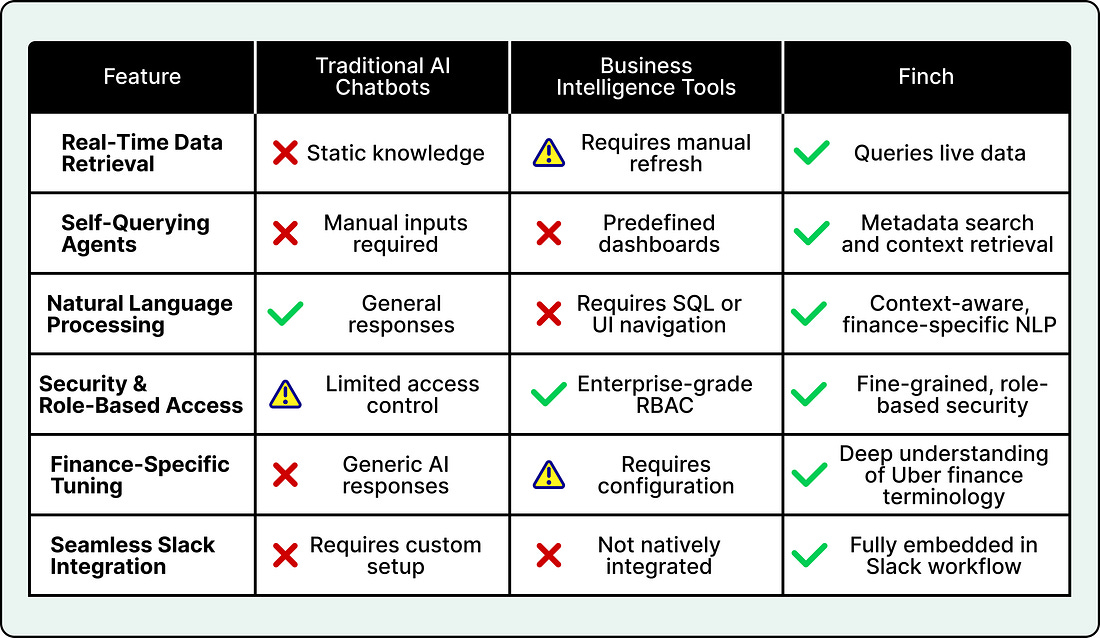
What is Finch?To solve the long-standing problem of slow and complex data access, the Uber Engineering Team built Finch, a conversational AI data agent that lives directly inside Slack. Instead of logging into multiple systems or writing long SQL queries, finance team members can simply type a question in natural language. Finch then takes care of the rest. See the comparison table below that shows how Finch stands out from other AI finance tools.
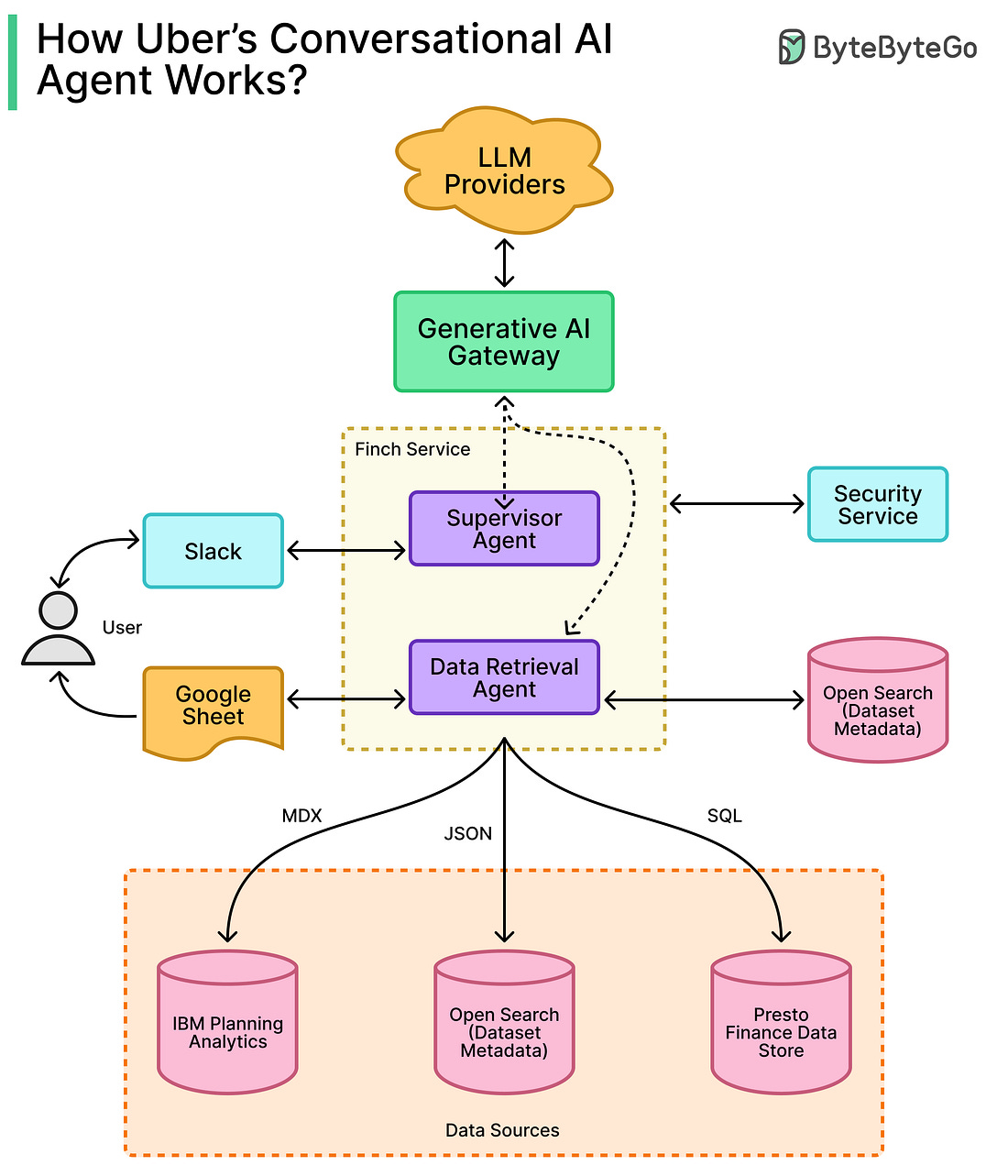
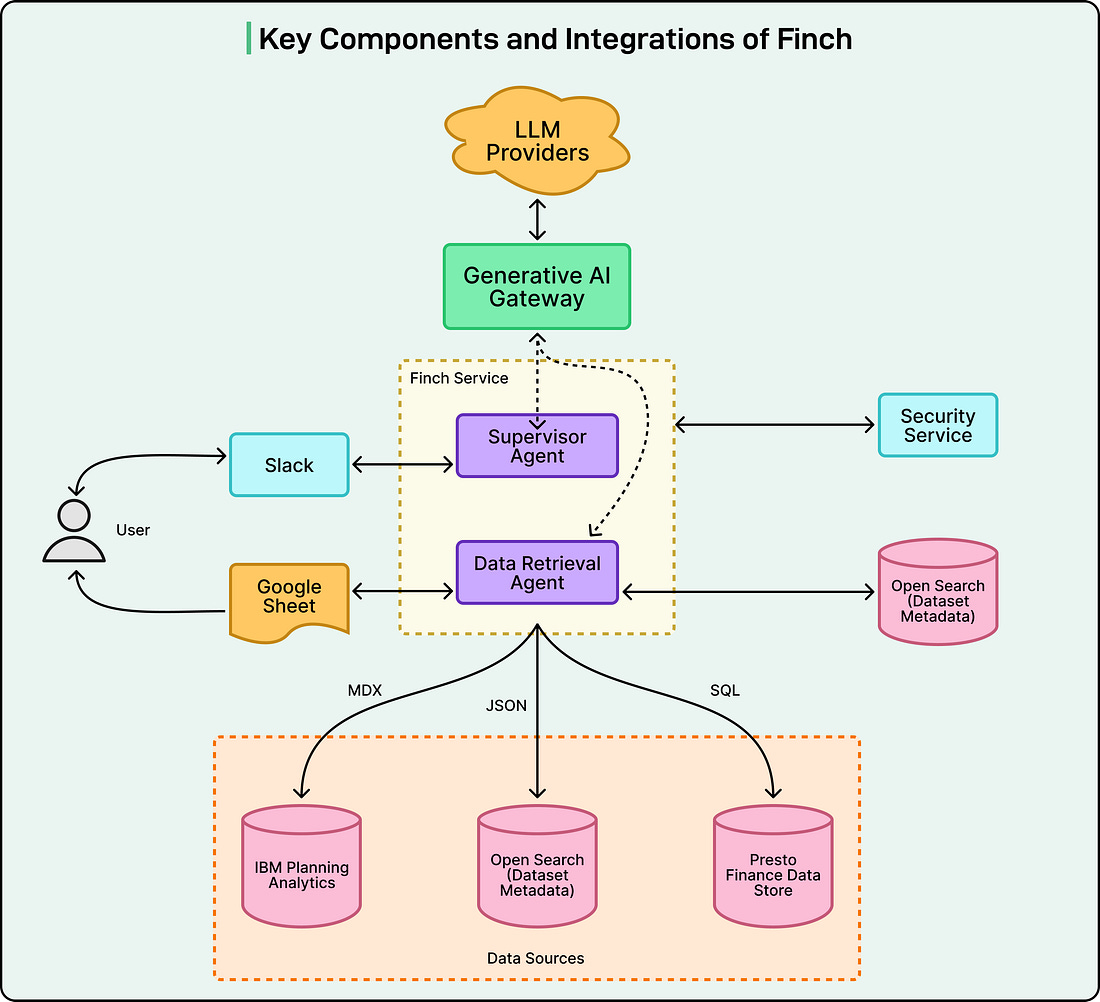
At its core, Finch is designed to make financial data retrieval feel as easy as sending a message to a colleague. When a user types a question, Finch translates the request into a structured SQL query behind the scenes. It identifies the right data source, applies the correct filters, checks user permissions, and retrieves the latest financial data in real time. Security is built into this process through role-based access controls (RBAC). This ensures that only authorized users can access sensitive financial information. Once Finch retrieves the results, it sends the response back to Slack in a clean, readable format. If the data set is large, Finch can automatically export it to Google Sheets so that users can work with it directly without any extra steps. For example, the user might ask: “What was the GB value in US&C in Q4 2024?” Finch quickly finds the relevant table, builds the appropriate SQL query, executes it, and returns the result right inside Slack. The user gets a clear, ready-to-use answer in seconds instead of spending hours searching, writing queries, or waiting for another team. Finch Architecture OverviewThe design of Finch is centered on three major goals: modularity, security, and accuracy in how large language models generate and execute queries. Uber Engineering Team built the system so that each part of the architecture can work independently while still fitting smoothly into the overall data pipeline. This makes Finch easier to scale, maintain, and improve over time. The diagram below shows the key components of Finch:
At the foundation of Finch is its data layer. Uber uses curated, single-table data marts that store key financial and operational metrics. Instead of allowing queries to run on large, complex databases with many joins, Finch works with simplified tables that are optimized for speed and clarity. To make Finch understand natural language better, the Uber Engineering Team built a semantic layer on top of these data marts. This layer uses OpenSearch to store natural language aliases for both column names and their values. For example, if someone types “US&C,” Finch can map that phrase to the correct column and value in the database. This allows the model to do fuzzy matching, meaning it can correctly interpret slightly different ways of asking the same question. This improves the accuracy of WHERE clauses in the SQL queries Finch generates, which is often a weak spot in many LLM-based data agents. Finch’s architecture combines several key technologies that work together to make the experience seamless for finance teams.
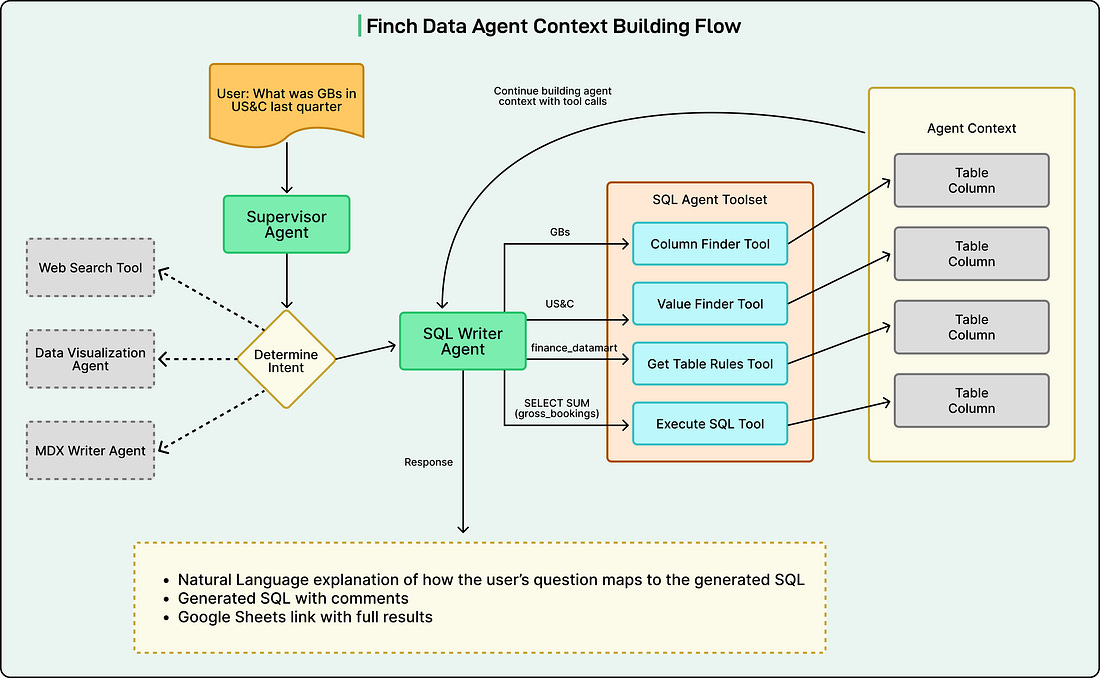
Finch Agentic WorkflowOne of the most important elements of Finch is how its different components work together to handle a user’s query. Uber Engineering Team designed Finch to operate through a structured orchestration pipeline, where each agent in the system has a clear role:
See the diagram below that shows the data agent’s context building flow:
Finch’s Accuracy and Performance EvaluationFor Finch to be useful at Uber’s scale, it must be both accurate and fast. A conversational data agent that delivers wrong or slow answers would quickly lose the trust of financial analysts. Uber Engineering Team built Finch with multiple layers of testing and optimization to ensure it performs consistently, even when the system grows more complex. There were two main areas: Continuous EvaluationUber continuously evaluates Finch to make sure each part of the system works as expected. Here are the key evaluation steps:
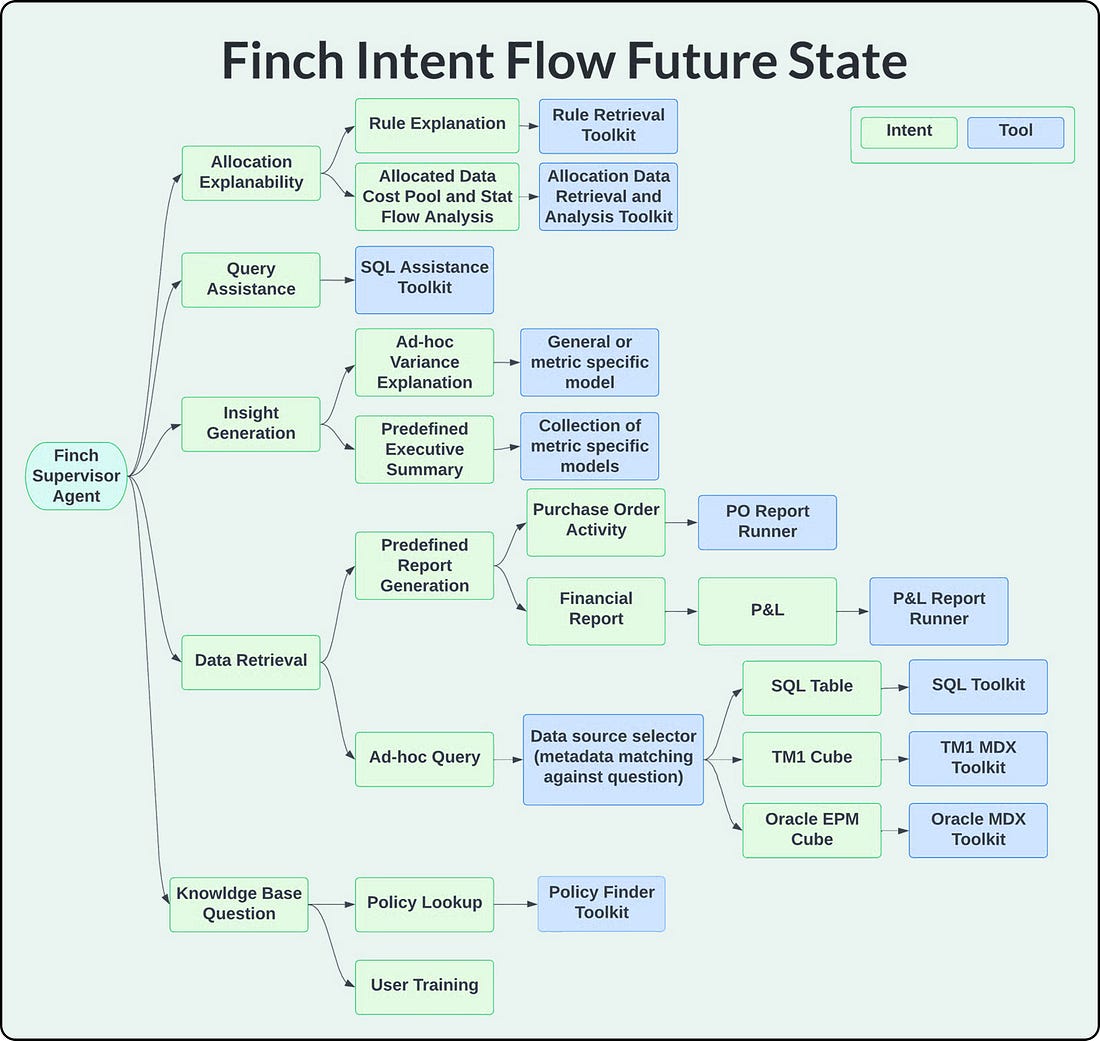
Performance OptimizationFinch is built to deliver answers quickly, even when handling a large volume of queries. Uber Engineering Team optimized the system to minimize database load by making SQL queries more efficient. Instead of relying on one long, blocking process, Finch uses multiple sub-agents that can work in parallel, reducing latency. To make responses even faster, Finch pre-fetches frequently used metrics. This means that some common data is already cached or readily accessible before users even ask for it, leading to near-instant responses in many cases. ConclusionFinch represents a major step in how financial teams at Uber access and interact with data. Instead of navigating multiple platforms, writing complex SQL queries, or waiting for data requests to be fulfilled, analysts can now get real-time answers inside Slack using natural language. By combining curated financial data marts, large language models, metadata enrichment, and secure system design, the Uber Engineering Team has built a solution that removes layers of friction from financial reporting and analysis. The architecture of Finch shows a thoughtful balance between innovation and practicality. It uses a modular agentic workflow to orchestrate different specialized agents, ensures accuracy through continuous evaluation and testing, and delivers low latency through smart performance optimizations. The result is a system that not only works reliably at scale but also fits seamlessly into the daily workflow of Uber’s finance teams. Looking ahead, Uber plans to expand Finch even further. The roadmap includes deeper FinTech integration to support more financial systems and workflows across the organization. For executive users like the CEO and CFO, Uber Engineering Team is introducing a human-in-the-loop validation system, where a “Request Validation” button will allow critical answers to be reviewed by subject matter experts before final approval. This will increase trust in Finch’s responses for high-stakes decisions. The team is also working to support more user intents and specialized agents, expanding Finch beyond simple data retrieval into richer financial use cases such as forecasting, reporting, and automated analysis. As these capabilities grow, Finch will evolve from being a helpful assistant into a central intelligence layer for Uber’s financial operations. See the diagram below that shows a glimpse of Finch’s Intent Flow Future State:
References: SPONSOR USGet your product in front of more than 1,000,000 tech professionals. Our newsletter puts your products and services directly in front of an audience that matters - hundreds of thousands of engineering leaders and senior engineers - who have influence over significant tech decisions and big purchases. Space Fills Up Fast - Reserve Today Ad spots typically sell out about 4 weeks in advance. To ensure your ad reaches this influential audience, reserve your space now by emailing sponsorship@bytebytego.com.
|
How Uber Built a Conversational AI Agent For Financial Analysis
Monday, 10 November 2025





Subscribe to:
Post Comments (Atom)


No comments:
Post a Comment