
This is Brad DeLong's Grasping Reality—my attempt to make myself, and all of you out there in SubStackLand, smarter by writing where I have Value Above Replacement and shutting up where I do not… Trump's Non-Reciprocal Transactionalism: Favors Flow Only to Supplicants Who Disclaim EntitlementAmerica’s plutocrat class talks, in private, about “hedging” and “exit”. But, so far, no people have and not much money has moved. Instead, they seem to have internalized three rules: (a) never...
America’s plutocrat class talks, in private, about “hedging” and “exit”. But, so far, no people have and not much money has moved. Instead, they seem to have internalized three rules: (a) never lead resistance, (b) avoid notice whenever possible, (c) flatter and promise when noticed, and (d) never claim reciprocity—approach as supplicants, not partners. Elon Musk’s humiliation clarifies the regime’s logic: hierarchy enforced by arbitrary dominance, not market exchange. What some call “transactional” is deeply asymmetric—favors only for those who deny they expect them. As norms erode, formal fixes are implausible; culture can’t be restored by statute. The quiet strategy of invisibility and ritual flattery isn’t neutral—each accommodation helps entrench a patronage-autocracy where proximity to the sovereign outranks institutions…
For nine years now—ever since Steve Schwarzman of Blackstone first got in bed with Donald Trumo—I have been using a more-or-less standard line: that American plutocrats regard kleptocrats like Donald Trump as their friends, while kleptocrats ultimately regard plutocrats as their prey. It sometimes gets a laugh. It sometimes does not. Mike Brock details how this is going:
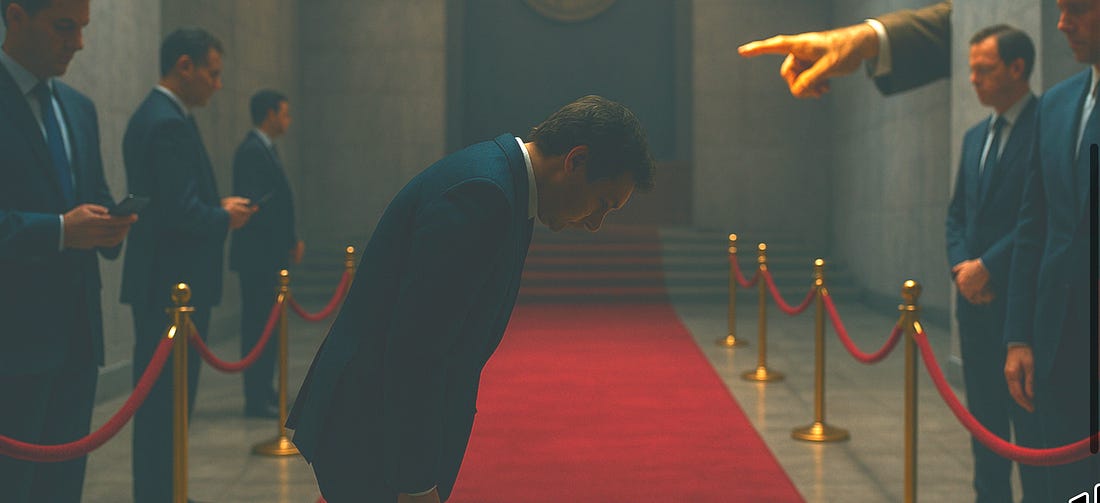
Step back: In the circles in which I move, I have noted some talk from America’s lower-upper class about guarding their safety by getting foreign passports or moving abroad, and from the truly wealthy about moving their money out of the United States. You hear nervous speculation about capital flight, about diversification strategies, about the need to hedge against American political instability. Yet when you look at actual money flows or on pressure on the exchange rate, the picture tells a different story: very little is actually happening. Perhaps the decline in the dollar is a sign. Perhaps. But I do have a strong hunch right now that there is a gap between rhetoric and action. Perhaps this reveals something important about how power is actually working here and now in Trump’s Second-Term America. Perhaps most billionaires and corporate leaders have arrived at a calculated conclusion: You get into trouble if you attempt to lead the resistance to Trump’s neofascist impositions—that much is obvious. But if you keep your heads down and do not attract Trump’s attention and ire, you will probably be fine. Besides, the net increase in instability abroad with the U.S. no longer serving as a security and rule-of-law backstop may well be greater than the net increase in instability inside the United States. Billionaires perhaps calculate that they can just stay out of Trump’s way. CEOs of public corporations still believe that the tariffs imposed on them will be survivable, as long as they spend sufficient time flattering Trump. As long as they make regular pilgrimages to Mar-a-Lago, praise Trump effusively, and announce vague plans to bring manufacturing back to America (plans that never need to truly materialize), they can survive the economic irrationality of the tariffs themselves. This is accommodation masquerading as business pragmatism. But there are clear rules to this game, and violating them carries consequences It’s a strategy of accommodation through invisibility, punctuated by occasional performances of loyalty. If this is so, then the Elon Musk situation illustrates what happens when you miscalculate the rules of this game. You also get into trouble, as Musk is discovering, if you attempt to profit from your connections with Trump while making it a little too clear that you see yourself not as offering tribute to the boss, but instead as having some right to return favors because of what you have done for him. Musk thought he had purchased favors: tariff carve-outs to keep Tesla functional as a production network. Extended EV subsidies to keep Tesla profitable. The NASA budget transferred to SpaceX. Trump reminded him that Trump does not owe him anything. Influence is not property. Indeed, influence is not even influence, if Trump decides that it isn’t. It is paradoxical, this essential structure of Trump’s “transactionalism”. Trump is indeed “transactional,” but part of the transaction is that you get favors done for you in return only if you insist, repeatedly, that you do not expect anything. You must approach as a supplicant, not a partner. You must frame every benefit you receive as an act of grace, not an exchange of value. What Musk failed to understand—and what quieter billionaires grasp instinctively—is that this is no longer anything that is capitalism, in which value is exchanged for value, or even feudalism, in which good lordship and assistance is exchanged for wise counsel and support. It’s something older: a patronage system where proximity to power matters more than productive contribution, where the appearance of submission matters more than the reality of exchange. The moment you treat it as a business deal between equals, you’ve violated the fundamental hierarchy that makes the system work. It’s tribute dressed up as commerce. It’s patronage-autocracy with a Forbes-499 ranking. The implications of this are profound and, frankly, somewhat terrifying. I confess I do not understand, given this profound norm ice-breaking, how the American system as it functioned before 2016 can be reestablished, short of some formal, official, bipartisan, post-Trump Stunde Null—whether through constitutional amendment, constitutional conventions, or some other means. And that ain’t gonna happen. The norms that once constrained arbitrary presidential power weren’t encoded in law. They were sustained by shared belief in their importance. Now they have been demonstrated to be optional. Once shown to be obstacles that can simply be ignored by someone willing to pay the reputational cost, they cannot be restored by good intentions alone. Perhaps the billionaires keeping their heads down understand this better than the resistance does. Perhaps they are not betting on the restoration of the old system. They’re adapting to the new one, calculating that performative submission is cheaper than actual capital flight, and that as long as they don’t challenge the hierarchy or demand reciprocity, they can continue to prosper. They may be right. But their silence is also a choice—a choice that ratifies the very system they quietly fear. Very quietly fear. Meanwhile, as far as policy is concerned, things have turned out to be much more bizarre in Trump’s second term than I had expected, or how even the plutocrat-kleptocrat court dominance politics would lead one to anticipate. On the level of policy, to the extent that Trump cared at all, Trump was always driven by three things:
Hence we always, in his first term, had chaos-monkey policy, with a pronounced lack of follow-through and consistency, and a predilection for reversing course suddenly a la “Nixon going to China” as a way of generating headlines. We had a Renaissance prince operating according to Renaissance-prince logic: hatreds, vanities, and calculations. Trump, admittedly, was much more of a chaos-monkey: Initiatives launched with great fanfare and then abandoned. Pronouncements were made, and then contradicted, sometimes within hours. There was a pronounced lack of follow-through or consistency. Trump delighted in reversing course suddenly—his own “Nixon going to China” moments—as a way of generating headlines and proving he couldn’t be predicted or controlled. If you expected consistency, you were playing the wrong game. The game was about Trump’s psychic needs, not policy outcomes. Thus “chaos monkey” rather than the Duke Vicenzo of Mantua of “Rigoletto”. Now we must add to this volatile mix Trump’s severe mental deterioration. The pattern has become familiar and terrifying: Trump tweets something. People show up in agencies or on cable news claiming to have the baton from Trump to implement those tweets as policies. They may be telling the truth. They may be lying. They may be telling the truth, but if someone else gets in to see Trump tomorrow, he will disavow them entirely. They may be lying, but if someone checks with Trump, he will back them because he doesn’t remember what he actually said or meant. This creates a power vacuum. In any “normal” autocratic system, that system would be filled by a strong Wazir or Chancellor—the person who stands at the separating lattice screen, the cancelli. Throughout history, with an autocrat mentally-challenged or dissolute it is the person who controls access—who literally stands in the chancel and determines who gets through the door—who seizes effective power. They become the real sovereign while maintaining the fiction of the autocrat’s authority. It’s a well-worn pattern: the declining emperor, the ambitious chamberlain, the consolidation of power through controlled access. But here’s where the situation becomes truly bizarre: Susan Wiles, Trump’s chief of staff, appears to be a cipher. Appears. She’s not, apparently, seizing power. She’s not establishing herself as the gatekeeper whose approval everyone must secure. She’s not building a faction or imposing order on the chaos. Instead, we have a system where the normal dynamics of court politics—predictable, if ugly—have broken down entirely. Multiple people claim Trump’s authority. No one can definitively say who actually has it. The sovereign is mentally absent, but no one has stepped into the vacuum. This may be the most dangerous configuration of all: not tyranny, which at least has a logic, but a simulacrum of tyranny where power is simultaneously absolute and incoherent, where no one is actually in control, but everyone keeps behaving as though someone is. And the Republican congressional leadership pretends that all is fine, and that those who claim to bear Trump’s name get to do what they want. And, so far, John Roberts’s Supreme Court agrees that whoever shows up claiming to speak with the authority of Donald Trump is all but a king—nay, not a Germanic king or drighten, but rather a post-Diocletian Roman Emperor. References:
If reading this gets you Value Above Replacement, then become a free subscriber to this newsletter. And forward it! And if your VAR from this newsletter is in the three digits or more each year, please become a paid subscriber! I am trying to make you readers—and myself—smarter. Please tell me if I succeed, or how I fail…#trumps-non-reciprocal-transactionalismPlease forward the email & otherwise share it to everyone you think would appreciate it…
|
Trump's Non-Reciprocal Transactionalism: Favors Flow Only to Supplicants Who Disclaim Entitlement
Wednesday, 22 October 2025





Subscribe to:
Post Comments (Atom)


No comments:
Post a Comment