
This is Brad DeLong's Grasping Reality—my attempt to make myself, and all of you out there in SubStackLand, smarter by writing where I have Value Above Replacement and shutting up where I do not… On the Surface, the U.S. Economy Looks Better than Its FundamentalsThe stock market says “all good.” Consumer sentiment says “2009.” Both can be true—if the scoreboard is rigged, and sends the wrong signals in the context of AI-overexuberance and a two-class system t
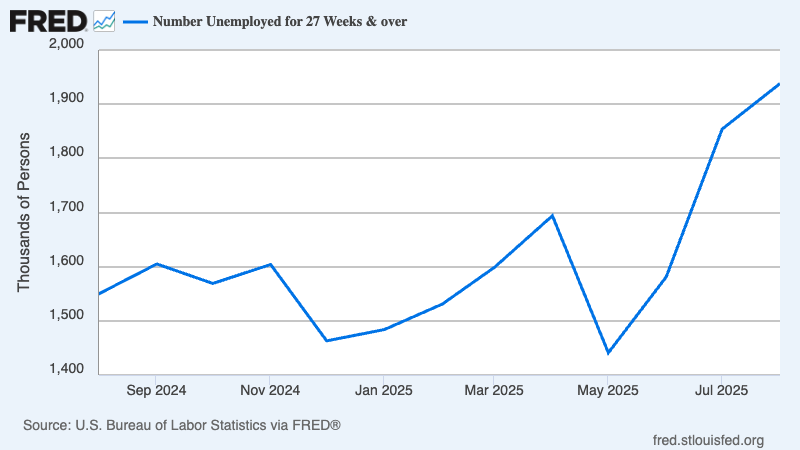
The stock market says “all good.” Consumer sentiment says “2009.” Both can be true—if the scoreboard is rigged, and sends the wrong signals in the context of AI-overexuberance and a two-class system that suppresses labor while juicing capital…Unemployment is low. Unemployment counts joblessness. It does not count fear. It does not count the worker who won’t complain, won’t organize, won’t quit—because deportation or lost health insurance is worse. Sentiment captures that reality first. The live question, therefore, for capital: do domestic gains from rent extraction enabled by labor suppression beat global losses from deglobalization and trade chaos? I think probably not. But the stock-market tape, also juiced by the AI bubble says yes. Maybe we have a genuine two-speed economy. Or maybe we are genuinely flirting with recession, with AI-hype euphoria papering over a broader stall. Thus if you want a historical rhyme, don’t fear 2009. Fear the late 1920s: ticker-tape joy atop sectoral distress and fragile distribution. When you watch the wrong scoreboard, you understate the risks of crashes. Perhaps the workers and consumers with strongly negative confidence are putting more accurate numbers up on the scoreboard. Paul Krugman writes:
My take: The disconnect between official metrics and what we seem to see in felt experience runs deeper than a mismatch between aggregate statistics and individual anxieties. There has been a vibe shift to a new régime of labor suppression, one that operates through immigration enforcement, regulatory abandonment, and the systematic dismantling of worker protections. The stock market’s buoyancy masks what may be either a genuine two-speed economy or—more troubling—a weak economy-wide recession papered over by AI-driven irrational exuberance. Start with what most economic commentary ignores: the precarity that now defines the status of all non-citizens in America. Many people I talk to do not grasp how thoroughly the ground has shifted. This is not merely about immigrants without papers, though their vulnerability has intensified. Even if you hold a green card—that putative guarantee of permanent residence:
The administrative machinery exists; the political will to deploy it has been demonstrated; the checks that might once have constrained such actions have evaporated. Or consider the H-1B visa holder. You face not just the risk of attracting political attention from Noem and Rubio, but the employer’s power to destroy your legal status by firing you and dropping a dime to ICE. What is your ability to negotiate wages, resist exploitation, or assert workplace rights collapses under this Sword of Damocles? The visa ties you to your employer in a bond of indenture. Your company knows it; you know it; the entire labor market knows it. This knowledge reshapes bargaining power across the board. These are more than vibe shifts. They are, I think, already having powerful consequences: Keep reading with a 7-day free trialSubscribe to DeLong's Grasping Reality: Economy in the 2000s & Before to keep reading this post and get 7 days of free access to the full post archives. A subscription gets you:
|
On the Surface, the U.S. Economy Looks Better than Its Fundamentals
Wednesday, 22 October 2025






Subscribe to:
Post Comments (Atom)


No comments:
Post a Comment