
Hey, Luca here, welcome to a weekly edition of the💡 Monday Ideas 💡 from Refactoring! To access all our articles, library, and community, subscribe to the full version: Resources: 🏛️ Library • 💬 Community • 🎙️ Podcast • ❓ About Brought to you by:
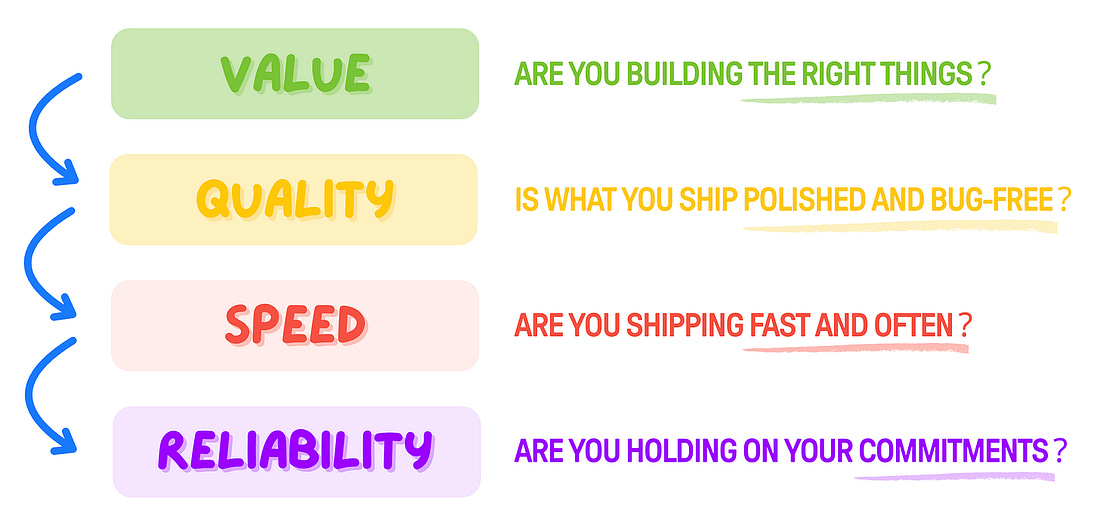
1) ❤️🩹 The Four StrugglesWhen you look at a team that is struggling, and try to figure out what the problem is, there are four big candidates:
Your mileage may vary, but as a rule of thumb, these matter exactly in this order.
In my experience, working on the right things is by far the most important factor. Many teams have misguided conversations about speed when they really mean: “we’re not confident what we ship is good, so let’s ship more things faster“. There is some merit to this, but it’s also true that teams that ship valuable, high-quality work rarely get questioned about speed. Working on the right things is a function of good feedback loops with customers, and feedback loops are what makes speed genuinely useful. Otherwise, you may be running fast, but in circles, without really going anywhere. Finally, reliability — meant as meeting deadlines, making good estimates, etc — is just cherry on top. When trust is created through the other factors, you discover most deadlines are fictional and estimates are not that useful. In most cases, these are control devices meant to make up for low-trust environments, and most often fail at that. Under good conditions, you can relax a lot of the process and just let people work. I wrote a full piece on how to help a struggling team, you can find it below 👇  2) 🎽 Durable teams vs task forcesThis summer I spoke with Shopify's Director of Product to explore how they execute their giant bi-annual editions. One of the ideas that stuck the most with me was how they used both long-lived teams and task forces which are assembled just in time:
The goal of this model is, in a way, to have your cake and eat it too. Durable teams provide the rock-solid foundation, while task forces provide the agility and firepower to make bold bets and drive innovation. Ultimately, this should help strike a balance between stability and innovation. So, if you are primarily working in one of the two modes, you can ask yourself these questions:
You can find the full exploration here: 3) 🔍 Testing in productionIn July I interviewed Maude Lemaire, Principal Engineer at Slack and Github and author of the awesome book Refactoring at Scale. Maude has worked on some of the most daunting migration projects ever, like moving Github massive infrastructure from on-prem to cloud-native, and she strongly advocates for testing in production.
Even if this is often considered controversial, she says the value is obvious:
Even at Slack’s scale, they relied heavily on synthetic traffic in production rather than trying to perfectly mirror their systems. The key is having proper monitoring, feature flags, and the ability to quickly roll back when issues arise. This approach becomes even more essential as systems grow larger and more complex — at some point, true staging environments become practically impossible to maintain. Here is the full interview with Maude:  You can also find it on 🎧 Spotify and 📬 Substack And that’s it for today! If you are finding this newsletter valuable, consider doing any of these: 1) 🔒 Subscribe to the full version — if you aren’t already, consider becoming a paid subscriber. 1700+ engineers and managers have joined already! Learn more about the benefits of the paid plan here. 2) 📣 Advertise with us — we are always looking for great products that we can recommend to our readers. If you are interested in reaching an audience of tech executives, decision-makers, and engineers, you may want to advertise with us 👇 If you have any comments or feedback, just respond to this email! I wish you a great week! ☀️ Luca
|
Struggling teams, task forces, and testing in production 💡
Monday, 6 October 2025





Subscribe to:
Post Comments (Atom)


No comments:
Post a Comment