
Hey, Luca here, welcome to a weekly edition of the💡 Monday Ideas 💡 from Refactoring! To access all our articles, library, and community, subscribe to the full version: Resources: 🏛️ Library • 💬 Community • 🎙️ Podcast • 📣 Advertise 1) 🔒 The startup guide to global complianceThis idea is brought to you by today’s sponsor, Vanta! Growing across markets? This guide helps you cut through SOC 2, ISO 27001, GDPR, and more — so you only focus on what matters for your stage and scale.
Built for startups that need to move fast, not hire a full-time compliance team 👇 2) 🙅♂️ Fix now or say noI hate backlogs. I understand why they seem useful, but I believe that any list that goes beyond 2-4 weeks of work eventually turns into a drag: it drains motivation, makes you work on the wrong stuff, and more. Now, it may not be hard to keep backlogs short for features, but what about bugs? How do you keep track? Just like the feature backlog, I believe a bug backlog should be extremely small. To achieve that I am a fan of fixing things either immediately, or… never. This is both a practical and a philosophical stance:
The final part of the equation is that it should be ok to reject bugs. When a bug is reported and its impact is low, it’s not obvious how to reproduce, and it’s unclear who is affected and why, it should be fair game (and everyone should know it) to reject it. Because, again, important stuff will just resurface. To implement all of the above, you can set priority thresholds:
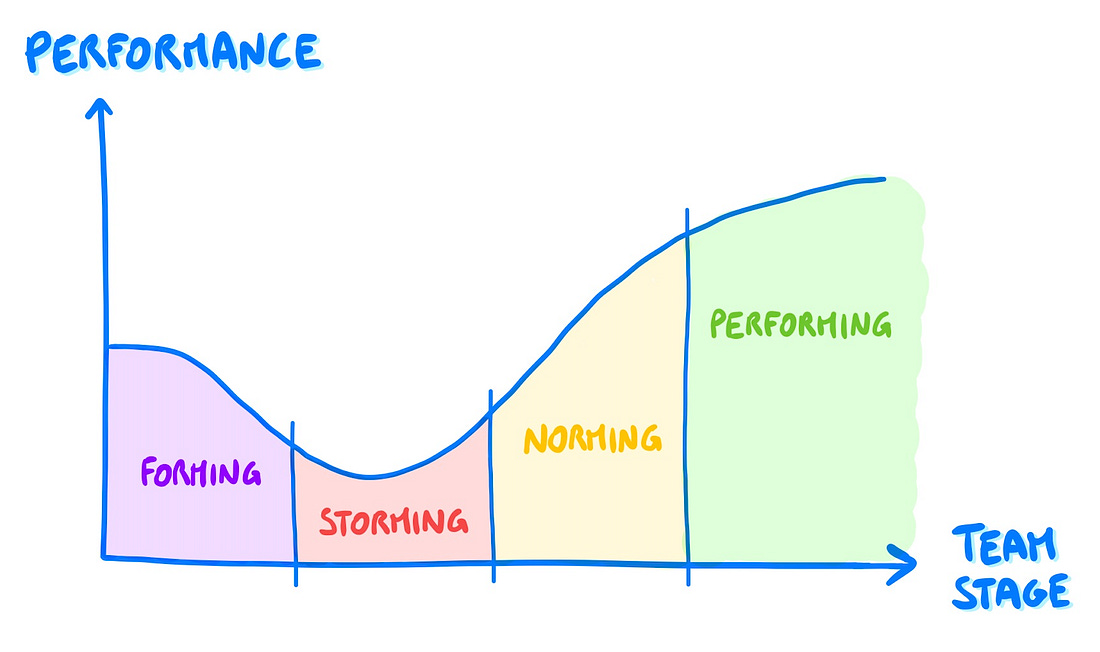
This is one of the many things I discussed with the Atono team during summer, when we eventually published a full article on how their product engineering team works 👇  3) 📊 The four stages of a teamWhenever I write an article about some topic, I usually restrain myself from giving advice that is too direct. I almost never feel comfortable saying “just do this” because each team is different, and along many axes: size, industry, product stage, and… team stage. The team stage in particular is something that gets often discounted, while in my experience has an enormous impact on how you can expect people to work. Bruce Tuckman, American psychologist and researcher, created a famous model for group development, describing the four main stages that teams typically go through as they work together:
So, when it comes to processes and ceremonies, the earlier the team is on the Tuckman’s scale, the more it benefits from a prescriptive approach: you want to invest more in coordination, get feedback more frequently, and make shorter-term plans. This simply calls for more rituals and shorter cycles.
Conversely, consolidated teams, made of people who have been working together for a long time, can remove more guardrails, make longer plans, and do more deep work. Standups are a perfect example of a ritual that largely depends on team maturity. Early teams might opt for daily, sync standups in a meeting/call. Later they may switch to async written ones, and finally remove them altogether. The last time we covered this was last year when we reviewed Scrum, wondering if it was still relevant for modern days. I went through the article recently and I enjoyed the ideas in there 👇 4) 🎙️ Balancing tech and people dutiesLast year I interviewed Pat Kua, an engineering coach, speaker, and one of my favorite writers in tech. One of the ideas that stuck the most with me, out of that chat, is how the balance between our tech and management duties, often doesn’t depend only on our role, but also on our biases.
People who are early into their management career, or who have tricky hybrid roles, like tech leads, when under pressure will often fall back to what they know best: coding. Pat offers advice for those in hybrid roles:
He also stresses the importance of foundation skills (often called “soft skills”):
He argues that these skills are valuable not just in professional settings but also in personal life. Here is the full interview:  You can also find it on 🎧 Spotify and 📬 Substack And that’s it for today! If you are finding this newsletter valuable, consider doing any of these: 1) 🔒 Subscribe to the full version — if you aren’t already, consider becoming a paid subscriber. 1700+ engineers and managers have joined already! Learn more about the benefits of the paid plan here. 2) 📣 Advertise with us — we are always looking for great products that we can recommend to our readers. If you are interested in reaching an audience of tech executives, decision-makers, and engineers, you may want to advertise with us 👇 If you have any comments or feedback, just respond to this email! I wish you a great week! ☀️ Luca
|
Fixing bugs, team stages, and balancing acts 💡
Monday, 27 October 2025




Subscribe to:
Post Comments (Atom)


No comments:
Post a Comment