
This is Brad DeLong's Grasping Reality—my attempt to make myself, and all of you out there in SubStackLand, smarter by writing where I have Value Above Replacement and shutting up where I do not… Watching People Jacking-in to an ASI Across a Half-Millennium& implications for AI-alignment, AI-safety, feral library card catalogs, the Volga as "Germany's Mississippi", Machiavelli's scrittoio, Tessier-Ashpool's virtual domains, artificial, alien, &...
& implications for AI-alignment, AI-safety, feral library card catalogs, the Volga as "Germany's Mississippi", Machiavelli's scrittoio, Tessier-Ashpool's virtual domains, artificial, alien, & anthology superintelligences, evaluating Yudkowsky and Soares’s “If Anyone Builds It, Everyone Dies”, & other Glass-Bead Game-related topics in addition…
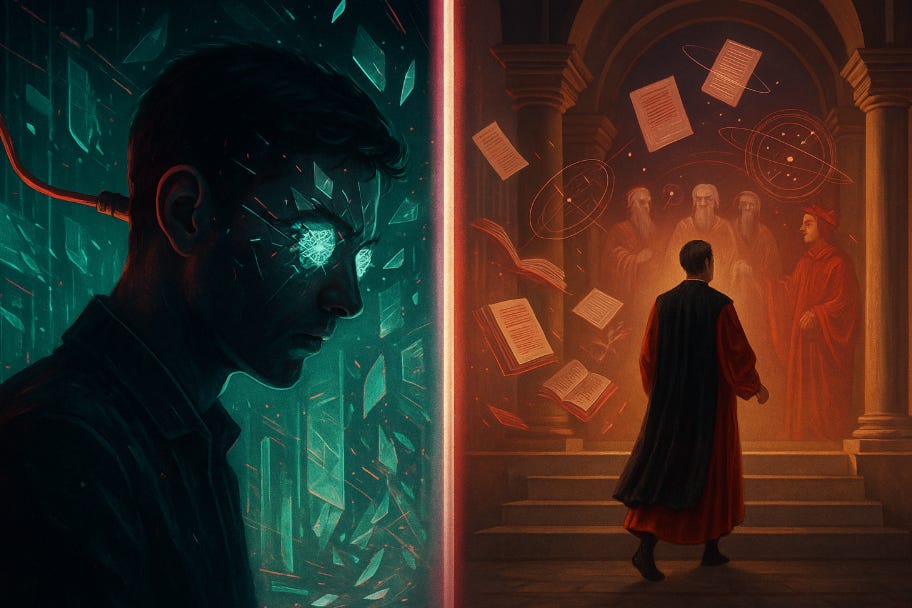
Jacking-in to an ASI: the modern, phantasmagorical:
Jacking-in to an ASI, nearly a half-millennium ago, in 1513:
To be clear: NeuroMancer is a fantasy. Nobody—nobody—nobody—has ever had anything like the subjective experiences that William Gibson presents his protagonist Case and his cyberpartner/tool the Dixie Flatline having as they access databases and write code to try to understand how to get around the Turing Locks that prevent the WinterMute AI system from merging with the NeuroMancer AI system. And—probably—nobody ever will. To be clear: Niccolò Machiavelli does not truly believe what he writes to Francesco Vettori. He does not truly believe that when he enters his personal library for his four hours of daily reading and writing in his evenings, he walks up marble stairs into a pillared hall or atrium that makes up one of the ancient courts of ancient men. He does not believe that he there finds himself greeted lovingly by the ancient sages. He does not believe that what he says he sees in his mind’s eye are then true fully Turing-Class entities who are “in their humanity” eager to answer all of the questions he asks of his library containing the works of, as Dante put it two centuries:
And, of course:
However, Machiavelli—under rustication house arrest outside of Florence, Italy, having been released after having been (probably) questioned under torture by the new Medici régime—is in deadly earnest on the next bunch. For he then goes on to write:
That is, in what he does in his library, Machiavell’s mind has been transported away from his serious troubles. He has gained wisdom. And so he has written The Prince. Niccolò Machiavelli now hopes that Francesco Vettori will be able to get his little work into the hands of the princes of the Medici clan, or at least of their senior advisors. There, he hopes, it will serve as a job application for them to employ him for the good of the Florentine state, even transformed as the Florentine state is from the republic led by his friend Gonfalonier Piero Soderini into a Medici-ruled principality. Machiavelli’s “Letter to Vettori” and Gibson’s NeuroMancer have resonated, for 500 and 40 words respectively, because their fantastic metaphors resonated anf continue to resonate with readers and ‘net surfers in powerful ways. Both descriptions are very real attempts at metaphorical descriptions of mental transformations that leave the subject truly in a different reality. NeuroMancer would not have the audience and Gibson would not have the regard it and he do if NeuroMancer’s metaphorical descriptions did not get at a psychological reality: "jacking-in". In the literature of CyberPunk, "jacking-in" is a key narrative and rhetorical move. In the novel via brain-to-circuit connection, in the real world to which the metaphor gives reference a connection mediated by eyes and hands, of the moment when a human plugs their nervous system into a networked machine system and steps across the membrane between “meatspace” and cyberspace. It is a metaphysical wager about selfhood: where the mind ends, what counts as reality, and how power flows when the informational substrate becomes the primary terrain of engagement, framed as something that technology could literalize—actual interface protocols of system-boots, hardware decks, 'trodes, interface ports,and plug-jacks, and when the connection is made the indicator lights turn on, as we become what we connect to as software and hardware transform wetware. The most iconic image soon became hackers who rock a hard jack at the skull’s base—plugging a cable straight into cortex and spinal cord. Cyberpunk uses the rhetorical and narrative trope of jacking-in at least four ways: (1) transformation from material grimy poverty to intellectual-informational power, (2) inversion as information becomes the protagonist's environment while their physical environment becomes mere background information, (3) dissociation as the body becomes inert meat while the mind goes elsewhere, and (4) prying open the mind/body problem to deal with questions of enhancement and augmentation, displacement and substitution of experience and attention, and transfer and translation. Machiavelli's version nearly a half-millennium earlier lacks the phone-line static-hiss and musical modem-tones, let alone the reprogramming of what the visual cortex thinks is coming up the optic nerve as its inputs are reshunted. Machiavelli merely—merely!—dissociates himself from sitting in his chair turning pages and looking at black squiggles. “I am sitting in a chair turning pages and looking at black squiggles” does not describe the experience. The alternative—dressed in regal and courtly garments, walking into the ancient courts of ancient men to be lovingly received and fed food that for four hours a night takes away all physical (and psychological) pain, poverty, boredom, and fear of death—somehow does. What is going on here? In both of these “heres”? I suggest that these are both best read—“read”!—as attempts by jumped-up monkeys, East African Plains Apes unable to reliably remember where they left their keys, to put into words— “put into words”! — meaningful metaphorical portrayals of the internal mental realities that resulted from what can only be properly classified as an ASI:
And now I, finally, arrive at the point of this piece. The books in Machiavelli’s scrittoio. the ‘net as Gibson imagined the low-life hackers of Chiba City would access it ca. 2050 or so. And, for us today 25 years earlier and in a very different timeline, dealing with the coming of the latest generation of Modern Advanced Machine Learning Models. All ways of jacking-in, of accessing, of becoming effective and useful front-ends to and contributing nodes in the ASI that is the Anthology Super-Intelligence Collective Human Mind. The point of this piece is to review Yudkowsky and Soares (2025), If Anyone Builds It, Everyone Dies. Yudkowsky and Soares’s fear is this: from Vernor Vinge’s wonderful novel A Fire Upon the Deep:
That the great-grandchildren of ChatGPT will turn us into meat-puppets, at best, and do so within a generation, at most. As The Power That Helps did to Øvn Nilsndot and all the other inhabitants of the star-commonwealth of Straumli Realm in A Fire Upon the Deep`. Similarly, the great-grandchildren of ChatGPT will be Artificial Super-Intelligences with strange, alien purposes. And since “making a future full of flourishing people is not the best, most efficient way to fulfill strange alien purposes… it wouldn’t happen to do that.” And, whatever it—they—decide to do, it will be useless for us to try to resist it—them. If Anyone Builds It, Everyone Dies. But take a look back at human history, and one’s first reaction has to be that this from Yudkowsky and Soares is lunacy, written by lunatic loons. Modern Advanced Machine-Learning Models—MAMLMs—are technology: ideas for usefully, productively, and coöperatively manipulating nature and organizing humans. They are cultural-socio-econo-engineering modes of collective human behavior, in a long line of things that have been such since the making of the first hand-axe, the first taming of fire, and the first declaration “Carg wants banana”. Normal technology. Except that technology is not normal, is never normal, for it transforms what humans are and the environment through which we stumble, individually too dumb to reliably remember where our keys are and yet collectively capable of:
MAMLMs do indeed confront us as strange alien powers that, as we anthropomorphize them, appear to possess strange alien purposes. Life after their arrival will be transformatively different than life before. But this has been the case, well, effectively forever. The lives of the humans 50,000 years ago who started the last out-of-Africa migration were fundamentally different from those of the homines erecti at the Bridge of the Daughters of Jacob 750,000 years ago; the lives of the serfs, priests, merchants, and warriors shepherded by Gilgamesh 5000 years ago were qualitatively different from those of the out-of-Africa migrants. I would argue that there was a roughly equivalent qualitative shift in human life between 5000 and 500 years ago. And then, successively, Early Steam, Applied-Science, Mass-Production, and now Attention Info-Bio Tech (you could periodize it differently) societies each have many aspects of a Singularity compared to wehat came before. But MAMLMs are cultural-socio-econo-engineering technologies. It makes as little sense to view them as harbingers of Gods that we will worship. (Or, in Elon Musk’s case, flirt with:
.) We need not tremble in fear of them, as Lord Gro and King Gorice trembled and feared what they had called to the Great Keep of Carcë, a spirit-entity which in earlier days had similarly confronted a human, and had “tare him and plastered those chamber-walls with his blood”:
As much sense, as Cosma Shalizi says, as to fear feral library card catalogs. We confront these things as we confront nuclear power, or bureaucracies, or polities, or market economies, or corporations, or other of our technologies for productively manipulating nature and organizing humans. But now, in this essay, comes the final turn of the worm. In the years around World War I, practically every card catalog in every library in Germany contained cards cataloging the Cowboys-and-Indians novels of Karl May, which Adolf Hitler loved. Before Hitler, imperialist Germans and viewed the slavic-inhabited east as, potentially, Germany’s India, to be conquered and ruled. Hitler viewed it, instead, as Germany’s trans-Appalachian west, with the Volga as Germany’s Mississippi, with whatever of the population survived pushed onto reservations while the land was divided up into farms for ethnic German farmers. No, Hitler was not meat-puppeted by a feral card catalog. But May’s novels and Hitler’s genocides were not unconnected. Was the ferality 100% outside of the card catalog? As with all distributed cognition systems, I think it would be a mistake to say so. Yudkowsky and others rave about fictional fantastical AI’s that decide to turn everything into paperclips because they are paperclip maximizers. But Purdue Pharmaceuticals is not fictional or fantastical. And Purdue did “decide” to addict as many Americans as it could to opiates in order to make as much money as possible from selling oxycontin. So, yes, fear feral library card catalogs. And feral corporations. Feral market systems. Feral bureaucracies. Feral polities. We do have reason to fear, greatly. But the fears we should have? They belong, rather, to the AI-Safety rather than the lunacy of the AI-Alignment existential-risk discourse of Yudkowsky and Soares. That is best viewed as a cognitive DDoS attack on humanity’s collective mind considered as a sane and functional ASI. This has been a rather long journey, so let me recapitulate: Pair Gibson’s NeuroMancer with Machiavelli’s “Letter to Vettori”, both are examples of, in a very real sense, “jacking-in”. Such metaphors are indispensable i helping us to narrate human mind‑altering encounters with collective intelligence. In Gibson, Case’s consciousness dissolves into Kuang’s velocity as it skims over and evades shimmering ICE—Intrusion Countermeasures Electronics. Riding the ICE-breaking Kuang, Case and the Dixie Flatline present the spectacle of a synaesthetic sensory system overloaded by computation. In Machiavelli, an evening costume change becomes a rite of entry into “ancient courts,” a cognitive transport where sages reply and pain and fear recede. Both render the moment when a small, local mind binds to a large, distributed system—the anthology of recorded thought or the matrix of networked code—and experiences the alien shock of superhuman scope. From this, meditate an ASI: I (Intelligence) is uncontested; S (Super) denotes comparative scope and speed relative to any individual; A is better read as Anthology (and only secondarily Artificial/Alien). The true ASI we have to deal with is not an Other but rather an upscaled version of all of us together—constructed from writing, catalogs, software, markets, and institutions. Anthropomorphizing “the machine” is thus a pragmatic metaphor for interacting with complex sociotechnical systems—provided we remember its parts are human and human-made. From here we can see exactly where AI existential-risk alignment discourse dissolves into lunacy. The paperclip‑maximizer and Vingean Blight imagine unitary agents whose strange purposes dominate, but our lived hazards are feral sociotechnical systems—corporations, bureaucracies, platforms—that already optimize ruthlessly for alien objectives. Purdue Pharmaceuticals is the paradigmatic example: a legal entity “deciding” to addict for profit. Fear that, the essay argues, not a hypothetical god‑machine. Contra Cosma Shalizi, we do need to fear feral card catalogs. They directed Adolf Hitler to Karl May’s American-frontier romances. They did not “control” Hitler. They helped supply frames—Volga as Mississippi, Slavic East as trans‑Appalachian West—that made genocide thinkable as settlement policy. Without the feral card catalog, would not Hitler have remained a standard German imperialist of his day—Russia to Germany as India to Britain, not as teh United States to its trans-Appalachian West. No, Adolf Hitler was not meat-puppeted by an Artificial Super-Intelligence. But he was, in a sense, putty in the hands of malign elements of the Anthology Super-Intelligence of the collective human mind that set agendas and normalized action. The risk is not supernatural AI painting the walls of the highest tower of Carcë’s Great Keep with the blood of us as unskillful sorcerers. The risk is different. Hence: worry abouty AI-safety, and regard AI-alignment existential-risk discourse as a bizarre attempt at a DDoS attack. Governance to curb misuse, auditing for incentives, secure deployment, robust evaluation, and political economy reforms that restrain feral optimization. We need to treat ourselves as front‑end nodes to the Anthology Super‑Intelligence of the collective human mind. We need to become responsible stewards rather than frightened cultists. We have, after all, been jacking‑in for centuries. Our task is not to fear the membrane through which he contact the Shoggoth, but to properly manage what flows across when we do jack-in. References:
If reading this gets you Value Above Replacement, then become a free subscriber to this newsletter. And forward it! And if your VAR from this newsletter is in the three digits or more each year, please become a paid subscriber! I am trying to make you readers—and myself—smarter. Please tell me if I succeed, or how I fail…#watching-people-jacking-in-to-an-asi-across-a-half-millenniumPlease forward the email & otherwise share it to everyone you think would appreciate it…
|
Watching People Jacking-in to an ASI Across a Half-Millennium
Tuesday, 23 September 2025






Subscribe to:
Post Comments (Atom)


No comments:
Post a Comment