
These days we often say engineers can own more work. Not more of the same, but rather product work — work that unblocks them and allows them to ship features. As part of this trend, we often hear that engineers should sit in customer calls — but what happens in those calls, exactly?! To cover this, I reached out to my friend Enzo Avigo, who is the founder and CEO of June, just recently acquired by Amplitude! June found product-market fit in an extremely competitive space: analytics. Incumbents are listed on the NASDAQ, have raised hundreds of millions, and have thousands of employees, while June is just a small team that raised an equally small seed round. Yet June found early product market fit in a way that almost feels magical, and Enzo attributes that to one skill: talking well with customers. So I brought him in to write this piece together 👇 More than 60 years ago, Peter Drucker penned a maxim in Managing for Results that I think about often: “The customer rarely buys what the business thinks it sells him.”
As soon as someone offered better mobile communication and more convenient entertainment, customers switched away en masse. Deciphering what customers truly want is as much of a struggle for startups as for mega-corps. That’s because, as Drucker said, “There is only one person who really knows: the customer.”
So here is what we will cover today:
Let’s dive in!
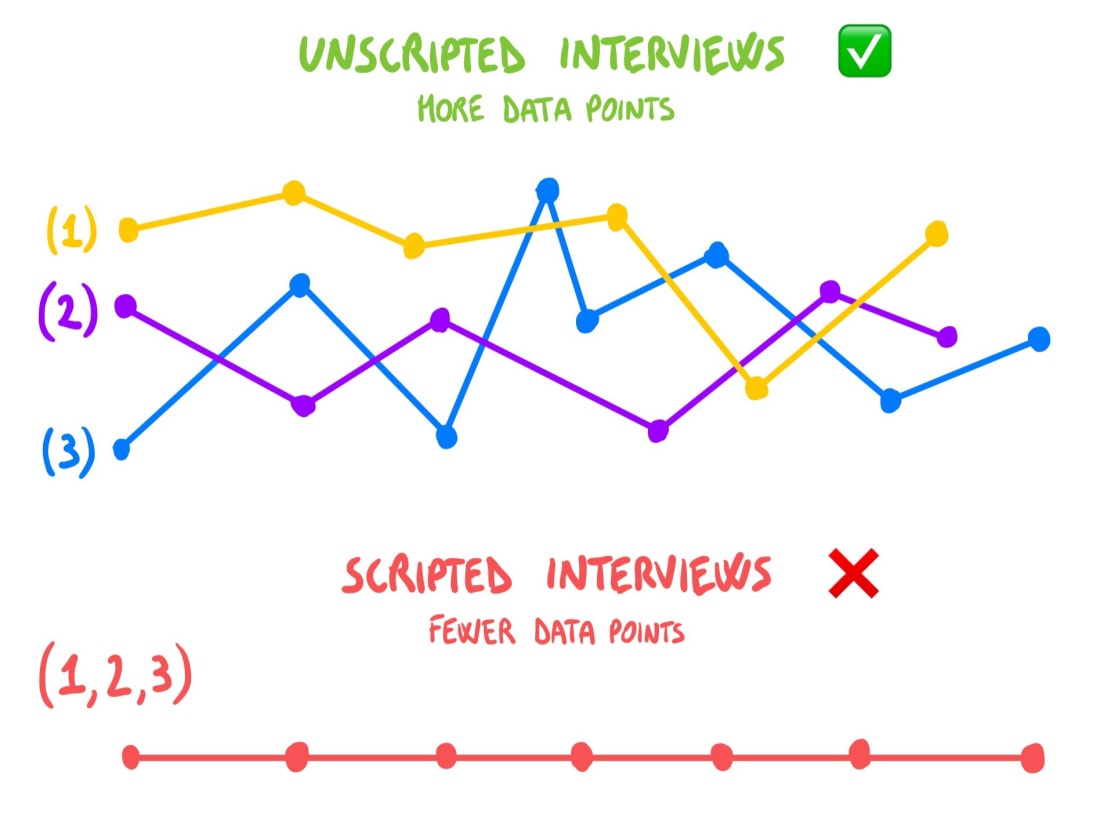
🌐 Why customer interviews matterCustomer interviews aren’t scalable. They require effortful listening, questioning, probing, and time. Quite a lot of time. This was an easier investment to justify, pre-LLMs, when interviews, surveys, and focus groups were the only way to get qualitative data. Today, companies strip-mine interaction data 24/7 and assume that’s enough to skip more opaque, laborious customer interviews. A founder might see one user sign up from a blog about one topic and another user sign up from a PPC ad on a different topic and think “Aha! This tells me where each came from and what they’re looking for, therefore I know who they are.” These are colossal leaps in logic. Every user contains a multitude and every market is littered with unknown unknowns. In 2002, Stewart Butterfield and Caterina Fake launched a game that was a financial failure. Customers weren’t spending money on it. They were, however, buying—or at least using—the game’s photo-sharing feature, built as a side project, which included the ability to embed the images on a web page. “It was a convergence of all of this personal publishing stuff, as well as social networking and the rise of camera phones,” Fake told Jessica Livingston in Founders at Work. While they were busy building something to serve one purpose, their users found a wholly different use for it. The game was shuttered within three years of beginning work, but Flickr–their image-sharing “side project”–was so successful that Yahoo! acquired it for $25 million. Focusing on what customers were actually using let Butterfield and Fake turn failure into success. One of the easiest ways to maximize your exposure to customers, to see their wants and needs, hopes and dreams up close, is to involve more people in the process. Usually, that’s some combination of the founder and customer-facing roles like sales, support, and PMs. I recommend taking it a step further and adding product engineers into the mix as devs who talk directly to users about what’s working and what’s not — but only if they have the necessary skills to get the most out of those conversations. But what skills? Talking to customers is a skill with a high ceiling. The best interviewers juggle improvisation, negotiation, reading between the lines, interpreting body language, expressing empathy, and a dozen other soft skills minute by minute. It’s taken me years of deliberate practice and reflection to get to a point where I feel confident enough to share what has been the most useful during my interviews with users. So here is my playbook: 1) 📜 Never use slides or scriptsThe whole point of talking directly to customers is to shed light on things you don’t know. Think of it like searching for treasure without a map. The more you let the customer steer the conversation, adapting and course-correcting on the fly, the more valuable your interviews will be.
I appreciate planning ahead and being prepared. But these conversations never go as expected. And even if they did, a list of pre-determined questions would box the customer into your expectations and views of the product and the problems it solves. Asking users to comment on things you’re already meditating on won’t reveal any new or interesting insights. 2) 🧘 Cultivate a calm and comforting toneThe second factor you should work on is your attitude. We have evolved to recognize and respond to body language. Customers won’t relax and open up to someone who’s visibly tense and audibly stilted, so you’ll have to find ways to shed those habits. I suggest starting with small, tangible changes. Some of my favorites are:
These positive signals can do as much to relax the interviewer as they do for the interviewee. Studies have found that consciously adopting a facial expression leads to an immediate increase in the associated feeling. Of all the factors I’ve mentioned, body language is the one with the biggest impact on the beginning, middle, and end of the interview. It’s also the one that feels the most awkward to practice. Stick with it and it’ll become second nature. 3) ❤️ Practice empathy and acknowledgmentOnce you are in the right mindset, you should focus on helping customers share as much information as possible. As a first step, I get them talking with open-ended questions:
Anything vague enough to let them direct us toward whatever they’re interested in, worried about, or obsessing over. At this stage, it’s critical to listen carefully and avoid interjecting until they’ve finished their entire train of thought. Interviewers frequently want to jump on the first surprising or interesting thing they hear, worried they’ll lose that thread if they don’t grab onto it. But more often than not, the most useful insights come later. Restraint during the first few minutes of a chat pays dividends. Mirroring 🪞When I want the person on the other end to elaborate and keep talking, I summarize or repeat the last few words they said:
Beyond reminding the customer that they’re still steering the conversation, this isopraxism or “mirroring” tells the customer that we understand each other. And that’s an essential first step toward building trust and rapport that you’ll need to lean on later. Labeling 🏷️Another invaluable interview practice I’ve picked up is labeling. After I’ve gathered enough information and feel reasonably confident I know what a customer is feeling (relative to our conversation topic), I share it with them. Something like:
This can work for a variety of reasons. Maybe they didn’t have the right words. Maybe they’re worried their feelings will sound irrational. Maybe I’m describing emotions they didn’t even realize they were experiencing! Regardless, when you accurately label and acknowledge how a customer feels and perceives their situation, they stop seeing you as a stranger asking about software. You become a confidant, a friend. I recommend getting comfortable with these techniques before worrying about practicing precision questioning. Active listening, mirroring, and labeling are more difficult to internalize than most people realize. It can help to read books like How to Talk So Kids Will Listen & Listen So Kids Will Talk (very relevant to adult communication, trust me) and Never Split the Difference while working on your form. 4) 🔍 Ask laser-focused questionsMy time and my team’s time are worth a lot. If we can’t squeeze concrete, actionable particulars out of an interview, it’s like flushing money down the drain. Authentic empathy and acknowledgment should earn you the privilege of probing the tiniest details of your interviewee’s experience with your app. But being allowed to dig deep and being capable of doing so are two different things. At some point during every customer interview, I make a conscious effort to switch from a listener to an investigator. Seasoned investigators aren’t interested in off-the-cuff opinions and observations. They want facts and evidence, vivid and exhaustive stories. Customers rarely volunteer these things at the level of detail I need without prodding. I had to learn how to both recognize when an answer is too hazy and how to come up with conversational catalysts in the moment. “I signed up for June because your homepage had a dashboard that looked helpful” isn’t useful information. It’s a zoomed-out, fuzzy picture. I want to know what metrics on the dashboard caught their eye:
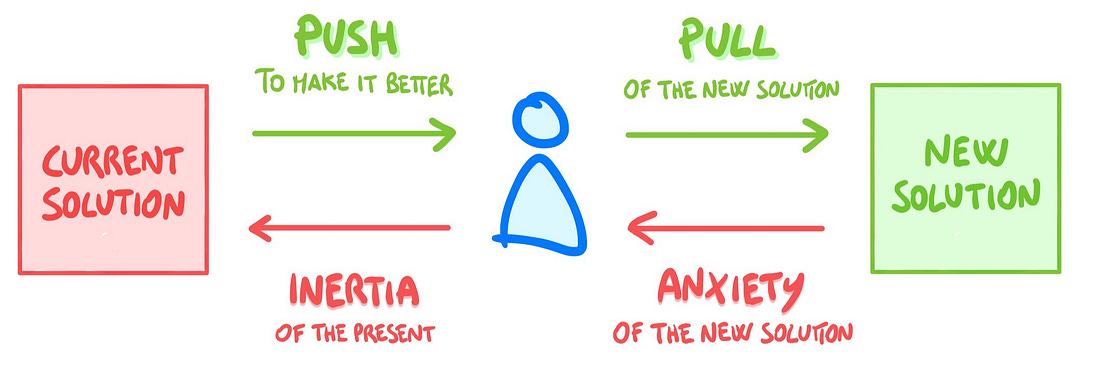
I want to push the investigation to its limits. 5) 🌊 Use the four forcesFinally, if I find it difficult to conjure questions like these on the fly, I resort to Bob Moesta's Jobs to Be Done framework.
JTBD which explores the four forces that influence a customer who is considering a new product:
If you come away from a customer interview without any new ideas or inspiration, your questions likely weren’t precise enough. Go back and watch or listen to the call recording, writing down new versions of them that would have yielded better responses. And, while you’re at it, pay attention to non-verbal cues. 📌 Bottom lineBe deliberate about how you talk to customersDespite more than 60 years of literature — from Peter Drucker’s Managing for Results to Paul Graham’s How to Start a Startup — gathering qualitative feedback from leads and customers hasn’t gotten any easier. It’s an inherently human activity that can’t be replaced by a form or chatbot. Awkward, sure, especially for devs-turned-founders and product engineers. But totally manageable with practice. To generate user insights that lead to big-picture breakthroughs and long-lasting refinements you need to be completely present and listening. No scripts, templated questions, or slides. Because with one eye on the customer and the other on your notes, you’ll never be able to build up the empathy and understanding necessary to engender feelings of trust and rapport. You won’t be able to adopt the body language necessary to put them at ease. If you listen carefully, however, repeating what interviewees say and imply, labeling their struggles and desires in your own words, they’ll happily answer increasingly specific questions about the pushes, pulls, anxieties, and habits they’re experiencing related to your product. These are incredibly hard skills to master. But without them, you could end up selling something that customers aren’t interested in, totally unaware of that misalignment. You can start today. You can schedule 10-12 customer interviews over the next month, learning about exactly what users want and don’t want, what your product makes them feel or not feel. You might just stumble across some hidden treasure without even needing a map. And that’s it for today! See you next week 👋 Luca
|
How to Talk with Customers 📞
Friday, 19 September 2025





Subscribe to:
Post Comments (Atom)


No comments:
Post a Comment