
This is Brad DeLong's Grasping Reality—my attempt to make myself, and all of you out there in SubStackLand, smarter by writing where I have Value Above Replacement and shutting up where I do not… Is Conan the Barbarian Actually Good?A Cimmerian strides through my brain between my retina and my frontal lobe, boasting “live, I love, I slay, and am content!” This is not good literature. &, yet, somehow… it is. Why Conan the...
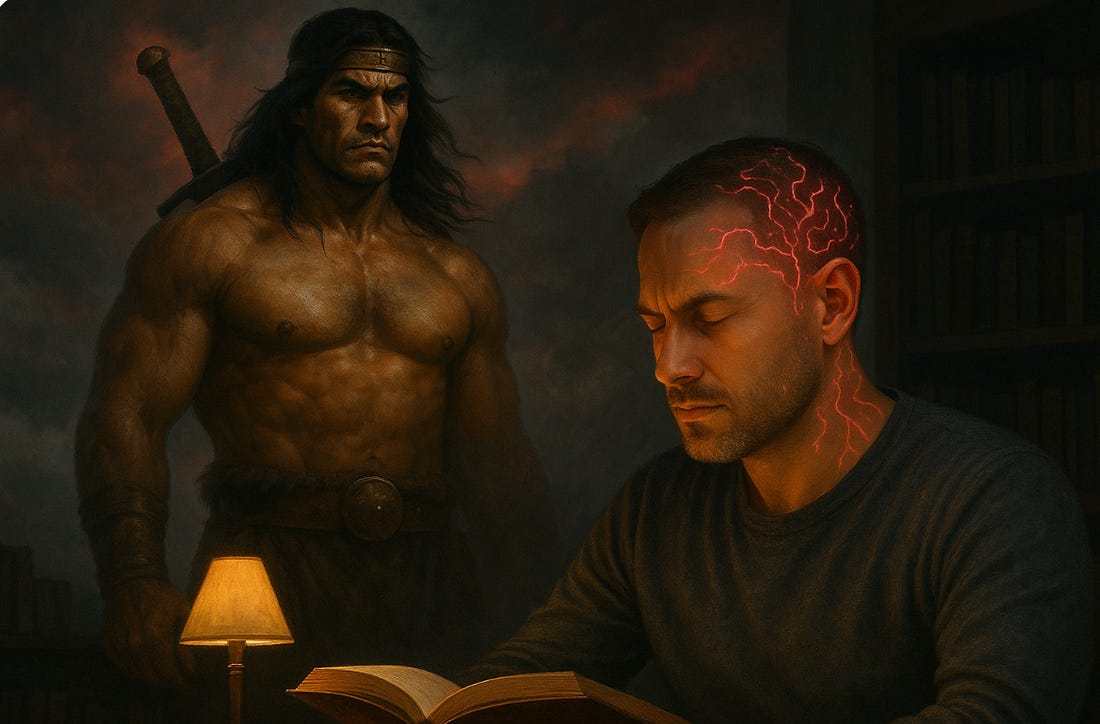
A Cimmerian strides through my brain between my retina and my frontal lobe, boasting “live, I love, I slay, and am content!” This is not good literature. &, yet, somehow… it is. Why Conan the Barbarian haunts us readers: what makes a pulp hero immortal is not the author’s prose—it’s the readers, who spin the gold of the Shadow Canon from straw…
Here we have, by Crom!:
And a little nuance:
I want to say yes. And I want to say no. The Conan stories are, really, not good. The plots are pedestrian. By Crom’s Bood, the prose is limping and halt! And the action scenes have little of spectacle about them, and are not spectacular. No, if there is anything that is good about Conan, it is not the black squiggles on the page. If there is anything that is good about Conan, it is, rather, what is between the ears of the reader. The real magic of the Conan stories is to be found in the imaginative work performed by those who pick up the tales: the reader, not the author, is much more the true architect of the experience. Conan, then, is not so much a literary achievement, as a shared cultural hallucination, a collaborative act of myth-making that draws on the reader’s own stock of images, desires, and half-remembered legends. Moreoever, to love Conan, the reader first has to turn their brain into the brain of a Conan-lover. This is not a trivial transformation. It requires a willingness to suspend disbelief, to accept—if only provisionally—the logic of a world in which brute force and animal cunning are the highest virtues, and where the “barbarian” is always more vital, more authentic, more alive than the decadent civilization he periodically demolishes. For some, this act of imaginative empathy is as easy as breathing;. For others, it is an insurmountable barrier. For all, it is, in a sense, an exercise in voluntary regression, a return to the adolescent or pre-adolescent pleasures of unreflective power fantasy. It is definitely not adulting. I understand that many people—most people—perhaps all thoroughly sane and well-grounded people—may really not want to do, or be able to do, this. At all. Not everyone is equipped—psychologically, temperamentally, or ideologically—to embrace the worldview implicit in Conan. The gender politics, the racial essentialism, the celebration of violence as the ultimate arbiter of worth—all these are, to put it mildly, out of step with contemporary sensibilities. There is a reason, after all, that the Conan stories have never made the leap into the “Penguin Classics” or the “Library of America.” They remain, as Naomi Kanakia puts it, part of the “shadow canon”—beloved, but definitely not respectable, or capable of being an un-guilty pleasure. But lots of people do turn themselves into enthusiastic Conan lovers. I know, because I do. There is, I think, a kind of guilty pleasure in surrendering to the mythos, in letting one’s critical faculties take a backseat for a few hours while the id runs wild across the Hyborian Age. The enduring popularity of Conan—across novels, comics, films, and video games—testifies to the resilience of this particular fantasy. It is, perhaps, a testament to the power of archetype: Conan is the ur-barbarian, the template from which so many subsequent heroes have been stamped. If one can make the leap, the rewards are not inconsiderable: a sense of primal energy, of unmediated action, of a world stripped down to its most basic elements. The questions are: How? And why? Out of all the possible naked power fantasies, why focus on this one? The answer, I suspect, lies in the peculiar alchemy of pulp fiction and modernity. Conan is not just a fantasy of strength; he is a fantasy of agency in a world that so often denies it. In the early twentieth century, when Howard was writing, the world was becoming ever more complex, bureaucratic, and impersonal. Conan’s world, by contrast, is one in which the individual matters—where a single man, by virtue of his will and his sword-arm, can reshape the world. In this sense, Conan is not merely escapism: he is a protest against the iron cage of modernity, a wish-fulfillment fantasy for every reader who has ever felt powerless. That, I think, is why Conan endures—why, despite the manifest shortcomings of the prose, the character continues to leap from mind to mind, gathering energy as he goes. Apropos of this, we have, by Crom’s Black Beard!:
And by Crom’s Burning Forge!:
That line of thought leads to:
And then Lois McMaster Bujold takes a further step into mystery, by Crom’s Unblinking Eye!:
I think that there is a huge amount of work to be done here: First, J.R.R. Tolkien’s has a theory of sub-creation, originally articulated in his essay “On Fairy-Stories.” He claims that the fantasy writer is a “sub-creator,” fashioning secondary worlds as an act of imaginative participation in the divine act of creation. What he does not say is that the act of sub-creation does not end with the author. Fan communities and individual readers have increasingly taken up the role of sub-creators themselves—the creation of meaning is not a one-way process but a dynamic, communal act, where the mythopoeic impulse Tolkien described is distributed across a network of engaged, imaginative readers. Second, there is reader-response criticism: Reader-response criticism tried to fundamentally reorient the study of literature by placing the reader’s experience at the center of meaning-making. Rather than viewing a text as a fixed artifact whose significance is determined solely by the author’s intent or the words on the page, reader-response theory asserted that literary works are completed through the active engagement of readers. As each person brought their own emotions, memories, cultural background, and expectations to the act of reading, interpretation becomes a dynamic and individualized process. The text thus served as a blueprint or set of cues, but it was the reader who constructs the narrative’s emotional resonance, thematic relevance, and even its basic coherence. Literature thus became a collaborative performance, shaped as much by the reader’s imaginative investment and psychological response as by the original composition. And then that line of thought more or less petered out. Third, someone should write up some Investigative case studies of fanfiction as world-building, showing how readers not only interpret but expand, transform, and sometimes challenge the original narrative universe. Nor is this phenomenon limited to modern fandoms. The Arthurian legends themselves are, in a sense, medieval fanfic: Chrétien de Troyes, Thomas Malory, T.H. White—all took the bare bones of the Matter of Britain and layered on new quests, new characters, new anxieties. In every case, the world-building of fanfiction is not mere homage; it is an assertion of agency, a declaration that the reader’s imagination is not a passive receptacle but an active engine of creation. And, of course, Aeneid. Fourth, and of course, people should examine the psychological mechanisms behind reader engagement and imaginative participation—how readers “inhabit” fictional worlds and why some texts inspire more active sub-creation than others. Here, the cognitive sciences and literary theory converge on a fascinating point: narrative transportation. When a story is sufficiently immersive, readers experience what psychologists call “deep narrative engagement”—a state in which the boundary between self and fiction blurs, and the reader’s own memories, emotions, and desires are recruited to flesh out the world on the page. This is why Tolkien’s Middle-earth or Le Guin’s Earthsea can feel more vivid than the actual world outside your window. But not all texts are equally generative. Works that leave narrative gaps—deliberate ambiguities, unexplored corners, characters with undefined motivations—invite readers to fill in the blanks, to “play” in the interstices. Last and fifth, reflect on the limits and risks of sub-creation—when does reader-driven world-building enrich a text, and when might it distort, dilute, or even undermine the original work’s themes or intentions? Here, we must acknowledge that the democratization of authorship, so exhilarating in its creative potential, is not without its hazards. There is a risk that the centrifugal force of a thousand headcanons and “fix-it” fictions can unmoor a text from any coherent meaning, turning a work of art into a Rorschach blot for the anxieties and fixations of its audience. Consider the fate of Arthur Conan Doyle’s Sherlock Holmes: the detective has been so thoroughly reinterpreted—hero, antihero, romantic interest, queer icon, even supernatural sleuth—that the original Victorian rationalist vanishes beneath the sediment. It can also, if unchecked, dissolve the very identity of the work it seeks to honor. References:
If reading this gets you Value Above Replacement, then become a free subscriber to this newsletter. And forward it! And if your VAR from this newsletter is in the three digits or more each year, please become a paid subscriber! I am trying to make you readers—and myself—smarter. Please tell me if I succeed, or how I fail…#is-conan-the-barbarian-actually-good
Please forward the email & otherwise share it to everyone you think would appreciate it…
| |||||||||||||||||||||||||||||||||||||||||||||||||||||||||||||||||||||||
Is Conan the Barbarian Actually Good?
Monday, 25 August 2025





Subscribe to:
Post Comments (Atom)


No comments:
Post a Comment