
This is Brad DeLong's Grasping Reality—my attempt to make myself, and all of you out there in SubStackLand, smarter by writing where I have Value Above Replacement and shutting up where I do not… I See the SubStack Culture Wars Have Started Up AgainEnriching and empowering through discoverability, or locking-in to roles as drones in a malevolent attention-hacking and harvesting grift? The unfinished battle for online publishing’s soul…
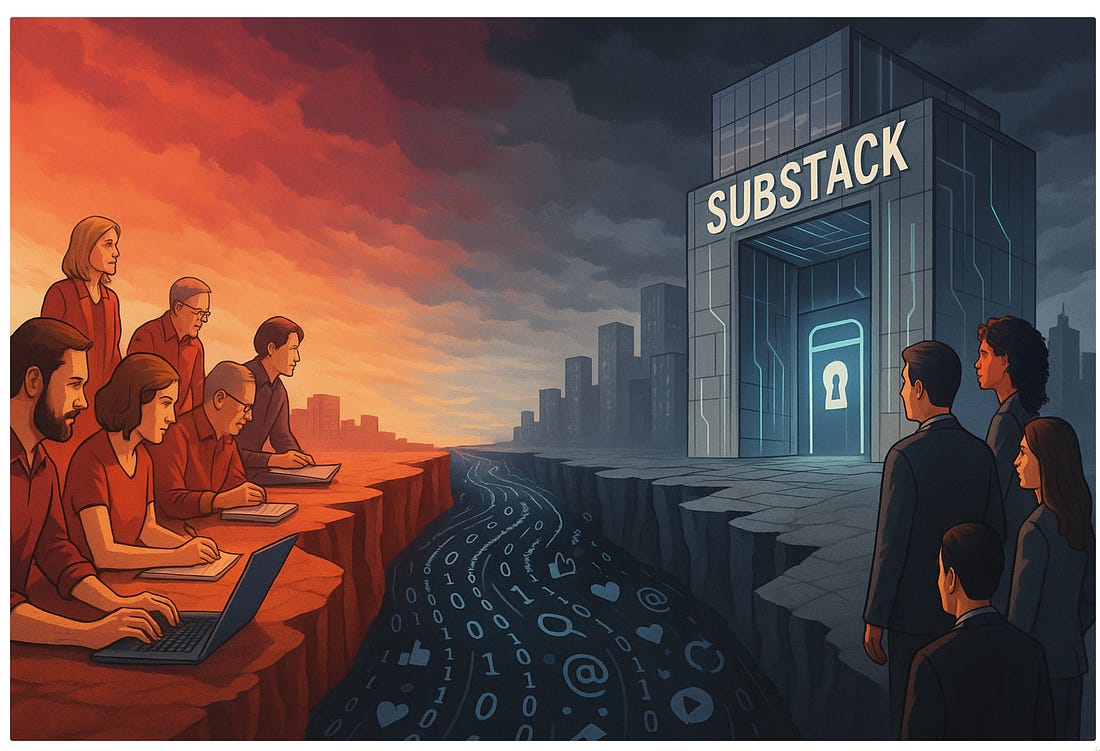
Enriching and empowering through discoverability, or locking-in to roles as drones in a malevolent attention-hacking and harvesting grift? The unfinished battle for online publishing’s soul. To what extent is SubStack’s discoverability layer a mirage? & the three-body problem of writers, readers, & venture capitalists…
A lot of people who pass by my screen these days loathe SubStack. Mostly, they have reasons. Mostly, these reasons are pretty good. We have: Molly White <https://www.citationneeded.news/substack-to-self-hosted-ghost/>, John Gruber <https://daringfireball.net/2025/08/substack_100_million_raise>, John Gruber <https://daringfireball.net/2025/08/the_substack_branding_and_faux_prestige_trap>, John Gruber <https://daringfireball.net/2024/11/regarding_and_well_against_substack>, John Gruber <https://daringfireball.net/linked/2025/08/02/cox-substack>, Anil Dash <https://www.anildash.com/2024/11/19/dont_call_it_a_substack/>, Ana Marie Cox <https://newsletter.anamariecox.com/archive/substack-did-not-see-that-coming/>, Molly White again <https://www.mollywhite.net/micro/entry/202504111009>, Matthew Ingram <https://mathewingram.com/2025/07/03/why-substack-shouldnt-be-the-future-of-online-publishing-2/>, Brittany Allen <https://mathewingram.com/2025/07/03/why-substack-shouldnt-be-the-future-of-online-publishing-2/>, Ana Marie Cox again <https://www.webpronews.com/ana-marie-cox-exits-substack-citing-fragility-and-rising-competition/>, Om Malik <https://om.co/2025/08/03/the-why-of-substack/>, Ana Marie Cox yet again <https://newsletter.anamariecox.com/archive/why-i-keep-writing-about-substack/>, and again <https://newsletter.anamariecox.com/archive/pushing-up-nazis/>/ And I know that there are MOAR that are not crossing my screen these days. Substack’s promise mixes tech and psychology, pointing toward reach, revenue, and relevance in a media world hostile to independents. Yet its “discoverability layer,” stacked on a blog-email-tip-jar core, risks repeating Web 2.0’s slide into walled-garden, attention-harvesting platforms. The deeper question is the fate of public discourse itself: can we rebuild an open web that truly serves writers, readers, and democracy?. That last is a little over-the-top. But only a little. Meanwhile, hanging out on SubStack, at least for now—even though it costs him and his posse $130,000 a year relative to alternatives—we have Matt Yglesias:
That delta, for Matt and company, is the cost of three interns, two research associates, or one full-time programmer or social-media maestro not existing and not paid living wages. That is money that could be ploughed back into the Slow Boring effort, but is instead going to make SubStack “accidently” profitable this year There is a countervailing factor.
And so, from Matt’s perspective:
But:
One who is trying to migrate elsewhere is Taylor Lorenz:
I would say that building a “better platform landscape” requires more than just attacking “the people who run these platforms” without an actual strategy for getting a better platform landscape, but let that pass. Moving on, Taylor struck a nerve. Examples:
And:
So what do I think? For me, the pitch that got me to move to SubStack was:
All that is much more true than not. At the moment, I am balanced between:
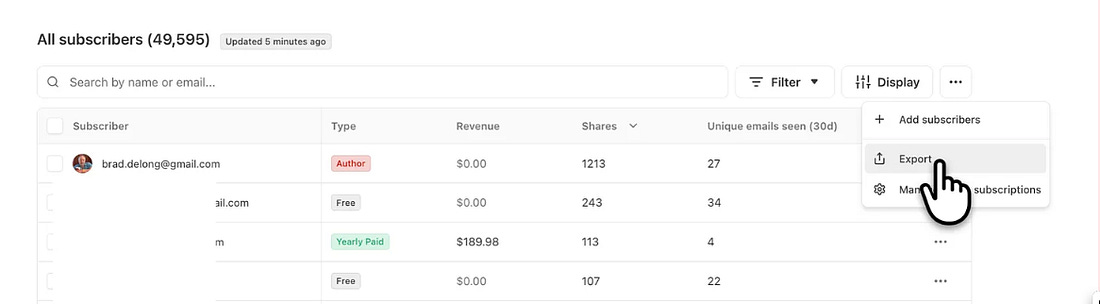
And, right now, if you have a SubStack, please: Go to: Settings → Subscribers → … → Export:
Now you have your .csv file of subscribers: 2025-08-02-substack-subscribers-l5RQirajSomgmBDYk3GlJA.csv. You can then go to any other email-newsletter-website-archive host to import. Hook your Stripe account. Tell SubStack not to charge and Stripe not to pay SubStack 10%. And there you are. It would be wise to repeat this download every month, in case this option-to-export should someday vanish. You are not locked in. As Anil Dash writes: “the counter-argument… [of SubStack’s] convenience… I was more empathetic towards before great options like Ghost and Beehiiv and Medium even WordPress stepped up their game…”. Which they did. Once SubStack had pointed the way. (Which happened only after Ben Thompson with <http://stratechery.org> and PassPort had pointed the way first.) Except that you are locked in, as people like Taylor Lorenz and Laura Jedeed find, because then you lose the SubStack discoverability layer. My view: For most people, right now there is insufficient reason to incur the hassle-of-moving and loss-of-discoverability layer now, for SubStack remains, as Ana Marie Cox says, by far “the easiest way” to start and run a newsletter. And, on net, Chris, Hamish and company are undertaking a mitzvah. However, some people—smart people—deny that the discoverability layer is worth much at all:
And:
But I have seen no statistical evidence that they are right. I have a bunch of anecdotal stories that they are wrong, and that the discoverability layer is in fact worth a substantial amount. Look: I grok where they are coming from. What they want is a decentralized system of individual writers writing for occasions semi-regularly on their own websites, all linked together by discovering and referring and boosting one another as they argue and inform, and perhaps it will be a side-hustle for some and a source of resources to keep body-and-soul together for others. Well, so do I. I want that too. Lots of us who have been around this internet rodeo for a while want that too:
But we have experience with this. Our experience with this has taught us that things with active discoverability-and-monetization layers—especially the clickbait attention-hacking advertising-supported ones—suck the life and energy out of the Open Web. Anil Dash, John Gruber, Ben Thompson, a number of others manage to make a good living at the weblogging-and-ancillary-services business. But they are few. More typical, I think, is an Ana Marie Cox, who we noted above writing that Patreon was the best of only a few bad options, and who we also find writing things like <https://newsletter.anamariecox.com/archive/substack-did-not-see-that-coming/>:
And yet we find her answers consist of:
Well, suppose John Perry Barlow and Friedrich von Hayek were right, and a combination of voluntarism in terms of contributions of work-hours and philanthropic gifts would support the creation of a discoverability layer. Suppose that layer would emerge spontaneously from the magic of the marketplace. Then would not be in this fix, would we? Then there would be no niche and no demand for a SubStack, would there? Thus I find Cox (a) calling for a functional discoverability layer, (b) while rejecting the one we have, and (c) not fully conscious of the tension here:
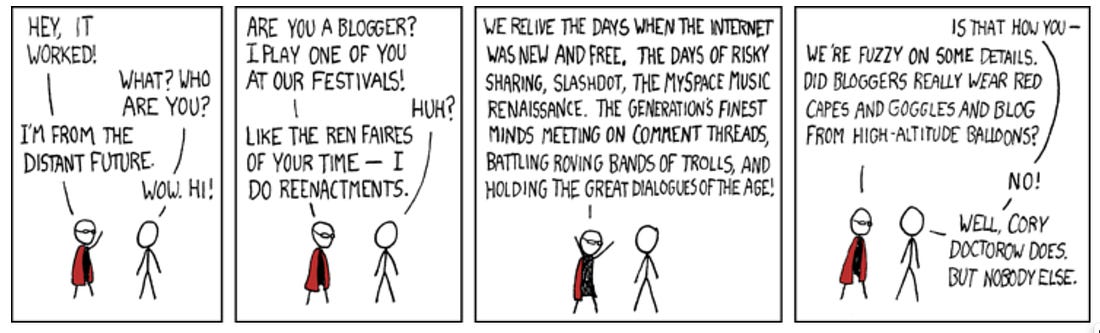
On the one hand she sees SubStack as a bad actor. It is pushing people to look at “audio, video, short-form posts, ‘discoverability’… listening, watching, interacting—anything but reading newsletters in their inbox as God intended…”. On the other hand it is those bad-actor services that are the discoverability layer and that create the monetization revenue layer money flows that gives us “thousands of journalists locked-in because that’s how they hoped to make a living…”—i.e., they don’t want to abandon SubStack because they make (some) money from it. And behind this, of course, there is the “Nazi Bar” problem. I accept that if you add any discovery layer to Substack—to any internet network—that is more than a simple reliance on individual writer shout-outs, and you will very quickly run into a problem. But for SubStack this problem is rather dire. It is rather dire given that (a) the honchos of SubStack have a very different view of where the Overton Window should properly be than I do, (b) my view of where it should be is substantially to the right of the average writers, (c) the extraordinary variance of human opinion, and (d) the ability of the internet to bring the far-away and extreme to your face immediately. The problem thus produced is this: The attempt to cast a broad net, as far as recommendations for what people should read, winds up, remarkably quickly, in two places at once. First, the system suggests that people who read my stuff might also like to read writers who are very eager to classify others as a blight on humanity who need to be removed from the gene pool, humanely (or not) not. Second, and at the same time, it also winds up recommending people who are very eager, for what seem like minor failures to toe some line, to drive others out in the wilderness to be food for Azazel. This is not good. The “Nazi Bar” problem is much worse than the “two-minute hate for small-scale trespass problem”, both (a) because it is a much bigger problem in American discourse today, and (b) because the right-wing lean of the SubStack honchos makes them vulnerable to it. They fail to see that they are platforming genuine bad actors (like Richard Hanania, for example), who then link to and recommend even worse actors, and so link-recommendations propagate. But both do emerge. And, as I said, they do emerge remarkably quickly. And they do emerge whenever you attempt a broad-net discoverability layer that is anything other then a defensive crouch. SubStack’s defense that they are a publisher and not a content-curator holds no water. They are publishers of newsletters. They are content curators of the discoverability laver. They are not either/or. They are both/and. My view is that they need to do a better job: more resources, more thoughtfulness, and less of a willingness to let themselves be gamed. They need to recognize that when one of their big backers is on record as telling Rick Perlstein that “I’m glad there’s OxyContin and video games to keep those people quiet…”, they are already deep under the water. Critics, correctly and cogently, do lambaste Substack for its fees, its discoverability “trap,” and its willingness to play host to some of the worser actors in digital discourse. And yet the vision of the imaginary good may turn out to be the enemy of the merely tolerable yet needed. This is the Fallen Sublunary Sphere, after all. And so, for most, the platform remains the path of least resistance—offering tools, audience, and a semblance of community. Moreover, for many—cough, cough, those without tenured jobs at respected research universities or similar lucky lighting strikes—it may be the only open path. I would prefer the Open Web of John Perry Barlow, Cory Doctorow, and Stewart Brand that seemed, when I was young, an intellectual utopia almost within our grasp? But, in the end, did the Open Web deliver? Since it did not, we must carve ourselves what crutches we can. Substack, however, proposes to carry us on a sedan chair. But will that sedan chair turn out to have a lock that is controlled only from the outside? I would say the chances are low. But I would also advise: keep your lock-picks oiled. Systems work best for those who both use, in Hirschman’s terms, voice while also making it very clear that they have the option of exit.
Remember when the web was open roads—or, rather, a place where we did not even need roads—and not tollbooths? The newsletter boom could replay the fall of Web 2.0, or could not. It is in our hands, as writers crave discoverability, and platforms crave rent, while venture capitalists crave ungodly amounts of lock-in money more than Smaug craves gold.
If reading this gets you Value Above Replacement, then become a free subscriber to this newsletter. And forward it! And if your VAR from this newsletter is in the three digits or more each year, please become a paid subscriber! I am trying to make you readers—and myself—smarter. Please tell me if I succeed, or how I fail…#on-substack-&-its-future |





| ||||||||||


No comments:
Post a Comment