
How to build a job application system using AI (NotebookLM and Perplexity)A plan to to help make your job application process more efficient
✨ Hey there this is a free edition of next play’s newsletter, where we share under-the-radar opportunities to help you figure out what’s next in your journey. These days, most startups seem to be experimenting with leveraging internal AI tools to boost their efficiency across important areas of their business like marketing, engineering, and customer success. I’ve heard about job-seekers taking a similar approach, and experimenting with AI tools to hopefully help increase their likelihood of landing their dream job. Though, just because you implement a system with AI, does not mean it will be a good or effective system. That is why we got in touch with Alex Mcfarland. He writes a popular Substack where he helps people leverage AI productively. His pitch: “No theory. No AI guru BS. Just stuff you can use immediately.” We asked him to put together a useful AI tutorial for the Next Play community—something that could *actually* help people land their dream job. Here’s what he put together:
A guide to building a job application system using AI (NotebookLM and Perplexity)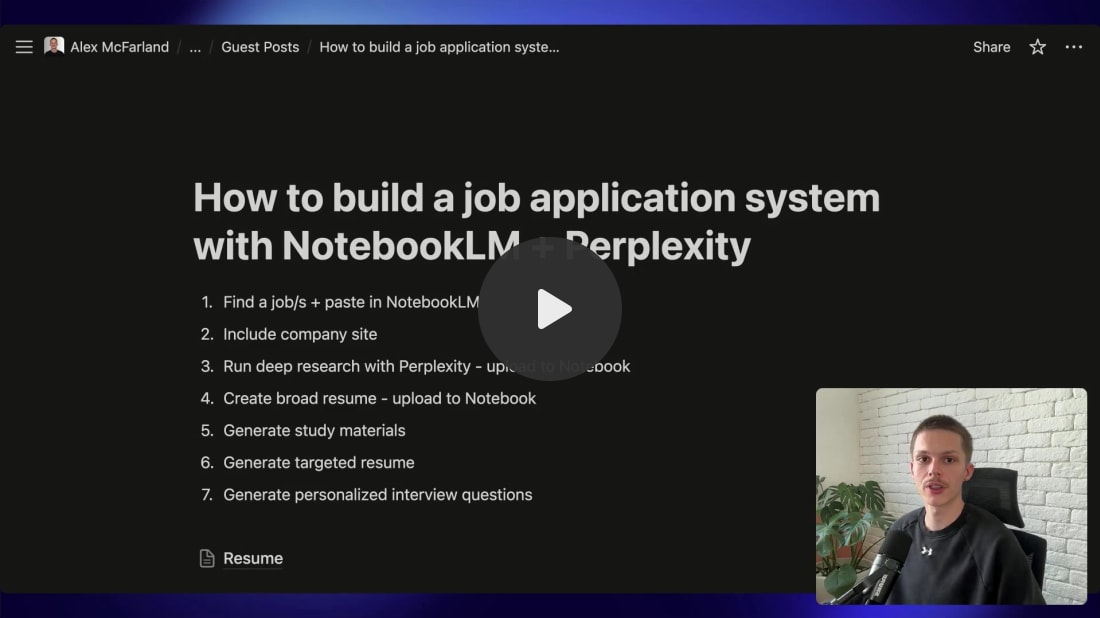 Forget generic resumes and spray-and-pray applications. This AI-powered system turns you into the most prepared candidate in any interview process—without becoming a tech expert. By the way, if you would like to meet like-minded people to help you on your journey in figuring out what’s next—maybe you’d like to find a cofounder or a mentor or get feedback on your Linkedin profile or just make some friends—you should check out Friends of Next Play. When you join, you get access to our private Slack group, get invites to virtual/in-person meetups, get discounts to our favorite software products, and much more. Some key takeaways from Alex’s guide
Why most people fail at job applications (and how AI fixes it)Applying for jobs the traditional way is broken. You send the same resume to 50 companies, maybe customize the cover letter a bit, and hope something sticks. Meanwhile, the person who gets hired? They walked in knowing exactly what the company needed and spoke their language perfectly. That's what this system does. It takes all the research grunt work and turns it into targeted, personalized materials that make you sound like you already work there. Setting up your job application command centerStep 1: Find your target job and gather intelFirst, obviously, find a job you're interested in. I use nextplay to search for content-related positions (since that's my world—I run a newsletter about AI content systems and ghostwrite for AI CEOs). Found an interesting one for Vellum AI: a technical content lead. Perfect example for this system. What you need to collect:
Step 2: Meet your new best friend—NotebookLMNotebookLM is hands down one of the most powerful free AI tools nobody's using properly. It's Google's research synthesis tool that lets you upload up to 50 sources and create study materials, summaries, even audio overviews. 💡 Key Insight: Unlike ChatGPT or Claude, NotebookLM only uses the sources you give it. No hallucinations, no made-up skills on your resume—just pure synthesis of YOUR actual information. Getting started:
Step 3: Upload your intelligence sourcesHere's where the magic happens. You're building a custom knowledge base about this specific opportunity. Source 1: The job posting
Source 2: Company website
Step 4: Supercharge with deep researchThis is where we level up beyond basic applications. Head to Perplexity (another must-have AI tool) and run a deep research report on the company. In Perplexity:
Copy that entire research report and add it as your third source in Notebook LM. Step 5: Add your career DNANow for the crucial part—your resume. But here's the thing: don't upload your polished, one-page resume. Upload your EVERYTHING resume. What I mean:
Why? Because NotebookLM will customize and condense this based on each specific job. You're giving it maximum material to work with. Generating your application arsenalNow you've got four powerful sources loaded:
Time to generate materials that make you unstoppable. The mind map—your strategic overviewClick "Generate mind map" and watch Notebook LM create a visual breakdown of how everything connects. You can click any node to explore deeper—like understanding their Series A growth strategy or how your experience maps to their needs. Study materials that actually matterNotebookLM also generates:
These aren't generic. They're synthesized from YOUR specific sources about THIS specific opportunity. The ultimate weapon—your targeted resumeHere's where it gets super practical. Tell NotebookLM: "Using my resume, generate an updated, targeted resume for this specific job at (X)" It creates a resume that:
Interview prep that reads their mindsLast power move—generate personalized interview questions: "Generate 10 potential interview questions targeted at me" These aren't generic "tell me about yourself" questions. These are specific questions an interviewer might ask after reading your resume for this role. Your implementation checklistToday: Set up NotebookLM and Perplexity accounts (both have free tiers) This week: Create your comprehensive "everything" resume For each application:
Advanced move: Upload multiple job postings and toggle between them using NotebookLM's source selection feature The competitive advantage nobody talks aboutHere's what's wild—this system is free and takes maybe 10 minutes. But you'll walk into interviews knowing more about the company than employees who've been there for months. You're not using AI to fake expertise. You're using it to surface the expertise you already have in the exact language they need to hear. That's being smart about your career. If you want to find more startup opportunities, be sure to check out Next Play.
You're currently a free subscriber to next play. For the full experience, upgrade your subscription.
|
How to build a job application system using AI (NotebookLM and Perplexity)
Thursday, 7 August 2025




Subscribe to:
Post Comments (Atom)


No comments:
Post a Comment