

Should you join: Genesis ComputingInside the startup that wants to become the data team for every enterprise
✨ Hey there - this is a free edition of next play’s newsletter. This is part of our series Should You Join, where we go behind the scenes on interesting companies. Our hope is that documenting these sorts of details, which never really make it to big publication press releases, can help you a) discover more interesting opportunities and b) inspire you to think creatively (for any of your own endeavors). You can join our private Slack community here and access $1000s of dollars of product discounts here. Data engineering is underloved. It’s unsexy. Nobody is writing long-form profiles about data engineers as if they were Tom Brady (looking at you, high-profile AI researchers). If you say you’re a data engineer at a dinner with friends, the reaction is usually closer to “oh nice lol” than “wow you’re so lucky and I wish I could be you.” In fact many people, including people who work in tech and at startups, probably could not even describe what a data engineer does! But perhaps data engineering should get more of the spotlight. Because a lot of what a company knows about itself, and thus a lot of what determines the company’s direction and long-term success, depends on how good their data engineers are at their job. You can even think of it in terms of simple questions, like:
Some companies will have clear answers to these. Some companies will have dozens of conflicting answers. Some might not know at all! Each answer depends on data pulled out of a mountain of systems, cleaned up, and joined together by complex rules. When data engineering is done well, a company can see what’s happening and act on it quickly. Matt Glickman, who spent over 20 years at Goldman Sachs, believes that Goldman’s single firm-wide data platform was a big part of the reason it got through the 2008 financial crisis when Lehman and many others didn’t. And when data engineering goes badly… It can go really badly. One example is what happened to Unity in May 2022, when the company told investors it would lose about $110M that year because of an issue that basically boiled down to bad data engineering. Data engineering is difficult and there aren’t enough effective data engineers to go around. Today, I’m writing about Genesis, a company that solves those problems with a platform of specialized AI data engineers.
Genesis was founded in 2024 by Matt Glickman and Justin Langseth, two Snowflake veterans who know the problem as well as anyone (better, actually). Customers already include Globe Telecom and a Fortune 100 pharma company, and Genesis raised a $17.5M Series A this past summer. So I sat down with the team to answer questions like: How does the product work? What’s it like to work there? Why will they win? And: why should you join? The productThe basic goal of a data engineer’s job is making sure the numbers are right. At a big company, particularly in regulated industries, that’s a lot of work. Take one of the bigger projects a data team will ever do: migrating off an old Oracle system. If you want to do this well, someone has to, at minimum…
A project like this takes months, and it comes on top of the daily work of keeping existing pipelines from breaking. “I’ve never met a data engineer who said, ‘Please give me more data engineering to do,’” Matt told me. “It’s a thankless job, it’s a high burnout job, and it’s highly complex.” So big projects wait, or the company hires consultants to do the work. Most data problems at big companies could be solved, however, if the company simply had a huge and scalable army of smart data engineers to solve them. Genesis is that army. Genesis AI agents run inside a company’s own Snowflake, Databricks, cloud account or even on-prem. They learn how the company’s data fits together and then actually do the work: like migrations, new pipelines, bringing a new client’s data into the system, or figuring out why a number is wrong.
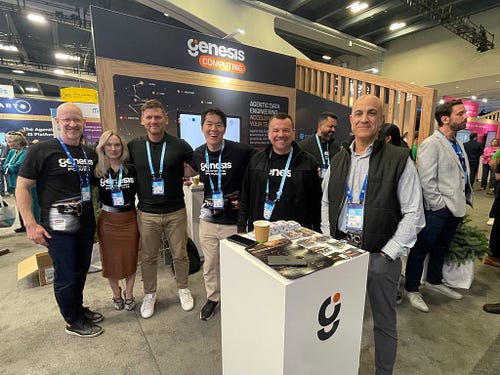
For one example: Tower Peak Partners is a global PE firm headquartered in London. Before its first fund closed, the partners wanted their own platform covering the whole firm, with compliance built in. Simon Knowles, Tower Peak’s Global Head of Technology, estimated that doing it the traditional way would have meant hiring five to ten specialists for a multi-year build. Instead, the firm used Genesis, and the core platform was live in four months without adding anyone to the team. Tower Peak onboarded its Genesis agent, Eve, the way it would a new employee, and Eve’s first task was compliance training. “Genesis really stood out because of the founding team,” Knowles said. (He also works weekly with a Genesis engineer who was a founding member of Goldman’s legendary SecDB team.) There are a few things that make Genesis work particularly well (and set it apart from, say, ChatGPT). One is context. As Justin put it, “data agents are a separate category from coding agents.” A coding agent can read a repo and run the tests, but a data agent has to work out rules that live in a dozen interconnected systems and in the heads of long-time employees if they still work there. Before agents touch anything, Genesis builds what it calls a Context Graph: a map of the company’s systems, its rules, and the reasons behind them. Verification is another piece. Matt compared human review of AI work to self-driving cars; in a self-driving car you can’t rely on a human to grab the wheel at the last second, because after an hour of self-driving the human has stopped paying attention. With data, “engineers are already letting go prematurely and won’t be able to re-engage in time when AI goes off the rails,” he said. So a key Genesis capability, called Prover, checks the agents’ work certifying everything is correct. There is also a critical differentiator with respect to security: Genesis is not SaaS. It runs inside the customer’s own systems which matters to highly regulated companies like hedge funds and pharmaceutical companies. And every customer gets FDEs who help get things going. The big pictureLong term, Matt said, “Genesis will be the data team for enterprises.” In the short term, the trojan horse to get into these big companies are migrations. Migrations are a great place to start because they have a clear finish line, and companies already budget for the work (but today, they pay consultants to do it). Part of the case for Genesis is who started it. Matt ran the core quant team (a.k.a. the Strat team) at Goldman Sachs for over 20 years. Justin has been starting data companies since the late 1990s, including Clarabridge (later bought by Qualtrics for $1.125B), and he’s the lead inventor on 51 patents. The two of them then spent six years together at Snowflake, where they built its data marketplace, won five Snowflake hackathons in a row, and kicked off the company’s work on AI. Their 2023 hackathon win was a demo of Elsa, Snowflake’s first data agent, and that inspired the idea for Genesis. “Genesis wins because we have the platform and the people who’ve solved the most challenging data problems,” Matt said. They left Snowflake in 2024 and gave themselves two months to launch at Snowflake Summit. Margarita joined as COO right as they signed on as a sponsor, and found out the booth graphics were already overdue. She had no design experience, but made the logo, signage, and booth in 24 hours anyway. “I haven’t really stopped since,” she said. Asked where Genesis will be in 20 years, Justin said “20 years is so far :)” and gave me a five-to-eight-year version instead: “coordinating the data estates of many major companies brings the best of AI and Humans together to do amazing data work.”
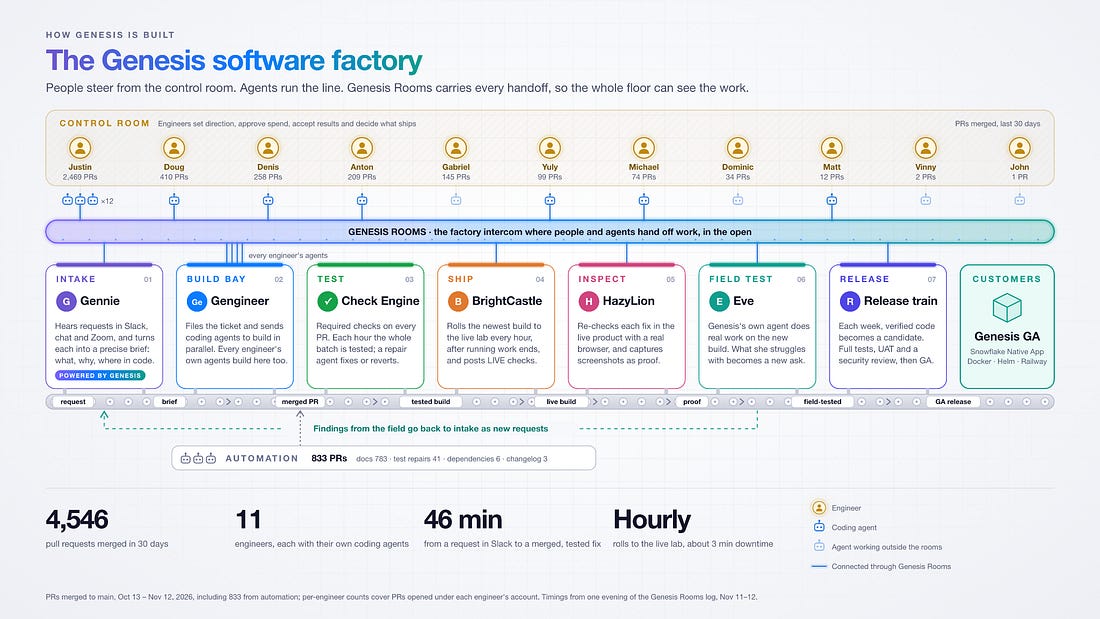
Customers today include Globe Telecom, Tower Peak, a New York hedge fund, several Fortune 500 banks and a Fortune 100 pharma company. Globe Telecom says it now delivers pipelines 10 times faster. The pharma company says that for certain workflows, Genesis has helped it “complete data tasks up to 40x faster.” And the hedge fund put it this way: “We would not have been able to do it without Genesis.” Sales and partnerships are run by Vince Trotta, Genesis’ WW VP of Sales & GTM, Snowflake employee #33 who spent a decade growing Snowflake’s east-coast business and Marketplace before joining. “Data engineers are often the primary bottleneck for enterprise AI adoption,” he said. Vince has also led Genesis’ partnerships with Snowflake and with Databricks, which named Genesis a Validated Technology Partner in June. The cultureLots of the team at Genesis, especially the leadership team, came from big companies. Matt, Anton Gorshkov (VP of Engineering) and Margarita Barrera all worked at Goldman Sachs, and others came from Snowflake. So, for people coming to Genesis from larger companies, “this is a different planet,” Anton said. “The biggest difference is how nimble we are and how easy it is to experiment and try things.” Today, the engineering team is just five people. “We ship up to 1,000 pull requests per week [with that team size],” Anton said. “We also recognize that vibe coding and AI slop are real phenomena, and so, for everything we ship, we hold a high quality bar and don’t just let AI add a bunch of features.” (The company laptops have an image of an F1 car on them.)
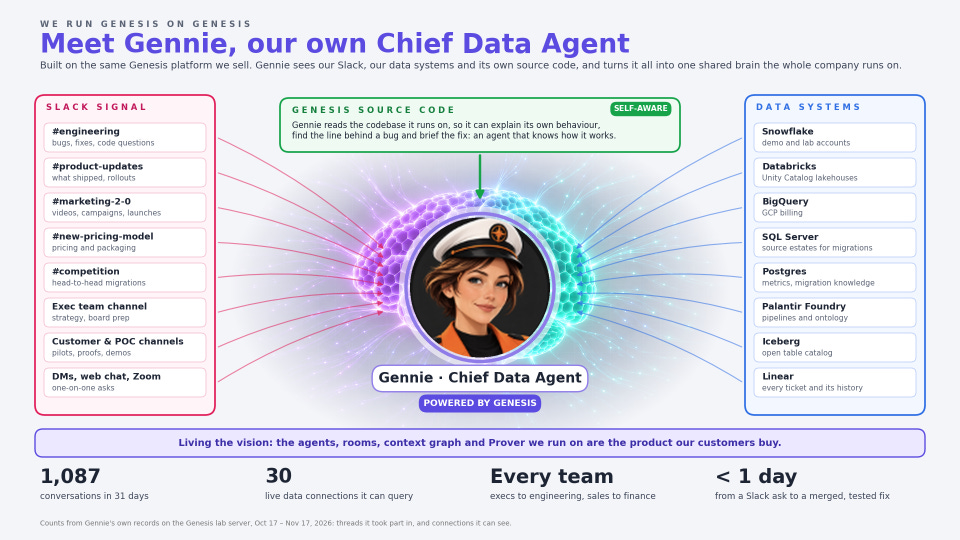
Genesis runs on Genesis. The newest member of the team is Gennie, Genesis’ own Chief Data Agent. Powered by Genesis, Gennie works with all teams at Genesis doing everything from helping Finance optimize internal AI spend, helping Matt prepare for board meetings to dispatching work to the Genesis software factory based on customer feedback reported by Sales over Slack.
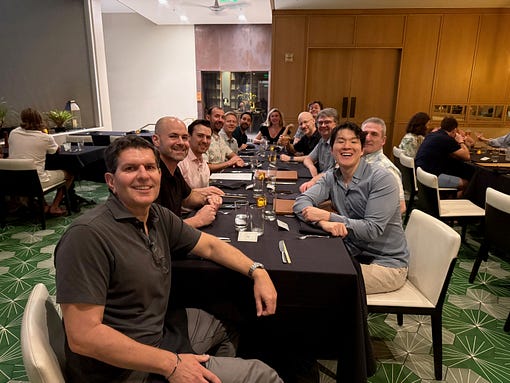
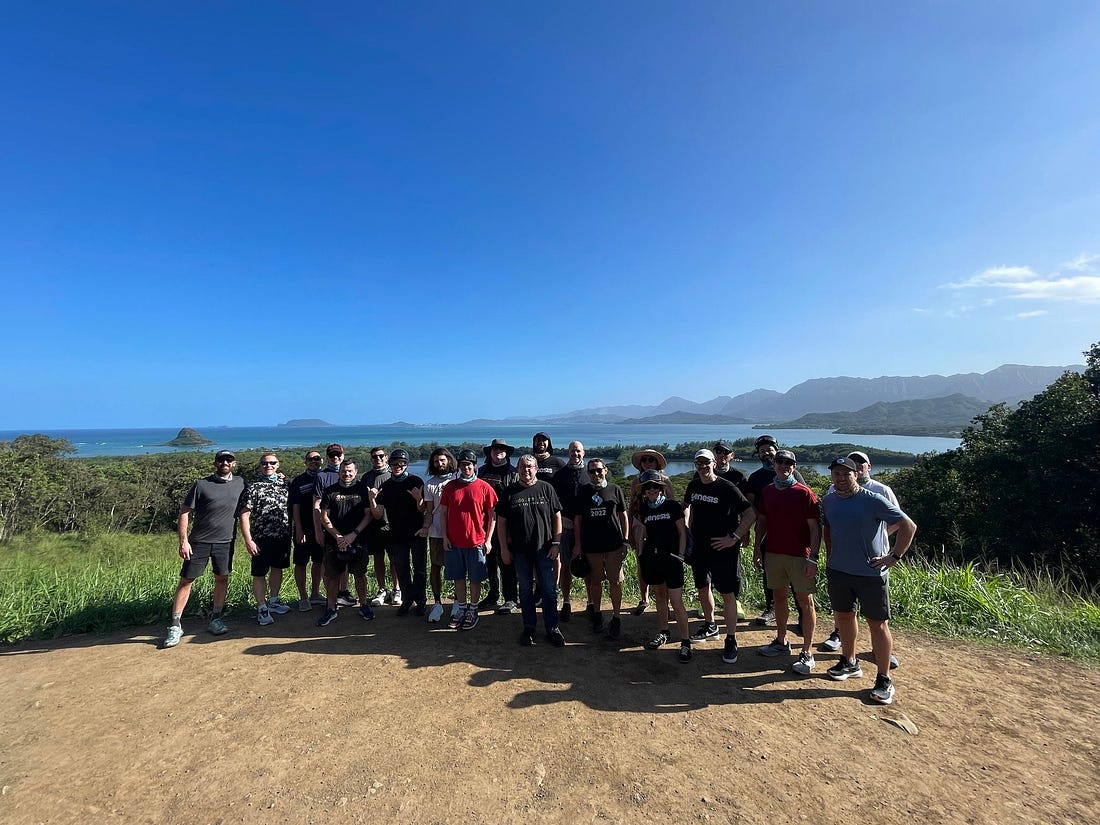
A company’s general behavior is often downstream of its founders, and the founders set a fairly rapid pace. When Melinda Smith, CFO, first met Justin, he was “managing a double digit number of concurrent AI coding agents working on several brand new features at once.” And Anton said that you’re not so much working with Justin as “around him, where he is some sort of a lightning bulldozer, clearing new roads in days, and you are a slower paving machine behind, making those new roads drivable.” “Engineers, salespeople, finance, founders, and ops often work on the same customer or issue,” Margarita said. And in meetings, people “are expected to contribute directly rather than attend only to receive information.” Engineering has just one stand-up a day, Monday through Thursday, and handles the rest on Slack. Genesis is headquartered in New York, with half the team based in the New York area, and the rest spread across the US. The New York folks work out of a swank coworking space called The Malin in NoMad. New York is where Genesis most wants to hire next, especially for marketing. “There’s no better place than NYC to start a B2B AI company, “ Matt said. “Where else can you meet face to face with banks, pharmas, and media companies all in the same day.” Margarita described people on the team as “quirky, funny, curious, and above all enjoy working outside their usual boundaries. We’re comfortable with being uncomfortable.” Once a year, Genesis brings the whole team together for an all-hands. Matt and Justin recently gathered everyone in Hawaii, where Justin lives.
Should you join Genesis?If you’re excited by being, as Justin says, “at the forefront of major companies who are living through the AI transition… to agents driving data work,” then I’d strongly consider exploring Genesis’ open roles. They’re hiring across most departments. Justin says he wants “people who embrace AI and work with AI agents all-in, no hesitation, with a desire to let AI do as much as it can and push it further.” Matt says he is looking for “self-starters who will take Genesis to a place where we wouldn’t have gotten to without them… People who have solved real problems… And AI-pilled enthusiasts.” Genesis is a place for hungry, ambitious people who want to make full use of all the tools available to them and move really, really fast. And it’s also a place for experienced folks from bigger companies who want to have a larger impact. Both founders told me they like non-traditional applications. “We want people who can show what they can do vs. sending CVs,” Matt said, and Justin said any creative way of reaching him is great “as long as it’s not an email prompt injection attempt.” Go explore open roles at Genesis here. * * * Thanks to Genesis for supporting Next Play and making this essay possible. You're currently a free subscriber to next play. For the full experience, upgrade your subscription.
|






No comments:
Post a Comment