
This is Brad DeLong's Grasping Reality—my attempt to make myself, and all of you out there in SubStackLand, smarter by writing where I have Value Above Replacement and shutting up where I do not… READING: U.S. Grant: Personal Memoirs :: Chapter 68Humanity's bravery & sacrifice & divinity’s vengeance & wrath, Grant & Lee, sorrowful victory & unacknowledged defeat at Appomattox Courthouse on April 9, 1865…
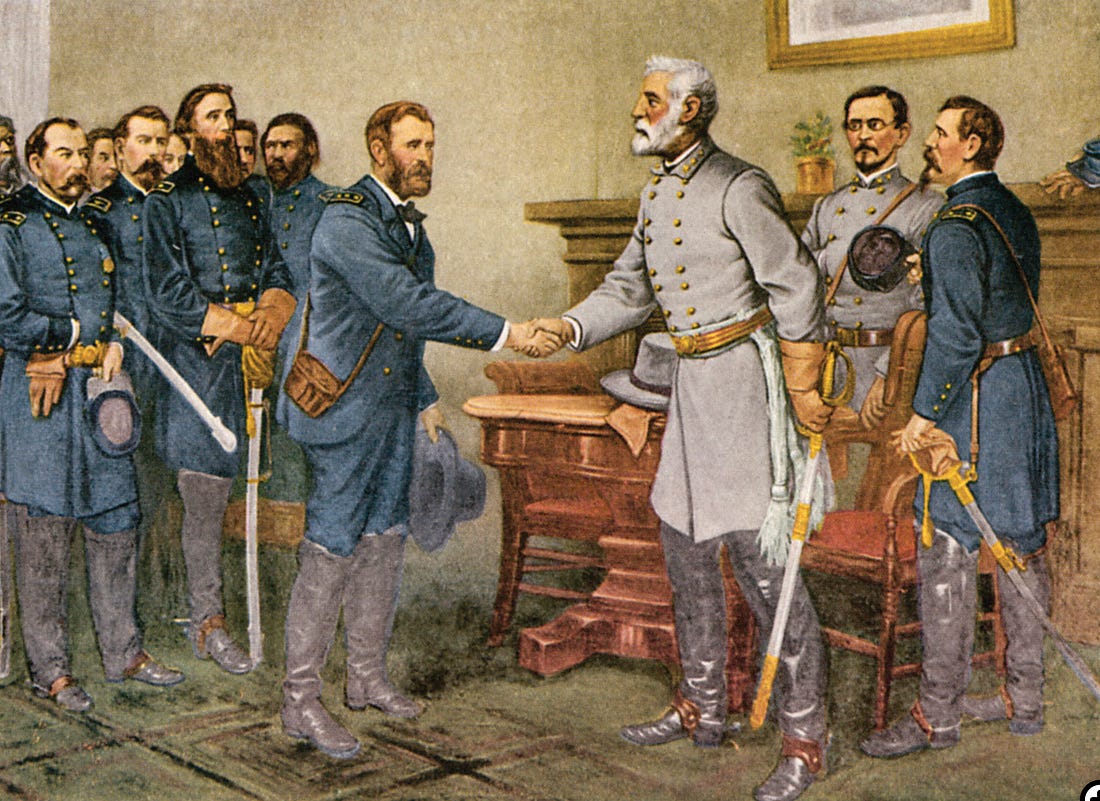
Humanity’s bravery & sacrifice & divinity’s vengeance & wrath, Grant & Lee, sorrowful victory & unacknowledged defeat at Appomattox Courthouse on April 9, 1865…
Here we have U.S. Grant:
U. S. Grant here sharply distinguishes between the (awful, criminal, in)justice of a cause and the (praiseworthy, to the extent that participation in the human—or should I say human male?—societal practice of war can ever worth praise) valor of those who fought for it. This is not, or is not merely, an exercise in Victorian magnanimity. It is one of the curses of the human condition. We see this, for example, in literature from the beginning. Consider ‘Omeros and his great poem Rage Be Now Your Song, Muse…. In it, Akhilleus and Agamemnon are definitely heroes—exhibiting excellence, arete, in an extreme, noble, and admirable form. But Akhilleus and Agamemnon are also tremendously stupid testosterone-addled devil-ape monsters. They wreak destruction and chaos: “doomed and ruinous… caused the Akhaians loss on hitter loss and crowded brave souls into the undergloom, leaving so many dead men—carrion for dogs and birds…”. And it is not even for their own ultimate advantage. Both wind up very dead as the not-unjust consequence of their rage-filled deeds. They both, very unwisely, as Akhilleus judges Agamemnon and can certainly be rightly judged in turn, “know… not at all [how] to look both backwards and forwards in time, so that his Akhaians might wage war securely besides their ships…” Grant’s lack of elation and sense of the sorrow and the pity is an acknowledgement of the deep structural forces that mobilize societies for this particular societal practice, sweeping up the “great mass” of the population in a tide of sincere but misdirected loyalty. Grant’s melancholy, then, is not simply personal but historical: it is the sadness of one who recognizes that the costs of war are paid by those least responsible for its origins, and that the meaning of victory is always shadowed by the suffering it entails. The Confederacy’s cause, as he observes, was indefensible: it was, in essence, a desperate bid to preserve a slave-based social order in the face of modernity’s onrushing tide. Yet the societal machinery of the South, like that of so many doomed regimes, was able to mobilize extraordinary resources, loyalty, and endurance. Here we see, once again, that sincerity and sacrifice are not sufficient to redeem an unjust structure. And the end of the Civil War did not, in fact, inaugurate a utopia: Grant’s presidency picked up the threads of Reconstruction four years late, and failed. The postbellum South’s economic and racial hierarchies were much less vicious than those that had underpinned the antebellum South, but they were still plenty vicious. Plus the cost of the Civil War was truly appalling. 4 million slaves were freed, or rather given one kind of (semi-)freedom. But the cost was 700,000 young men dead—400,000 blue, 300,000 grey—prematurely, most of them dying in great pain, killed in battle, expiring afterwards of wounds, or shitting their guts out from dysentery. One for every six. Plus the treasure—the resources—spent on and dissipated during the Civil War could, applied differently, have bought the freedom of every single slave in the United States at peak-boom prices, plus purchased 40 acres and a mule for every slave family, and more. I do believe the cost of the Civil War drove Abe Lincoln mad with grief. As of his Second Inaugural Address, he was seeing the enormous cost of the Civil War as the planned, deliberate, and conscious vengeance of the LORD on America:
It was so paid. And Lincoln found that vengeance righteous and deserved—deserved by Union and Confederate states and people alike:
I could say more. I actually have an outline, with bullet points. But I do not have the heart to fill it in:
References:
If reading this gets you Value Above Replacement, then become a free subscriber to this newsletter. And forward it! And if your VAR from this newsletter is in the three digits or more each year, please become a paid subscriber! I am trying to make you readers—and myself—smarter. Please tell me if I succeed, or how I fail…#reading-grant-personal-memoirs-ch-68
|
|||||||||||||||||||||||||||||||||||||||||||||||||||





|
||||||||||


No comments:
Post a Comment