
This is Brad DeLong's Grasping Reality—my attempt to make myself, and all of you out there in SubStackLand, smarter by writing where I have Value Above Replacement and shutting up where I do not… Contemporary Governance & Contemporary Prosperity & Past Settler Colonialism & Its Ilk: What Can We Infer, Really?Colonial origins, causal claims, the baggage left behind in the overhead bin via the absence of a structural model, settler-colonist mortality, modern pro-prosperity “institutions”, and structural...
Colonial origins, causal claims, the baggage left behind in the overhead bin via the absence of a structural model, settler-colonist mortality, modern pro-prosperity “institutions”, and structural-empirical truth…
I was thinking I would do an economic history post yesterday and a political economy post today, but life is busy, busy, busy, what with chaos, staring at screens watching people get blown up and so forth. Then I sat across from Jón Steinsson at the faculty lunch, and in the course of the conversation he mentioned that he still taught the graduate students the quarter century-old Acemoglu, Johnson, and Robinson “Colonial Origins…” paper. Why? Because it is both incredibly strong and incredibly weak, a true rabbit and a true duck, depending on how you look at. Teach it, and students get very valuable experience in having strong reactions and figuring out how to explain them—and also (we hope) practice in listening to people with whom you violently disagree but who think what they think for reasons. AJR's "Colonial Origins" is surely among the most influential empirical paper in historical development economics of the last quarter-century. Its argument is elegant:
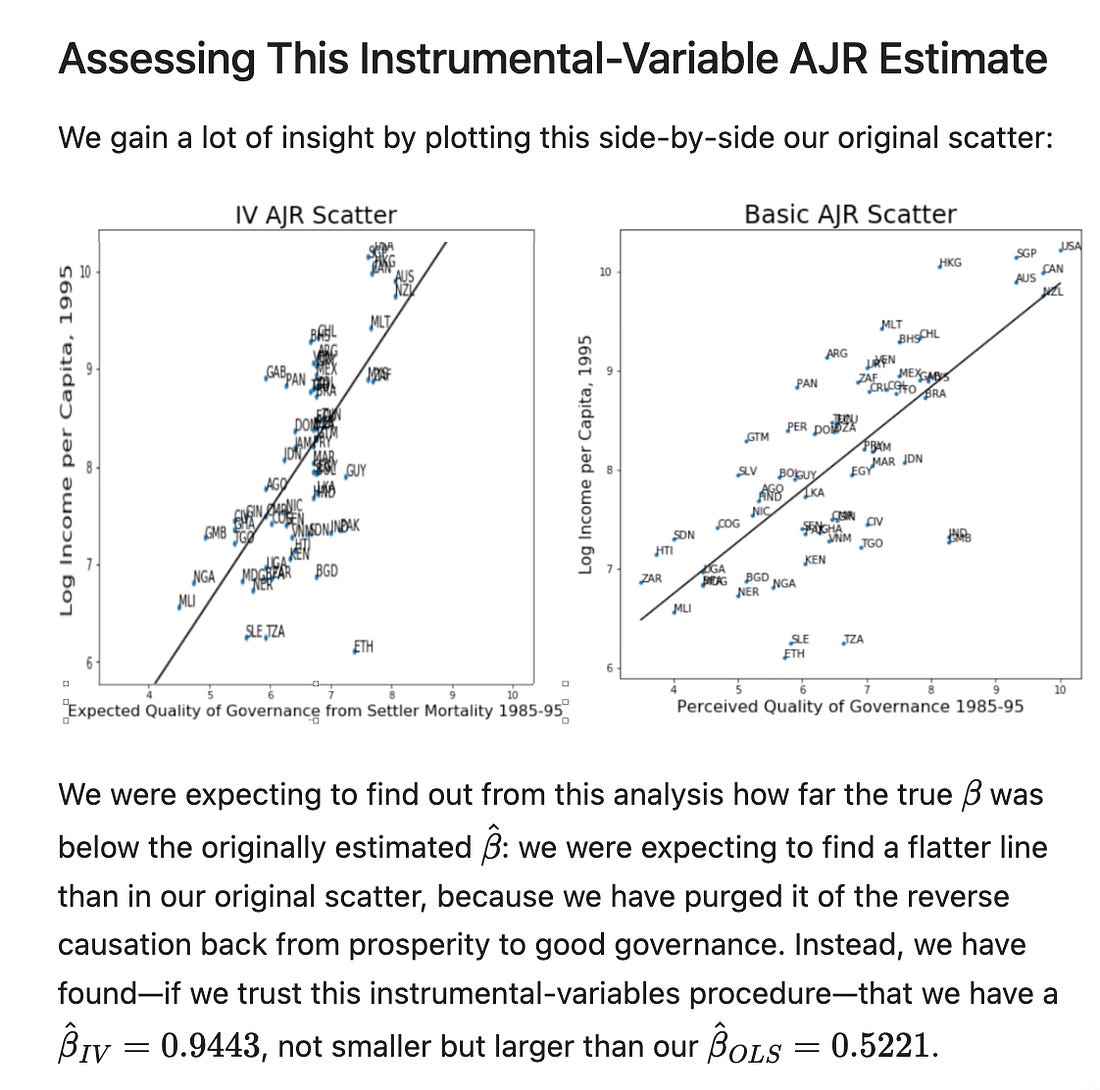
The result that Acemoglu, Johnson, & Robinson claim?: that differences in institutions explain about three-quarters of the income per capita differences across former colonies. Geography, latitude, disease burden—once you control for institutions, they do not matter. But this is a paper that turned me into a Heckmanite—into a believer in the idea that only those who have fully specified structural models, at least in their mind’s eye if not out there on the table, have a valid warrant to do anything statistical that they claim is in any sense “causal”. Structural models keep you from abandoning burdensome baggage in the overhead compartment when you exit the plain—and AJR’s procedures and paper has a lot of such, which the non-strucrtural IV-framing hides from view. Briefly: either prosperity has a strong negative structural effect on governance quality—which contradicts everything we know from political science and history—or settler mortality in the 17th century is a better measure of what matters in modern institutions than present-day institutional analysis by people who know about and can see them is. Yet both are concealed by the IV design. In any event, here is a .pdf print of the notebook:
And here is a link to where you can pull it down as an interactive python document: <https://github.com/braddelong/working_20251227/blob/main/2026-04-07-DELIVERED-EDITED-econ-196-week-9-reversals-of-fortune.ipynb>. If reading this gets you Value Above Replacement, then become a free subscriber to this newsletter. And forward it! And if your VAR from this newsletter is in the three digits or more each year, please become a paid subscriber! I am trying to make you readers—and myself—smarter. Please tell me if I succeed, or how I fail…##contemporary-governance-contemporary-prosperity-past-settler-colonialism-its-ilk-what-can-we-infer-really
|
|||||||||||||||||||||||||||||||||||||||||||||||||||





|
||||||||||


No comments:
Post a Comment