The very smart Chad Orzel writes:
Chad Orzel: Top 40 Radio and the Punditsphere: ‘there are people who write about physics and astronomy who regularly recapitulate the exact same argument about how the Many-Worlds Interpretation is Bad, or about the failings of dark matter and the superiority of MOND, or about the unreasonably high cost of particle accelerators, or about the failings of MOND and the superiority of dark matter, and so on. Those topics come around again and again and again, always with the same people on the same sides, and I just roll my eyes.
But those topics are absolutely evergreen, because as my cousin said years ago, someone is always just tuning in, having narrowly missed the last round of the argument, and they’re happy to hear it…. This used to bother me more, but since coming around to the realization that I’m not the audience for this, I’m much more chill…
This leads me to ask a question:
Where do those of us who have tuned in, and who took Physics 143: Introduction to Quantum Mechanics long ago, and who want to learn more and have our questions answered look in a world in which pop-science writing “regularly recapitulate[s] the exact same argument about how the Many-Worlds Interpretation is Bad, or about the failings of dark matter…”?
Share
Example: The question I had back in Physics 143:
I had learned that there were quantum states, represented by a ket, like: |ψ>
I had learned that when a quantum state |ψ> went through some apparatus and it was affected so something happened to it so it emerged as a different quantum state |F>, we represented the apparatus by a linear operator ⍺ and the process of interaction by an equation, like: |ψ’> = ⍺ |ψ>
And then I got to II.10. Observables: “Establishing connexions between the results of observations… and the equations of the mathematical formalism…. When we make an observation we measure some dynamical variable…. If the dynamical system is in an eigenstate of a real dynamical variable ξ, belonging to the eigenvalue ξ′, then a measurement of ξ will certainly give as result the number ξ′...”
That is:
the apparatus is a matrix ⍺
that matrix also can be the observation of the matrix’s associated dynamical variable A.
to calculate the value oberved, we express the quantum state |ψ> in the basis composed of the eigenvectors a(1)…a(n) of matrix ⍺ with their associated eigenvalues A(1)…A(n)
then the probability that our measurement produces eigenvalue A(j) is the squared amplitude the component of |ψ> along eigenvector a(j).
So if we conduct a measurement, then what comes out of the other side of the apparatus is not quantum state |ψ’> = ⍺ |ψ>, but rather whichever a(j) with associated measurement value A(j) the dice thrown by the Old One happened to land on.
And I went: WTF? Why?
And I was told: that is an advanced topic.
Share Brad DeLong's Grasping Reality
I would like to know how the matrix of the linear operator ⍺ is both how the quantum state |ψ> evolves over time in a particular environment and the measurement of a dynamical variable. But pop-science says that is an advanced topic. And non-pop-science assumes everybody already knows it. For example, Sydney Coleman:
The state of a physical system at a fixed time is a vector in Hilbert space. Following Dirac we call it ψ. We normalize it to unit norm. It evolves in time according to the Schrödinger equation, where the Hamiltonian is some self-adjoint linear operator….
Now if there is anyone who has any questions about the material on the screen at this moment, please leave the auditorium, because you won’t be able to understand anything else in the lecture….
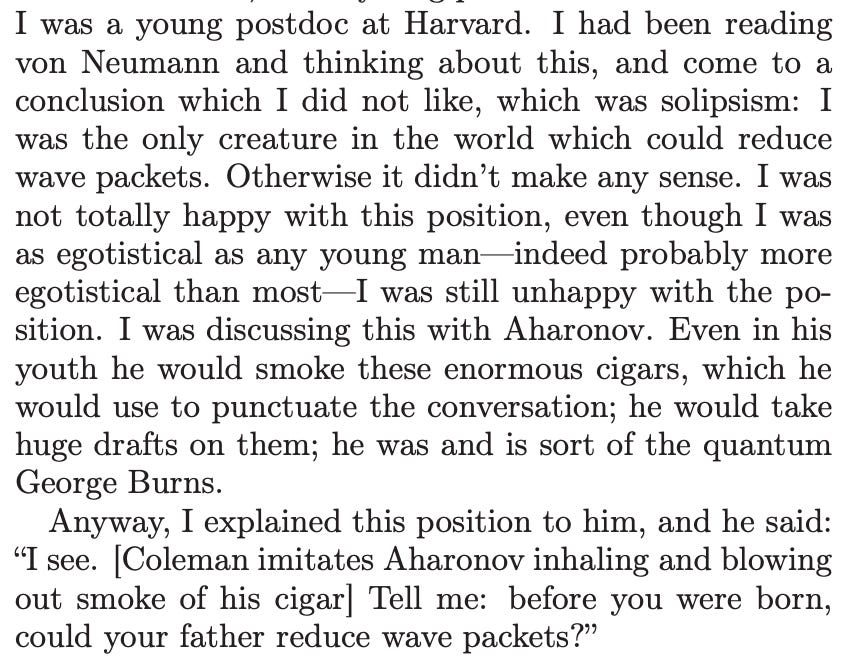
Now some, maybe all, self-adjoint operators are “observables”. If the state is an eigenstate of an observable A, with eigenvalue a, then we say the value of A is a, is certain to be observed to be a…. There’s an implicit promise… that the words “observes” and “observable” will… act… as those entities do in the language of everyday speech…. Now to show that is a long story. It’s not something I’m going to focus on here, involving things like the WKB approximation and von Neumann’s analysis of an ideal measuring device, but I just wanted to point out that that’s there…. Now we come to the fourth thing… the famous projection postulate… sometimes called “the reduction of the wave packet”. It’s very different from the previous three… on the board because it contradicts one of them: causal time evolution according to Schrödinger’s equation… <https://arxiv.org/pdf/2011.12671.pdf>
So what is Sydney Coleman’s “long story here”?
Leave a comment







No comments:
Post a Comment