
Should you join: MomenticAn inside look at Momentic, the AI testing platform that Notion, Retool, Quora use to ship faster (and better).
✨ Hey there - this is a free edition of next play’s newsletter. You are reading a Spotlight, part of a series where we go behind the scenes on interesting companies. What makes their business work? What is the culture like? What is the long-term strategy? How do they get their customers? And more. There’s so much noise out there—our goal is that these deep dives are actually useful for you. You can join our private Slack community here and access $1000s of dollars of product discounts here. It’s a bit crazy how fast the definition of “impressive” has shifted in software development. Twenty years ago it was impressive if somebody built a website, any website. Then Wordpress and website builders came along and a site was less impressive, but building an app was still a feat. Now, someone could show you a full-fledged software application built for the enterprise and your reaction might be: “meh. seems vibe coded.” It seems unlikely we have fully adapted to this new world yet. What are the consequences? What happens when the hottest companies in the world are using AI to write almost all of their code? When companies are shipping 2X, 5X, 100X faster? What problems arise? One obvious side effect: testing becomes a lot more important. There is more code than ever. Fewer people than ever are writing the code or even understand how the code itself works. This might be a bad thing. Today’s spotlighted company, Momentic, wrote about this problem in their recent Series A announcement: “[Shipping faster] is incredible… Until you realize you’re shipping bugs faster too.” Traditional testing (QA) tools were already brittle and flaky. They could barely keep up even when humans were writing all the code at a human pace. Nobody liked QA before, but it’s simply untenable now in a world where AI is doing a lot of the work. So is building better testing infrastructure? If you ask Wei-Wei Wu, the answer is Momentic (the company he is CEO of). They raised their $15M Series A in November last year and want to become the “definitive verification layer for modern software.” That sounds nice. But I wanted to dig deeper: what does Momentic’s product actually do, and in what ways is it really new? What is their trajectory? And should you consider joining?
The productHistorically there have been two ways to test software: one way is you write code (often in Playwright or Selenium) that runs automatically and tests things for you. The other way is you test the product manually, clicking through by hand. In practice most teams do some combination of both. These approaches are brittle. They are the reason few engineers will tell you that QA is their favorite part of the job. A script that says “find the element with ID submit-btn and click it” breaks the moment a developer renames that element. And in the 22 years since Selenium came out—despite attempts at ‘automatic’ solutions—not much has changed. Testing scripts are still full of Xpath, data-testid, and hardcoded attributes that nobody cares to maintain. The other problem with the old approaches is that they are slow. It takes time to write the tests, it takes time to run the tests, it takes time to maintain the tests. Far too much time for an era where code generation is automatic and a fast feedback loop is the most important thing to make sure you can actually ship a good product. Momentic is taking a net new approach: you describe what you want and AI agents interpret your instructions against a website, iOS app, or Android app at runtime. No intermediate code, nothing to maintain. “We don’t generate test code like Playwright or Appium,” Wei-Wei Wu, CEO, told me. “This is how we’re able to achieve incredible speed (<200ms per interaction) and world-class accuracy and reliability. Notion runs hundreds of thousands of tests a day with a 99.99% pass rate.” The workflow is rather simple to imagine:
That is the basic summary. The obvious follow up is: “Well, is it useful?”
Momentic is small, and early, but the results they’ve published seem good: Retool now releases 8X faster. Quora went from 7 hours of daily QA to 30 minutes. Mutiny reduced production incidents by 85% and sped up their release cycles. GPTZero ran tests much faster (and sped up their release cycles, too). This is an encouraging start. But how do they become a $1B, or $10B, or $100B company? The strategyThere are a few key bets that Momentic is making as part of their strategy to become the definitive layer for software verification. The outcomes of these bets will likely help determine whether or not this is a company you look back on in 5 years and think “I should have joined!” The first bet is the one we touched on earlier: as AI writes more code and teams want to ship faster, testing is going to become a more valuable (and important) industry than ever before. More testing will be required, and increasingly that testing will be performed on software that no human had a hand in actually writing. A successful verification layer in this world is one that both moves faster and is more effective than existing testing infrastructure. A second, related bet is Momentic’s novel approach to product. The biggest products in testing right now are code-first. Whether via AI or your own hand, you are writing code to test your product. Momentic is making a bet that the future of testing, of AI-native QA, will involve AI testing software at runtime instead of building brittle test code. The idea being that because this is faster and more effective, it will replace the status quo approaches to testing. And then there is a third bet: that the QA function as it exists today will cease to exist. Instead, it will transform into something more integrated. “Roles across QA, engineering, and product are blending together,” Wei-Wei told me. “QA as a separate role and function from [engineering and product] is inefficient.” With Momentic, people owning the product will be the ones owning testing. “Quality should be wholly owned by the person who built it,” Wei-Wei said. “It’s the fastest feedback loop and will only become faster and tighter as better AI models and tooling become available.” To be clear, Momentic does not believe that QA people or their work are useless. Rather, they believe that today’s workflows are inefficient. That testing should be more effective and faster, that the feedback loops should be tighter. That QA should be better integrated. The company is so opinionated about this shift that they don’t even sell to non-technical teams. “Our ICP is highly technical engineering teams,” Wei-Wei said. “A lot of startups in the space cater to the non-technical persona, which is a mistake. QA as a role won’t exist soon.” There is logic to this. The current approach to QA at many companies is like if spellcheck didn’t live inside your word processor but you had to instead email it to Grammarly, and in a few days they would get back to you with the corrections. That would be inefficient. In QA, this kind of thing is the status quo. The future Momentic is aiming for is one where:
In this world, companies will need a different sort of software—a new layer—to help them confidently ship as fast as they’d like to. If they win, Momentic will be that new layer. The growthIn 2024, co-founders Wei-Wei Wu and Jeff An were accepted into Y Combinator’s winter batch of companies. Most of their first customers in this era—when things were small—came from launching often and talking about it on social media. A few were personal connections. This rather humble start snowballed quickly. Customers started coming through inbound. Via Google Search. Via some paid ads. ChatGPT and Claude started recommending Momentic. Customers started referring to other customers. ARR began to grow. In March last year, not long after graduating from Y Combinator, Momentic announced their $3.7M seed round. And just 8 months after that, they had raised a $15M Series A led by Standard Capital with participation from Dropbox Ventures (and existing investors like Y Combinator, FCVC, Transpose Platform, and Karman Ventures). Momentic doesn’t share many other metrics, like ARR, publicly. (Wei-Wei told me that they are growing fast, which is perhaps unsurprising considering their two rounds in 2025.) But the customers they feature (Mutiny, GPTZero, Notion, Retool, and others) are impressive, as are the results those customers are purportedly seeing with Momentic. There is a long way to go, but this feels like as good a start as any. The teamSometimes you read about startups whose founders have nothing to do with the problem they are solving. We’re two ambitious college grads who made a few SaaS prototypes and now want to create a brain scanning company! This can be fine. It can work. But it is often more confidence-inspiring when the founders and the team do seem to have real experience in the thing they are solving. That is the case with Momentic.
Both Wei-Wei Wu (CEO) and Jeff An (CTO) are technical. Wei-Wei was the first employee and founding engineer at Nashi (acquired by Density in 2021) and has been an open-source contributor to Node.js, Storybook, Rollup, and more for years. Jeff built integration test infrastructure at Robinhood, then led enterprise quality at Retool (where he was recruited by Nicole Sgarlato, who is now Momentic’s recruiter). Now that may sound good, but what would it be like to work at Momentic? “Our edge is our culture,” Kailen Swain, founding product designer, said. “I’m sure every company says this so it sounds pretty stupid but here’s why: We’ve built a team where we can be completely honest, pointing out flaws and debating ideas because there’s a foundation of deep mutual respect. We win because we’re building with people we actually enjoy being around and who are all-in on the same goal.” We often hear from startups about how the team trusts each other. But, at Momentic, trust is something that has to be earned. “Wei-Wei is not inherently trustful,” one team member said. “When I first started, he didn’t trust me, and I’ve noticed that he doesn’t trust anyone when they first start. He pushes back a ton in the early days. Once he trusts you, then he lets you run wild.” I’m told that this early trust-building phase with leadership isn’t intimidating, though. Just the opposite—there is a lot of support as you prove yourself. “I know I’m hard to earn trust from early on,” Wei-Wei said. “So I try to be really explicit about what I’m looking for and give direct feedback fast, so people aren’t left guessing where they stand.” Like you might expect with a startup of Momentic’s size, working there means you can expect to work on things that are not exactly in your job description. “I spend a lot more time at Momentic thinking about product and business goals [than I have at other jobs],” Henry Haefliger, a software engineer at Momentic, said. Still, though, this is an “engineering-first culture selling to engineers,” he said. “The people at the company are the right ones to build the product.”
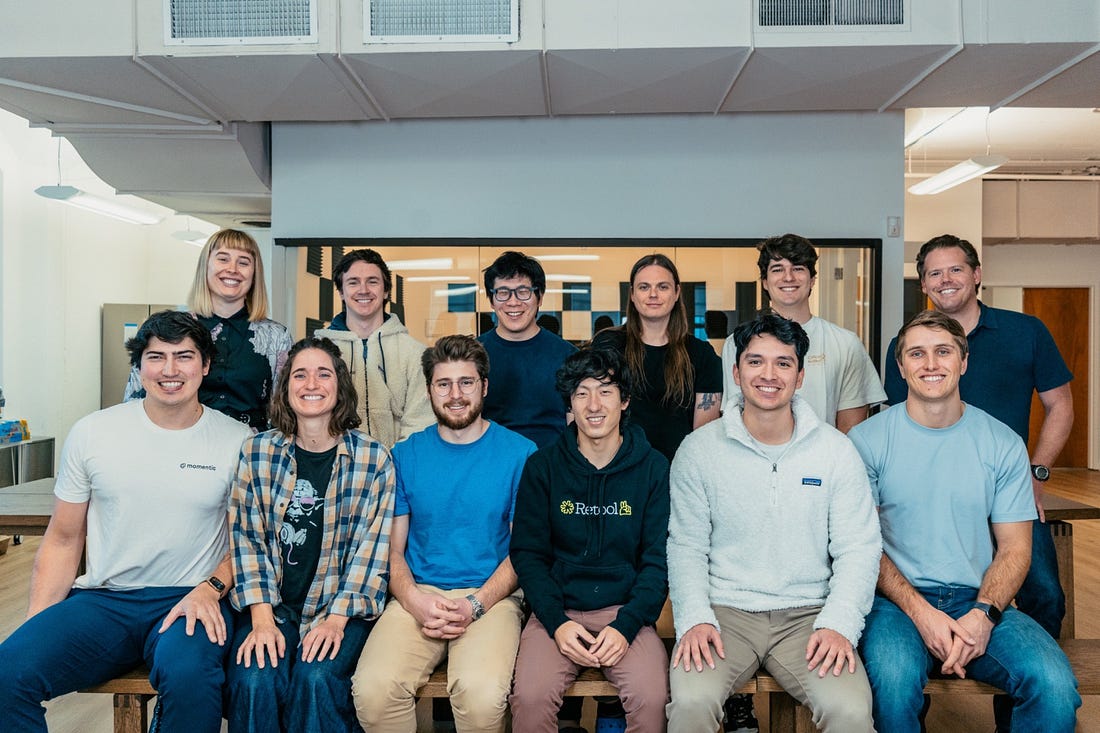
The whole team works in-person in San Francisco. The culture is extremely outcome and output-oriented. One of the qualifying attributes for success listed on Momentic’s own career page is simply: “You dislike meetings.” Should you join Momentic?For now, Momentic is small. Smaller than most of the companies we spotlight here on Next Play (which tend to be at Series B, C, or beyond). Today there are 14 people on the team. Joining now means you’ll know everyone, probably quite well. You’ll be an important part of the founding team. You’ll help shape the culture, the direction, the roadmap. Being the third or fourth engineer (or marketing hire, or whoever) is different from being the thirtieth. Perhaps most importantly, I think you need to both agree with and be excited by some of the ideas that (probably) need to be true for Momentic to succeed:
If these ideas ring true for you, the other question is whether Momentic is the right place to go build this. The early customer list—and those customers’ results—would indicate that Momentic is ahead of the pack on truly becoming the new layer for software verification. “We’re growing fast,” Wei-Wei said, “and some of the best product teams on the planet, like Notion, Quora, Bilt, Webflow, and Retool, use Momentic every single day.” If you are excited by the trajectory and buy into this vision, there would be no better time to apply to Momentic than right now. You can check out their open roles (all in person!) here. Thanks to Momentic for supporting Next Play and making this Spotlight possible. You're currently a free subscriber to next play. For the full experience, upgrade your subscription.
|
Should you join: Momentic
Thursday, 19 March 2026






Subscribe to:
Post Comments (Atom)


No comments:
Post a Comment