
This is Brad DeLong's Grasping Reality—my attempt to make myself, and all of you out there in SubStackLand, smarter by writing where I have Value Above Replacement and shutting up where I do not… CROSSPOST: RICHARD BALDWIN: Why Didn’t Trumpian Tariffs Wreck the World Trade System?Richard’s subhead: “Because World War Trade didn’t spread.” It is very true: World War Trade did not spread. Other countries recognized that it was not any sort of semi-rational mercantilist...
Richard’s subhead: “Because World War Trade didn’t spread.” It is very true: World War Trade did not spread. Other countries recognized that it was not any sort of semi-rational mercantilist economic policy but rather chaos-monkey social-media performative theater & spectacle for a post-literate age in which even semi-rational policy goes into eclipse. & so, rather than engaging in normal tit-for-tat deterrence-and-negotiation, other countries gave Trump optical social-media performative victories while mobilizing counter-pressures behind the scenes. That was the smart way, in our context of weaponized Interdependence, to deal with the chaos-monkey in the Oval Office. But that is only the smart way in the short-run. In the medium- and the long-run, the interdependent globalized value-chain economic mode world is quietly decoupling from America. Trump’s performative tariffs may well evict the U.S. from the center of the world economy, for, when trade policy becomes reality-TV spectacle, ci-devant allies reroute supply chains, not just talking points…
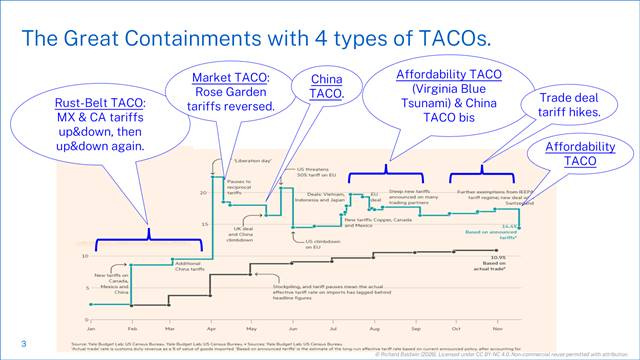
If you want to know what is happening to the world trade system these days, pay very close attention to Richard Baldwin. Here Baldwin treats Trumpian tariffs as they semi-scripted reality-TV theater that they are. He treats them as performative: a performance for a domestic audience animated by grievances that it cannot verbalize. Tariff announcements are thus a way of producing “happy headlines” for voters who listen to Trump and Fox News telling them that they are the victims of cosmopolitan elites. And TACO rules: Either “Trump Always Chickens Out” or “Tactical Adjustment, Climbdown, and then Oblivion” The result is a world in which headline US tariff aggression is enormous, but effective short-run disruption is minor. And the gullible press corps floods the zone with Trump’s desired optics. <https://rbaldwin.substack.com/p/why-didnt-trumpian-tariffs-wreck> <https://rbaldwin.substack.com/cp/192412851> 
The incompetent reporters on this one are: Daisuke Wakabayashi, Amy Chang Chien, and Alan Rappeport. Foreign governments, for the most part, understand this Baldwinian logic. Thus they chose restraint. China, uniquely exposed and uniquely powerful in US supply chains, pushed back just enough to demonstrate that it had true escalation dominance—and then, too, stopped short of blowing up the system that has served it so well. What Baldwin offers here, therefore, is not just a narrative of one more Trumpian tantrum, but a useful analytic template: The world trading system survives a shock that ought, in the textbooks, to have been fatal. Why did it survive? Look first to domestic politics in the post-literate age of not policy but spectacle. Look second to institutional inertia. Pluso: also look, third, to the quiet, often self-interested prudence of everyone else. I do, however, think that Baldwin’s story as told here is massively incomplete as we move from the short- into the medium- and the long-run. The rest of the world—the United States too—is in a configuration in which its prosperity depends on the extremely deep and integrated global division of labor: The world is still 30% in the Globalized Value-Chain mode of production, after all. (It is 20% in the Attention Info-Bio Tech mode, 30% in the Mass-Production mode, 10% in the Applied-Science mode, 5% in the SteamPower mode, and 5% in the Mercantile-Imperial mode.) The rest of the world knows that Trump is eager to weaponize that interdependence for the sake of gaining domestic headlines for his reality-TV spectacle. And the rest of the world knows that Trump is an uncontrolled chaos-monkey: that the fewer and fewer reality-based people around him may not always be able to get him to TACO when the random trade-tariff bullets he fires threaten to hit either powerful economic actors who have Republican senators on speed-dial, or his political base. Hence the rest of the world has begun to take every step it can to decouple from America, as Trump is making the United States an intolerably unreliable counterparty, Large economies look deceptively self‑sufficient in the aggregate. Yet they are, at the micro level, riddled with choke points in specialized intermediates, logistics, and knowledge. Enter “weaponized interdependence”. Baldwin makes it clear that Trump is not weaponizing interdependence to pursue a coherent mercantilist strategy. Baldwin makes it clear that Trump is staging performative tariff theatre. But from the standpoint of everyone else, intent matters little. A White House that treats 25 percent or 125 percent tariffs as TV props, and supply‑chain disruption as a backdrop for rallies, is a White House that cannot be trusted as a long‑term anchor for your production network. You do not want your factories, or your national security, wired through a chaos‑monkey in the Oval Office. So partners do the logical thing. They begin, cautiously but steadily, to re‑route. Canada and Mexico look east and west rather than north; Europe doubles down on intra‑EU resilience and leans toward Asia; Asian manufacturers hedge by building capacity that bypasses U.S. territory and U.S. law. Britain chose to step away from its deeply integrated neighborhood and is now poorer, less influential, and more peripheral. The United States, under Trump, is achieving much the same outcome from the other direction: by convincing the rest of the world that it is too erratic, too performatively bellicose, and too eager to weaponize interdependence to remain at the center of the system. The damage will accumulate slowly—lost investment here, diverted trade there—but over a decade it looks to me likely to add up to at least the equivalent of a cis-Atlantic BREXIT. Please keep the magnitude of the likely long-run disaster in the front of your mind. References (by AI):
how did it do?If reading this gets you Value Above Replacement, then become a free subscriber to this newsletter. And forward it! And if your VAR from this newsletter is in the three digits or more each year, please become a paid subscriber! I am trying to make you readers—and myself—smarter. Please tell me if I succeed, or how I fail…##crosspost-richard-baldwin-why-didnt-trumpian-tariffs-wreck-the-world-trade-system |



| ||||||||||


No comments:
Post a Comment