
Tech’s favorite AI notetaker is on the verge of becoming a product worth billionsGranola wants to be the primary interface for knowledge work
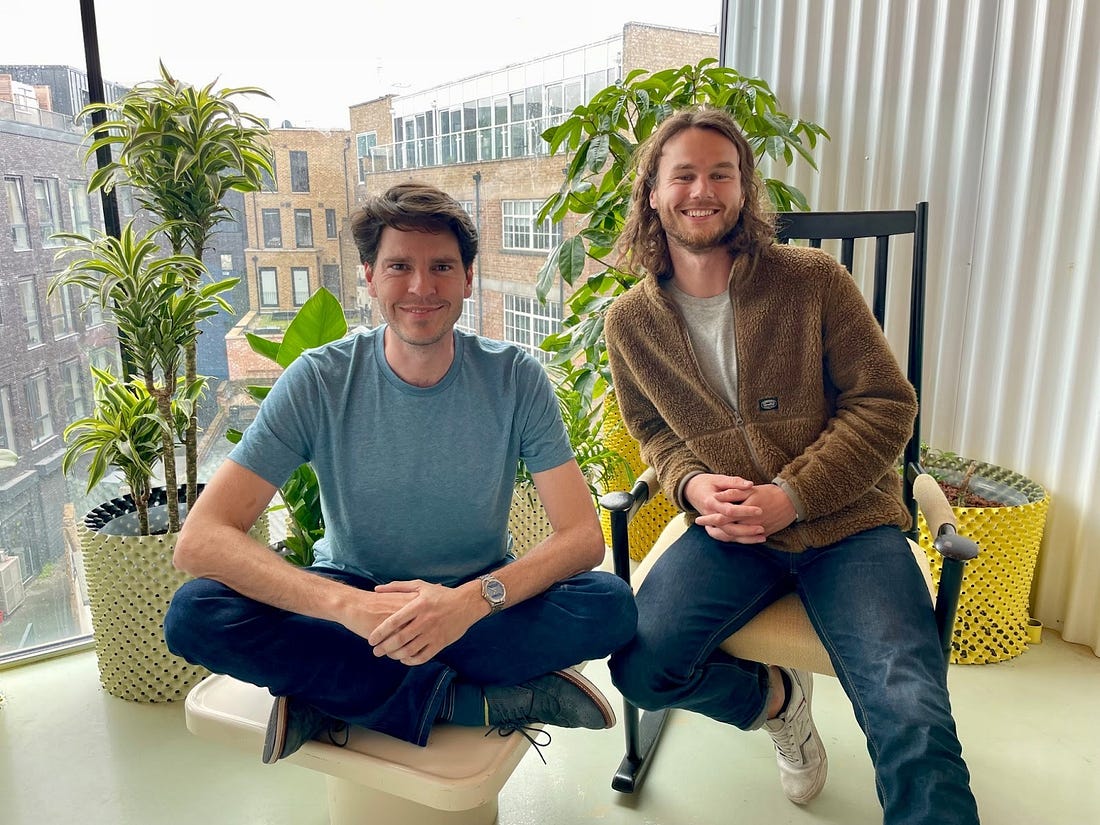
✨ Hey there this is a free edition of next play’s newsletter, where we share under-the-radar opportunities to help you figure out what’s next in your journey. Join our private Slack community here and access $1000s of dollars of product discounts here. Recent top post: 2026 Tech Private Markets Analysis. If you are a person who has been in regular meetings for the past few years, you have probably heard of Granola. And if you have heard of Granola, you may know the general consensus about it: Granola is the best AI notetaking tool for meetings. It transcribes your meetings, writes helpful notes, enhances your own notes… The sort of stuff you would’ve needed a real assistant for. There is one version of the world where Granola is truly just that: an AI notetaker. If co-founders Chris Pedregal and Sam Stephenson wanted to, they could probably thin down the team to ten people or so, never raise another round, and run Granola as a profitable lifestyle business that owns its niche.
So it may surprise you when I say that Granola’s vision (and the reason they raised a $43M Series B from Nat Friedman, NFDG, and others last year) is far bigger than AI notes. Co-founder Sam told me: “We want Granola to be the primary interface where knowledge workers do most of their work.” If you are looking for interesting startups to join, this sentence should probably make Granola significantly more interesting. Now we’re talking about a many-billion dollar market. Now we’re talking about a trajectory that would position Granola as one of the most impactful startups of this decade. Then again, you probably just know Granola as a notetaker. So… how? What is the plan here? And should you join to help Granola accomplish this mission?
Don’t underestimate the scribeEvery software engineer knows that modern code editors (IDEs) are spectacular. They can help engineers work far faster and make fewer mistakes. And the AI versions these days could be the best yet. On their pre-launch 2024 landing page, Granola wondered: Why is there no great IDE—no great workspace—for knowledge work? Today’s knowledge work is “fragmented across dozens of different tools,” co-founder Sam Stephenson said. “You’re constantly switching between email, Slack, your CRM, task management, [and so on]. We believe AI agents will eventually handle much of that context-switching and updating for you.” You may have seen some early attempts at this in the market. Email software like Gmail and Superhuman these days can try (and often fail) to write good emails for you, as one example. Anthropic launched Claude Cowork back in January. Companies are aware that AI could integrate into everyday work. Granola has had this in mind ever since they began working on their product back in 2023. The key question, though, was how to realize this vision in a way that would be actually useful. How do we make AI feel like a valuable extension of yourself and not a context-less slop machine? Sam says the answer was simple: “For [this] to work, you need something that understands your context deeply. And meetings are where the most important context lives.” If you were a medieval ruler with a royal court, you would want your advisors and scribes to be present for everything. You would want them to have the same information you do so that they could help you make good decisions. And you would trust them over a know-it-all who rode in from afar with no information. Starting as a humble meeting scribe, then, was the smart place for Granola to begin. The Cambrian explosionPublicly, all was quiet for the first year that Chris, Sam, and their small team worked on Granola. Internally, the product was undergoing an iteration process that Jim Fisher (software engineer) describes as a Cambrian explosion approach. The traditional v1, v2, v3 path was ditched for an iterative process in which they would onboard users one-by-one and ship all kinds of different permutations of the product; different features, different styling, different everything. As 2024 approached, they honed in.
And then, when Granola launched in the spring of 2024, they removed 50% of their features. “If you add 50 buttons in there with new features,” Chris Pedregal said, “you kind of kill the golden goose.” This focus on restraint, taste, and what I would call “actual usefulness” paid off. Word-of-mouth took off and Granola was quickly recognized as the most reliable AI notetaker around. And people stuck around. “From very early on, we had this retention curve that just flattened out at a really high level. People who did one meeting with Granola kept coming back. We didn’t have to growth hack our way to virality - once people tried it once, they just naturally kept using it for all of their meetings,” Sam said. 70% of people stuck around for a week. 50% of people stuck around for ten. You know it’s good because an AI notetaker isn’t exactly an impossible product to build. (This isn’t powerful military tech.) I bet you could go spend a few hours with Claude or ChatGPT and vibe code a meeting notetaker this afternoon, and maybe it would even work. As a result there are 100s of legitimate competitors for Granola; the idea feels simple and easy to replicate. And, yet, Granola is winning. They are winning a lot. This says something about the team’s approach: the restraint, the taste, the knowing how to build and what to build and when. There’s a long way to go still, and “[the founders] don’t feel like we’re there yet: they want to keep listening to users and keep trying to think about how to make the product better,” Vicky Firth said. Sam and Chris are “down-to-earth, optimistic, and visionary,” someone on the team said. “They are super transparent - a lot is shared about how they’re feeling, what investors are saying, how the company is doing. They have strong opinions about the product but place high trust in the team.”
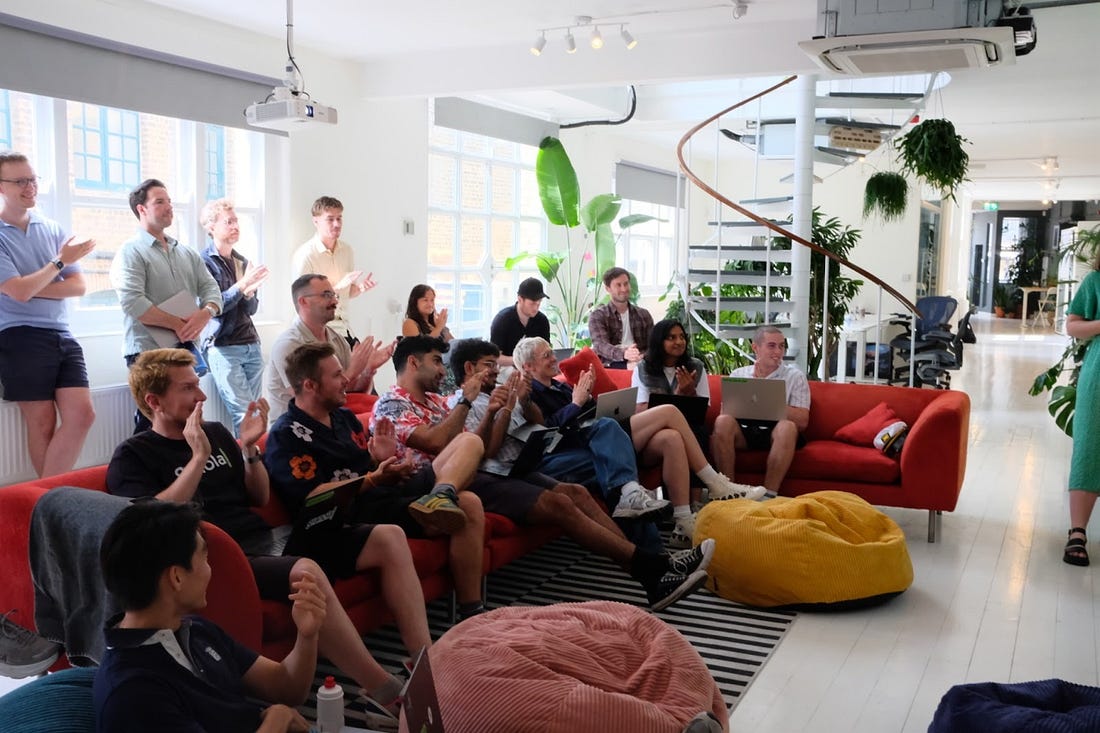
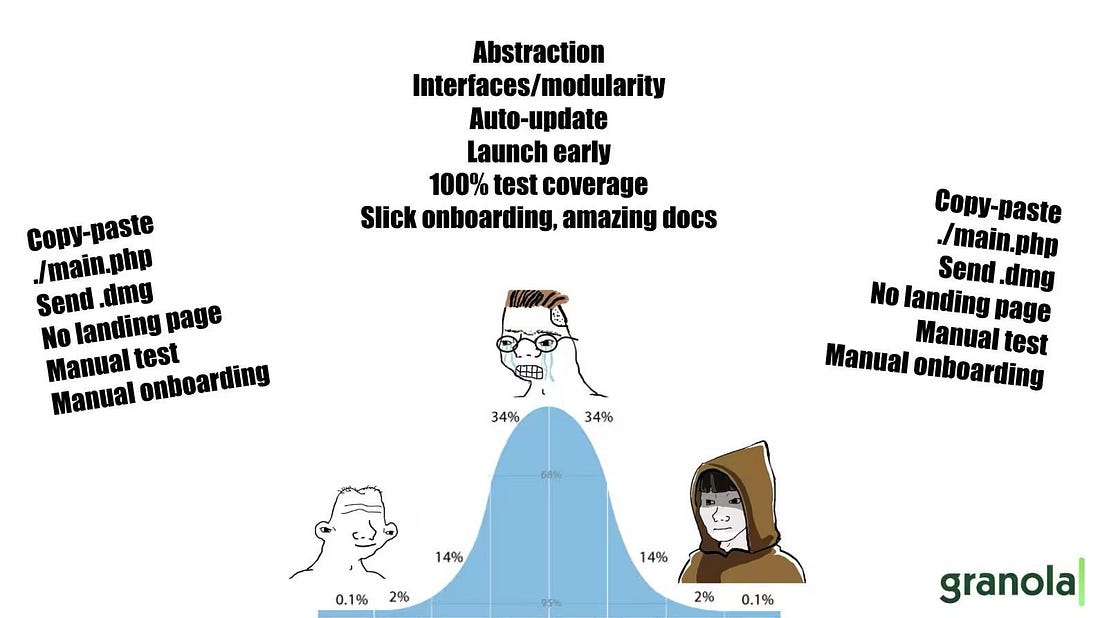
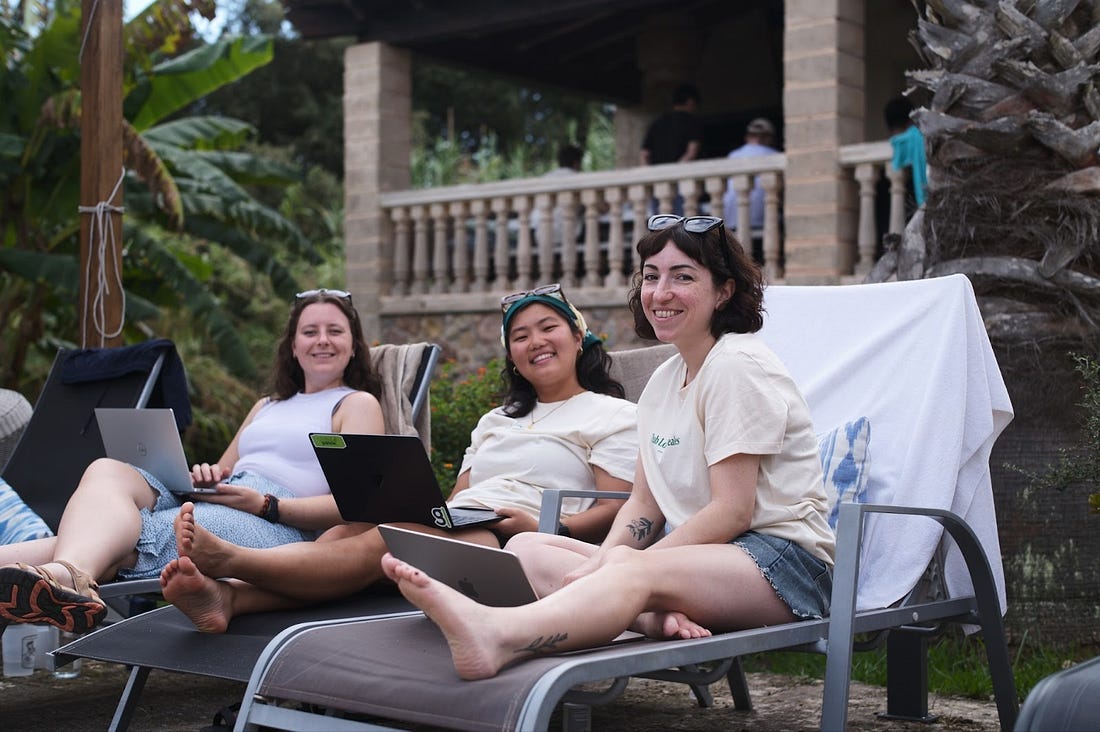
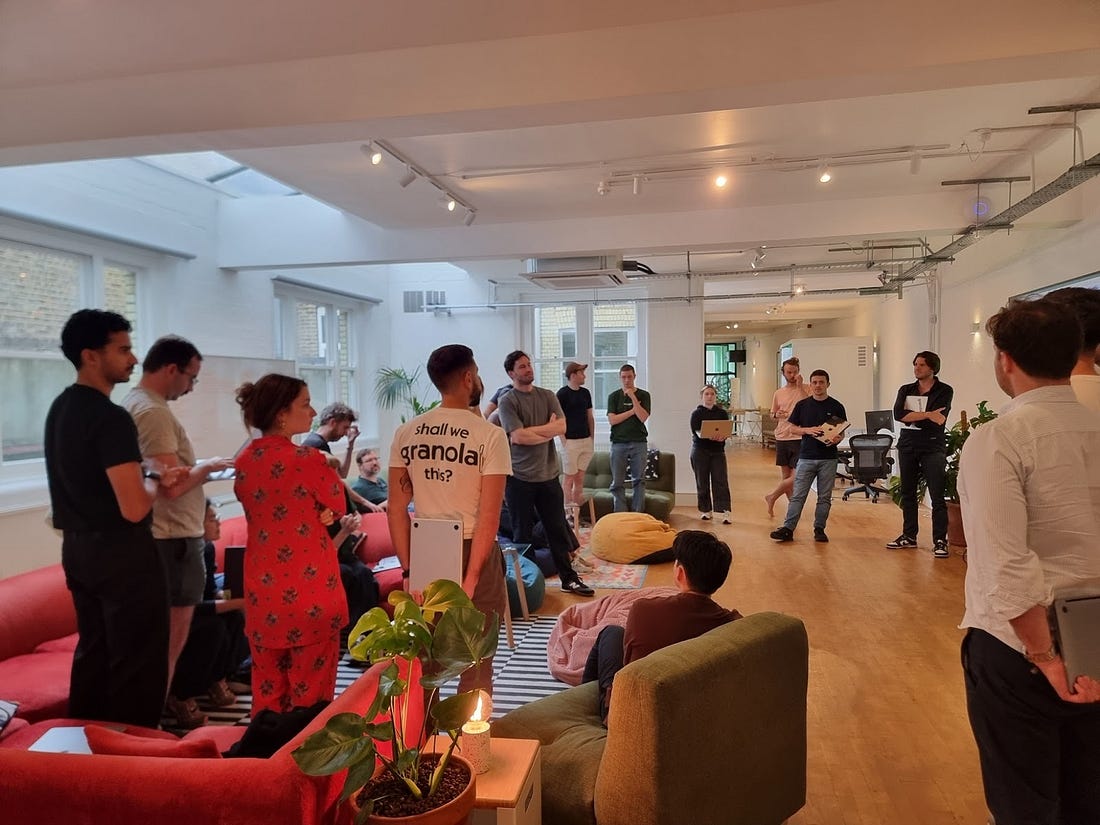
Traction? Check. Smart, measured founders? Check. What about the culture? Merge first, ask questions laterGranola’s offices in London and San Francisco, where everyone works in-person, are not safe spaces for complainers. “There is a huge amount of positivity and very little complaining at Granola,” Vicky told me. “This covers everything from big product changes all the way to which drinks are in the fridge. There’s a buzz here that you don’t see everywhere.” There is a “just give it a go” energy at Granola. You’re trusted to do a great job and, if you try something but it doesn’t work (like when Jim, an engineer, deleted half of the prod database), the team is not going to bury you for it but rather solve the problem and move on (and maybe ask you to drink ‘OMG whisky’.) “There are no pre-code merge reviews,” an engineer said. “You just merge and iterate! Many other companies I’ve worked at would balk at this.” But it works at Granola, and this general philosophy—just do a good job and we’ll iterate as we go—seems to be present on every team.
How long should you expect to work? Everyone I talked to said they worked about 9 or 10 hours per day, but they also stressed that hours can be flexible. “You’ll often find me dashing off at 5pm for another commitment,” someone said. My overall impression is that, while the team at Granola works hard, this is not a startup that will ask you to come in on weekends; they will not force you to stay up until 2AM working on some feature (though I’m sure you could do it if you wanted to). Shreman Shrestha, who works on various business and growth projects, had three points to sum it up: “1. Highest density of talent I’ve ever encountered. Top-shelf talent, great founders, and perhaps a cheeky pint after work. What more could you ask for? Should you consider joining Granola?If you have read this spotlight and feel like Granola is the right company and right team to build the primary interface for knowledge work, then the basic filter is: Do you live in London or San Francisco? If you don’t, are you willing and able to go live in London or SF? Perhaps you could get hired as a contractor somewhere else, but the entire full-time team at Granola works in-person.
Beyond that, “if acting with high caution or constantly trying to play devil’s advocate… are your default modes, Granola probably isn’t the place for you.” You should be the sort of person who assumes things can work, approaches your job with optimism, and can take a lot of autonomy. If you want to increase the chances that your application gets looked at, you could put in a little more effort than usual. “We love to see side projects, or signs to show you care,” co-founder Sam said. (As it happens, we recently wrote an essay with some advice on doing just that.) Most of the people I talked to described having a one- or two-week work trial in the office. “I felt I was able to have impact quickly,” Vicky, CX lead, said of her work trial. “Thankfully they felt the same!” A few of the folks I spoke to told me that they had been rejected for jobs at Granola they’d originally applied for, but that the team had then reached out in the future about other roles. Another encouraging sign that—if the company seems interesting—you should let them know how you can add value. Granola has a long way to go if they want to become the interface where most knowledge work gets done. But, with AI notetaking, they have already won the first game. Why not go help them win the next? Thank you to Granola for supporting Next Play and making this spotlight possible. You're currently a free subscriber to next play. For the full experience, upgrade your subscription.
|
Tech’s favorite AI notetaker is on the verge of becoming a product worth billions
Thursday, 19 February 2026




Subscribe to:
Post Comments (Atom)


No comments:
Post a Comment