
This is Brad DeLong's Grasping Reality—my attempt to make myself, and all of you out there in SubStackLand, smarter by writing where I have Value Above Replacement and shutting up where I do not… Reacting to Matt Yglesias's Confession that A.I. Progress Is Giving Him Writer’s BlockMatt’s subhead: “It’s hard to write good articles when you have no idea if everything is about to change”. In short, Matt has half-drunk the AI-psychoactive koolaid. My view: Matt should talk to...
Matt’s subhead: “It’s hard to write good articles when you have no idea if everything is about to change”. In short, Matt has half-drunk the AI-psychoactive koolaid. My view: Matt should talk to Ezra Klein, and have Ezra Klein recount to him Ezra’s days in San Francisco, when it seemed every day made him stupider as he found himself rubbing elbows with yet another bunch of crypto-enthusiast grifters and self-grifters. while BitCoin is still a thing today, nobody sees it as anything societally transformative, or indeed as having any other serious use case other than “digital gold!” and “number go up!” “AI” will have more of an impact, yes, and the balance between cynical grifters and self-grifters on the one hand and genuine technologists exploring use cases on the other is very different. But the vibe is the same: in both cases the evidence of the rapid total overturning of human society is not present…And yet Matt thinks there is a genuine fork here, and stands transfixed, like Buridan’s Ass:

That’s where Matt’s pre-paywall version ends. But the real meat of the piece comes lower down:
As you know, my view is that when Matt needs to take a step back when he starts slinging around things like:
And:
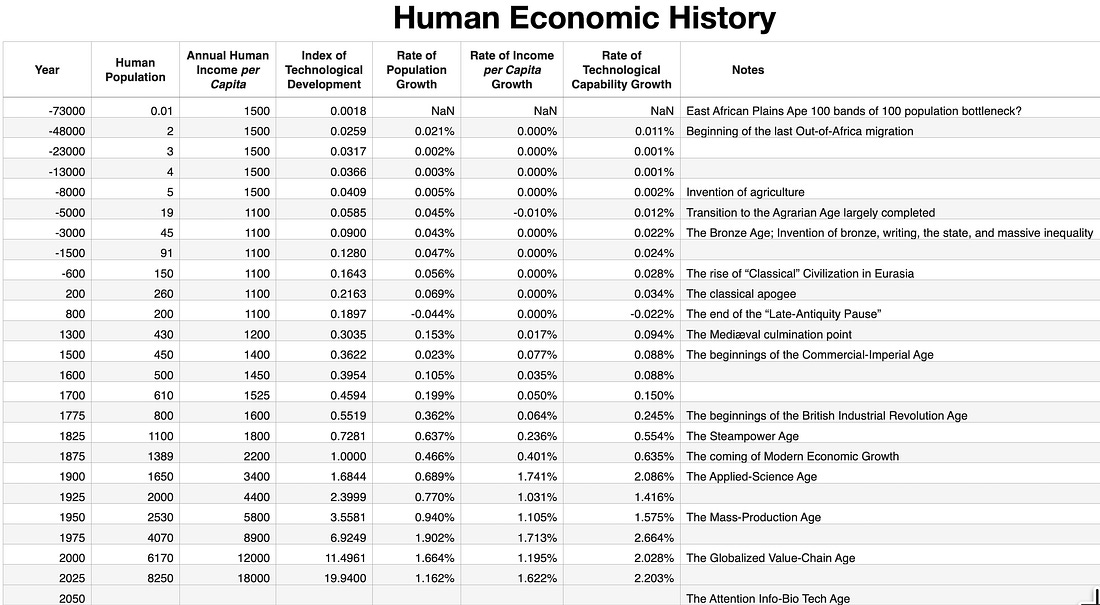
Consider the human economy over the past 75000 years, very roughly:
We have been “cultural” specieses for millions of years, roving around in bands of at most 100 or so, with our band-level division of labor and generationally transmitted tool-making and tool-using “technologies” being our big edge. But even as of 50,000 years ago, we were not a huge Darwinian success. Yes: there were then perhaps 2 million of us scattered around Africa. Plus perhaps a couple of hundred thousand of our very close Homines Sapientes Neandertalenses and Homines Sapientes Longi cousins. But there were also 2 million other great apes scattered around Africa and greater Sundaland. And our “technology” was limited to (a) what we could carry, and (b) what we could remember down the generations, (c) as that fit with the varied environments in which we lived. Then between the year -48000 and -8000 we spread Out-of-Africa across Eurasia, Australasia, and the Americas, intermarrying along the way with our close cousins, and greatly expanding our technological portfolio as we figured out how to successfully adapt to pretty much every ex-Antarctica environment on the globe. But, still, that rate of adaptive technology progress was very limited—1% per millennium, say, perhaps? The sea-change came 10,000 years ago, when we became more sessile and invented agriculture. Then our “technology” could be not just what we could carry and remember, but what we could build and what our built environment could remind us of. And then 5,000 years ago we invented writing. And we became not just a cultural species, not just a technological species with what we could carry, build, remember, and have our built environment remind us with, but a genuine world-scale æon-scale time-binding space-binding anthology intelligence. Then the real ASI emerged. Not an Artificial Super-Intelligence constructed in a computer lab as some kind of silicon digital god that some want to teach the rest of us to worship and that Elon Musk wants to teach the rest of us to try to bang. But, rather, the distributed knowledge and thought base that is the Anthology Super-Intelligence that is humanity’s collective mind present and past stored in and as our information technology capital stock. And since then, each generation, we have been seeing further than other humans and those before us. But it is not because we, individually, have been becoming (much) smarter and cleverer. It is because we have been finding ourselves, over and over again, standing on the shoulders of ever-taller pyramids of giants. And so, as the scale of the number of currently thinking brains in the human race and the accessible storehouse of knowledge and the power of our information technology tools for accessing that storehouse have grown, the pace of technological advance has grown as well. Perhaps 3% per century during the Bronze-Writing and Iron-Antiquity ages up to the classical apogee with the Roman Empire at the west and the Han Empire at the east edge of Eurasia in the year 200. A seeming retrogression over the next 600 years as it really looks like knowledge of some technologies and of how to organize some of the division of labor falls away, and world population may have been smaller in 800 than in 200. Perhaps we should appease the sensibilities of snowflakes by calling this not a “Dark Age” but rather a “Late-Antiquity Pause”. But technological progress during the long Agrarian Age after -8000 was not guaranteed. After -3000 these societies were largely societies-of-domination, in which ideas were primarily judged not by whether they were true about the world but whether they were useful in helping a predatory élite extract a third of the crafts and a third of the crops by force, fraud, and rigged-price market exchange. With the coming of the mediæval period around 800 or so, however, standing-on-the-shoulders of giants regained its mojo: rates of technological progress of perhaps 10% per century up until 1600. At that time people were beginning to look around—Francis Bacon and his New Atlantis and Tommaso Campanella with his City of the Sun are my poster boys—and note that there did seem to be an arrow of technological progress in history. Before that had not been the case. Consider the “Nine Worthies” of Jacques de Longuyon’s The Peacock’s Vows—pagans Hektor of Troy, Aleksander of Makedon, and Gaius Iulius Cæsar of Roma; Jews Joshua the Prophet, David the King, and Judah the Hammer; and Christians King Arthur Pendragon of Britain, Emperor Charles le Magne of the Franks, and Advocate of the Holy Sepulcher Godfrei de Bouillon; all seen on a level as behaving like 1300s-era knightly aristocrats. Then the gears shift:
That is the big-scale picture of human history. Now, in our generation, the leading-sector Schumpterian creative-destruction upending of orders and institutions as everything established and fixed is steamed away process has set its bulls-eye on the learned intellectual professions that Matt and I specialize in. And it is not a comfortable thing to be in the bulls-eye. But neither was it comfortable to be John Henry vs. the steam-drill. Nor was King Arkhidamos III the Europontid (reigned -360 to -338) pleased to see Philippos II of Makedon introduce, alongside his military innovations of the sarissa-phalanx and the companion shock-cavalry, the torsion catapult: “By Hercules! Man’s bravery is ended!” But I am a Gopnikist. Much better ways at accessing and remixing the real ASI—the Anthology Super-Intelligence of human collective wisdom—is not a Digital God. It is natural-language front-ends to structured and unstructured databases: something that, given our mental affordances, is of immense value. It is very large-scale, very big-data, very high-dimension, very flexible-function regression-and-classification analysis tools: also something of immense value. These are our tools, not our masters, with unanticipated and often adverse consequences as tool development often brings. These are not our adversaries who are going to outthink and outsmart and dominate us. What we do about our problems over the next decade matters to us. A large part of what we do about our problems today is to invest in boosting the capabilities of our successors a decade from now to master the problems they will face then. How much and how to invest is worth thinking about, hard. Dealing with our problems as we face them over the next decade is worth thinking about, hard. Throwing up our hands because maybe not just the learned intellectual professions but much more will be overthrown over the next decade or two is certainly not helpful, and hence almost surely not rational. If reading this gets you Value Above Replacement, then become a free subscriber to this newsletter. And forward it! And if your VAR from this newsletter is in the three digits or more each year, please become a paid subscriber! I am trying to make you readers—and myself—smarter. Please tell me if I succeed, or how I fail…##reacting-to-matt-yglesiass-confession-that-a-i-progress-is-giving-him-writers-block |




| ||||||||||


No comments:
Post a Comment