
This is Brad DeLong's Grasping Reality—my attempt to make myself, and all of you out there in SubStackLand, smarter by writing where I have Value Above Replacement and shutting up where I do not… "Star Trek: The Wrath of Khan" as Franchise Hinge: Wednesday Comfort WatchingThe Day Trek Changed: From “Where No Man” to Wrath— & a real franchise was born. Sixty years ago, production wrapped on the second “Star Trek” pilot: Where No Man Has Gone Before” Friday, December...
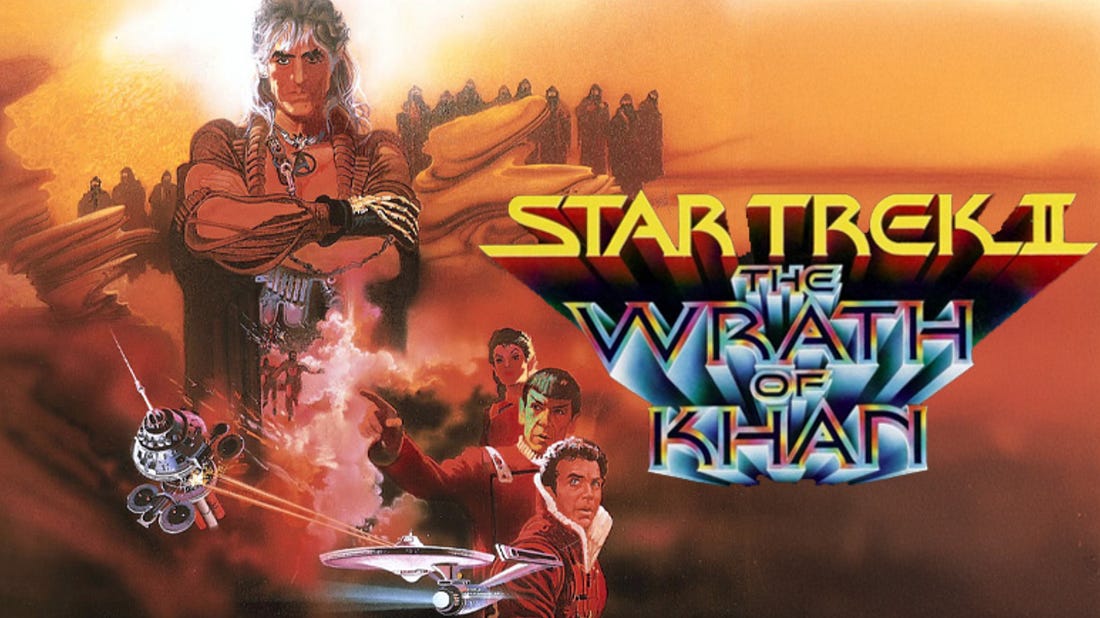
The Day Trek Changed: From “Where No Man” to Wrath— & a real franchise was born. Sixty years ago, production wrapped on the second “Star Trek” pilot: Where No Man Has Gone Before” Friday, December 24, 1965. That, I think, was the first true franchise-hinge moment. The second came seventeen years later, with Nicholas Meyer taking the quarterdeck of HMS Star Trek on the voyage of “The Wrath of Khan”…Sixty years ago, Friday, December 24, 1965, production wrapped on the second “Star Trek” pilot: Where No Man Has Gone Before” . That, I think, was the first true franchise-hinge moment. It created “Star Trek”. But it did not make “Star Trek” a cultural phenomenon, or an economic IP franchise engine worth the attention of the princelings and princesslings of Hollywood. That came after. I recall a friend whose daughter returned home from her first semester at an engineering college. She immediately said: This vacation we are going to watch all 80 episodes (including “The Cage”) of the three seasons of ST:TOS. And they did. But that would not have happened without the second franchise hinge moment, the one that came second came 17 years later. What was that second moment? It was the launch and then the phenomenal launch of the movie: “Star Trek: The Wrath of Khan”.
The way things had gone down between 1964 and 1982 was, roughly:
Did ST:TMP actually make any money? Hollywood accounting is notoriously the domain of thieves, but $139 million worldwide on a roughly $35–44 million budget. But expectations had been sky-high after Star Wars, and overruns plus marketing and distribution costs meant Paramount judged the return underwhelming. There is a peculiar kind of mindwarp found in the big-budget-studio piece of Hollywood that is in sharp contrast to the Golden Age of pre-TV. Pre-TV, you needed a lot of movies to fill a lot of theatres owned by studios. So you made movies, rapidly. And a base hit was a base hit. But in the post-TV post-theater-chain-breakup world, simply saying “this will be a solid single” in terms of market no longer got the greenlight. For there were others out there pitching things they promised were guaranteed homers. And since you did not have to fill your theaters, committing studio and investor money to something that did not aim high tended not to get the enthusiasm: better to hold your financing for someone whose this-will-be-a-homer pitch was convincing. That almost always the people making that this-will-be-a-homer pitch were delusional, and that their sole superpower was one of hypnosis, was something that studio executives and investors rarely learned. Thus never mind that ST:TNG almost surey was, ex post, a better financial use of Paramount’s own and investors’ money than the marginal other Paramount project. It wasn’t cloud-castle good and profitable. And so, if “Star Trek” were to have a future in the 1980s and beyond, the successor movie would have to show better performance-price ratios. Hence Paramount pushed for a cheaper, livelier sequel model. $12 million budget for ST:TWoK. And here came the second franchise hinge: At least as Nicky Meyer recounts it (and I find him completely plausible), it turned out to be a very strange hinge of the franchise indeed as he carried: ST:TWoK on his back, from plot and script coherency through the final day of shooting and into post-production. The final script, and then on through direction and editing to produce Khan’s coiled rage, Spock’s earned death, Kirk shaved down from preening star to captain outmatched by foe and fate, and submarine-tight direction restored stakes and audience trust.: No Nicholas Meyer taking control of the quarterdeck to produce a final script in twelve days, no “Wrath of Khan”. No “Wrath of Khan”, and “Star Trek” as a Hollywood, cultural, and economic phenomenon dies after ST:TMP. Odds are that nothing subsequent—extraordinarily varying in quality as it has been—from the best moments of ST:TNG and ST:DS9 to the bizarre and strange storm of photons that is the recent ST:§31 Michelle Yeoh vehicle would ever have been made. And so we have:
Nicholas Meyer said, when the film was added:
Read Meyer’s memoirs, and you get the following major beats: Hornblower-in-space vision: Meyer reframed “Star Trek” as nautical adventure, returning to one of Roddenberry’s original root bundles. This made unifying tone, visuals, and character arcs easy. For what was “Star Trek” at its core but Horatio Hornblower in outer space? This had a bonus of providing stakes via prioritizing nautical aesthetics over futurism—claustrophobic submarine-like interiors, military uniforms, and blinking instrumentation to replace soft pastels and tracksuits. Pop metaphor, not hard science: “Star Trek’s” superpower lies in entirely in allegory—war, ecology, racism—refracted through sci‑fi. The universe it presents makes no hard-scientific sense. But it can make human sense, pulling human questions out of our present-day context. Meyer’s twelve-day script-synthesis forced-march: He merged five disparate drafts into a coherent screenplay in twelve days to meet ILM’s deadline for beginning visuals. Meyer asked himself: Why not make a list of everything we like in these five previous script drafts? Then I will string them together. And that will force the lot. Direction as key, given the very difficult star dynamics: Meyer dealing with:
Editing for tightness: Indeed, cutting half the dialogue. Spock’s death must be earned: The question was not whether to kill Spock, but how to do it well. And without Meyer? “Star Trek” likely ends in 1979. The cascade followed:
Not trying to spend a gold-plated budget, “Star Trek” IV’s mainstream comedic triumph, VI’s political grace, and TNG’s open spec pipeline under Piller’s character‑first discipline produced tghe enduring cultur-entertainment complex we have tody. Of course, the best “Star Trek” movie remains “Galaxy Quest”… The “12 Days” Star Trek II: The Wrath of Khan” chapter from Nicholas Meyer’s “The View from the Bridge” memoir:
If reading this gets you Value Above Replacement, then become a free subscriber to this newsletter. And forward it! And if your VAR from this newsletter is in the three digits or more each year, please become a paid subscriber! I am trying to make you readers—and myself—smarter. Please tell me if I succeed, or how I fail…#star-trek | |||||||||||||||||||||||||||||||||||||||||||||||||||




| ||||||||||


No comments:
Post a Comment