
This is Brad DeLong's Grasping Reality—my attempt to make myself, and all of you out there in SubStackLand, smarter by writing where I have Value Above Replacement and shutting up where I do not… Let Us Attack "Continental Philosophy" & Philosophers!: Thursdays in AcademiaTheodore Adorno, Greta Karplus, & a Late-Capitalist Frankfurt-School Marriage; or, why what Theodore Adorno needed was not respect and attention from philosophers, but treatment by psychiatrists...
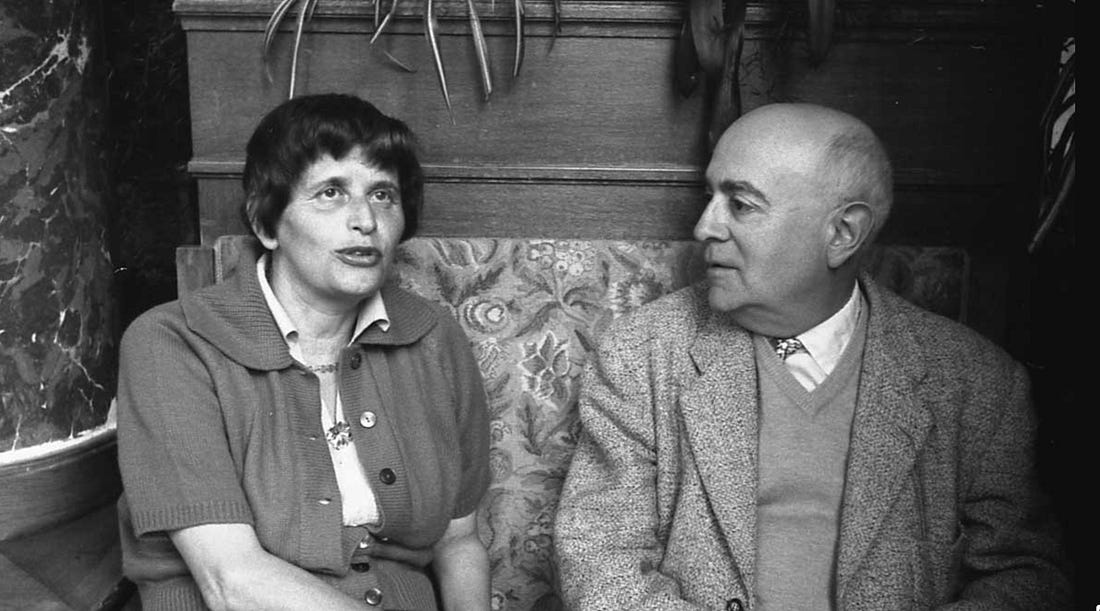
Theodore Adorno, Greta Karplus, & a Late-Capitalist Frankfurt-School Marriage; or, why what Theodore Adorno needed was not respect and attention from philosophers, but treatment by psychiatrists for a tremendously dire case of patriarchal misogynistic self-oblivious delusion. Or, bluntly, for being a callow a**hole egomaniac (which is, admittedly, a common failure mode for boys whom too many authority figures told them they were very special when young, but even so)…
How did I get there? By chasing links due to an insufficient ability to keep myself on-task. Let me start with a little throat-clearing: Back in the Day, when I was a college senior, I had the extraordinary privilege of taking a seminar on “Deconstruction” from the truly brilliant Stanley Cavell. I ended it thinking that much of “Continental Philosophy” was an intellectual power game, in which sometimes the—very true—argument that “the map is not the territory” was decisive and led to the rejection of a group of authors positions, sometimes it did not, and that the only intelligible reasons for why it was sometimes one and the other were reasons of social-network allegiance and academic-positional power. In short, bad “Continental Philosophy” was a series of the following intellectual moves:
Now there are good “Continental Philosophers”! I was and am wowed by Keith Tribe’s deployment of Foucaultian theory to understand the British classical economists: <https://braddelong.substack.com/p/hoisted-from-e-archives-two-months> But there are a very great many bad Continental Philosophers. And so I find myself agreeing with Matthew Adelstein here:
And I see a protest:
But what, then, is the reason that Butler claims that we ought to view A as not B but C? Why should we of that A (the relationship of gender to culture) as not B (as sex is to nature, i.e., a fitting of a conceptual frame to the patterns of mammalian reproduction that exist out there in the real world), but instead as C (gender is the discursive/cultural means by which ‘sexed nature’ is produced)? I mean: certainly B is there: There are processes of meiosis and fertilization, there are animals in which flipped genetic switches make some providers of ova and a substantially disjoint set providers of sperm, there are all kinds of other biological structures and patterns that usually but not always cohere with those flipped switches (but not always! seahorse fathers carry the young, after all!). And we call this “sex” and we call highly correlated cultural labels of biological bodies “gender”. But we all agree that this is a map, not the territory: There are no platonic ideals of ♂ and ♀out there. There is no “So God created man in his own image, in the image of God created He him; male and female created He them…”. (This is so, even though most human cultures assume that there are such platonic ideals of ♂ and ♀out there and the assumption is so strong that it seriously and badly misled Platon as to the inner structure of the universe.) But while you can truly say that gender is not congruent to biological sex in nature, Butler provides us with no good reasons, anywhere, to take “gender… [to be] the discursive/cultural means by which ‘sexed nature’ or ‘a natural sex’ is produced…” Our homines habilenses ancestors had a sexed nature before there was any human culture, after all. So I went down the rabbit hole. And, today, chasing links leads me to see another protest, this time about Matthew on Theodore Adorno:
Okay. That was Adorno. What does James have to say to explain it? This:
My response is: No. Simply Not. Bulls***. The rhetorical moves of bad Continental Philosophy—1. Viewpoint X is bad because it is a map. 2. The map is not the territory. 3. Therefore we reject viewpoint X. 4. Here is my map: viewpoint Y. 5. My map is good. 6. FULL STOP—are best understood not as intellectual arguments but rather as deployments of social-network power and as products of human psychology. And so I have once again come back up the same rabbit hole I came back up back in 1982, with much the same conclusion: that looking inside the texts of the bad “Continental Philosophers” (NOT ALL CONTINENTAL PHILOSOPHERS!) is the very worst place to seek for any valid insights. Thus one had to look very much outside the text at the psychological life-experiences and socio-cultural-institutional settings of the bad “Continental Philosophers” to understand why they were at the rhetorical level, spending so much energy and time doing nothing but wasting their own and their students’ brains—and trying to waste mine. (Admittedly, I had been predisposed to think this by having read, the year before, E.P. Thompson’s The Poverty of Theory critique of Continental Philosopher Louis Althusser the year before; which reading had been followed a month later by Althusser’s descent into deadly madness and his murder of his wife Hélène Rytmann.) Let me stick to Adorno. Contrary to what James claims, Adorno, after all, is not saying “the standard map is not the territory: here are some other ‘what-if’perspectives on it that give us a broader and less constricted view”. There is no “what if…?” in Adorno’s passage. There are, instead, declarations: THIS IS HOW IT IS:
What happens when I take the black marks on the pages of the codexes of Minima Moralia and Dialectic of Enlightenment, when from it I spin-up a subTuring instantiation of the mind of Theodore Adorno, run it on its separate partition in my wetware, and then ask SubTuringAdorno why his map is to be preferred? In what sense is his view less “not the territory” than, say, Archbishop Cranmer’s view: that marriage is for the sake of the “children… [as] a remedy against sin and to avoid fornication… [and] for the mutual society help, and comfort, that the one ought to have of the other, both in prosperity and adversity”? I get no intelligible answer at all. ... Continue reading this post for free in the Substack app
|
Let Us Attack "Continental Philosophy" & Philosophers!: Thursdays in Academia
Thursday, 18 December 2025






Subscribe to:
Post Comments (Atom)


No comments:
Post a Comment