
LAST CHANCE Hi all, This is the final post in our four‑part series, Ten things I’m thinking about AI. It maps the next 24 months of AI as we mark ChatGPT’s third anniversary – and it’s the most comprehensive macro take we’ve published this year. If you missed the first three parts, catch up here: Part I: The Firm [read here, no paywall] Part II: Physical limitations [read here] Part III: The economic engine [read here] Part IV: The macro view [today’s email]
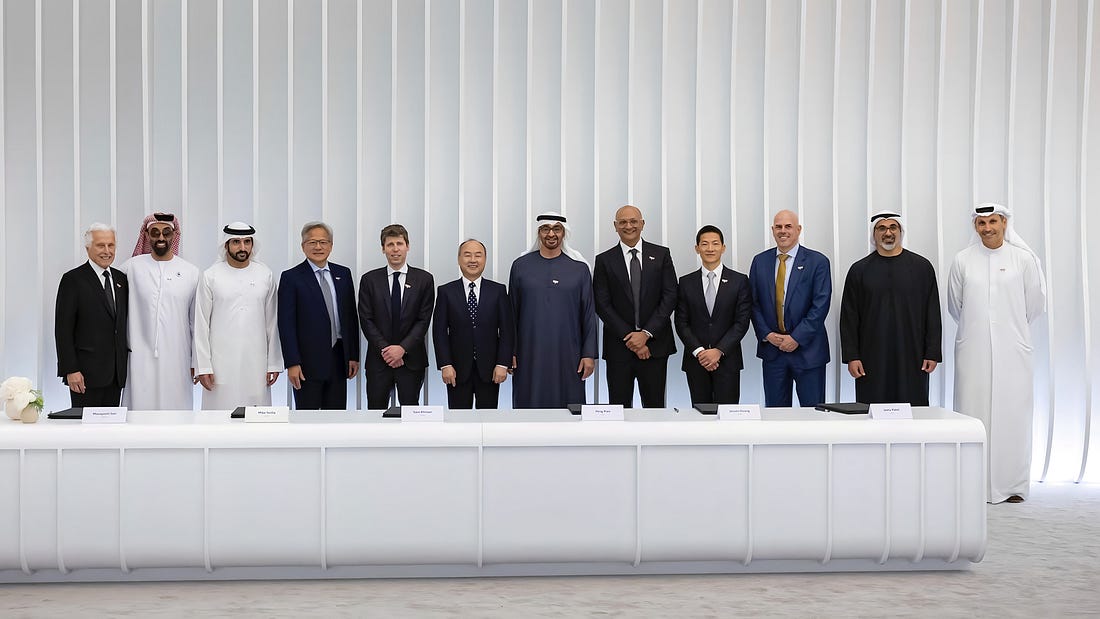
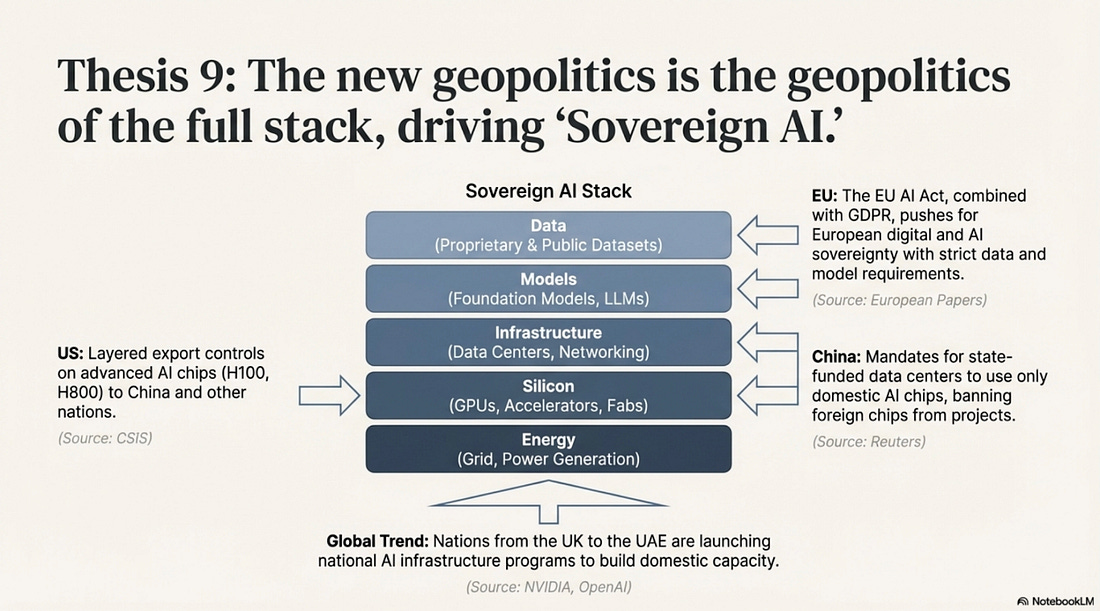
Part 4: The macro view9. Sovereign AI is splintering the stackIn early 2025, sovereign AI was mostly posture. The AI landscape has become starkly bipolar: the US controls 75% of global AI compute, China 15%, leaving everyone else marginalised. You can adopt US/Chinese AI systems and become vulnerable to data exploitation, service restrictions, embedded values, and unfavourable terms. Or accept weakness, limit adoption and fall behind as frontier states achieve economic, scientific, and military breakthroughs. You can see the logic hardening. Britain is building national infrastructure with Nvidia; the Gulf is spinning up its own polity via the $100 billion MGX vehicle. OpenAI’s “Stargate” initiative fits this fractured landscape perfectly. Stargate UAE offers a gigawatt-scale compute cluster under US-aligned governance. Meanwhile, South Korea joins the orbit as a chip arsenal, and Saudi Arabia finances “AI factories” for local workloads.
Even Brussels is softening regulations to keep champions like Mistral onshore. Officials now discuss compute and models as strategic assets to be rationed through alliances, not left to the market. The challenges are most acute for mid-sized and smaller nations, where mid-sized means anything smaller than the US or China. One possible route may be multinational or minilateral approaches that involve pooling capabilities or resources, as argued in this working paper from an Oxford University research group. This question is also the focus of a working group I co-chair on how governments need to approach next-generation computing infrastructure. This logic virtually guarantees a splintered world. We are moving toward distinct US-aligned, China-aligned, and “non-aligned” stacks. The era of the borderless internet has come to an end; the era of the sovereign stack has begun.
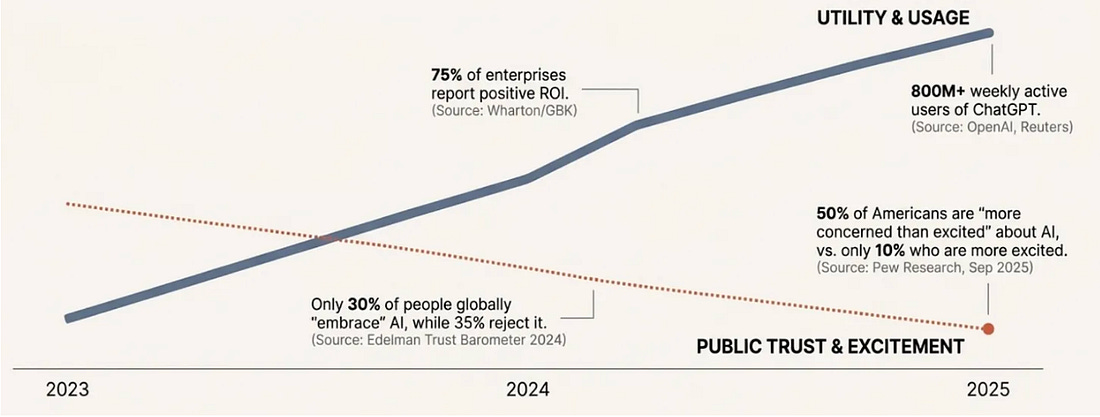
10. A growing utility–trust gap risks a societal schismWe are living through a massive psychological split. On the one hand, utility is winning: 900 million people now use ChatGPT and other LLMs to code, write and think, bringing the “sovereign stack” into their personal lives. The utility is too high to ignore.¹ Yet, familiarity has bred fear, not contempt. Three-quarters of Americans now believe AI will negatively impact their lives, a figure that has hardened even as adoption skyrockets. We have become pragmatic addicts, dependent on a tool we fundamentally do not trust. This isn’t a “tech backlash” of the previous eras. I see it as a new kind of social bargain – we will use the machine to do our jobs today, even while we suspect it will take our jobs tomorrow.
Subscribe to Exponential View to unlock the rest.Become a paying subscriber of Exponential View to get access to this post and other subscriber-only content. A subscription gets you:
|
🔮 Ten things I’m thinking about AI | Part 4
Saturday, 29 November 2025




Subscribe to:
Post Comments (Atom)


No comments:
Post a Comment