
How this AI startup with a high-agency work culture has scaled fast with a tiny teamZingage is bringing healthcare home
✨ Hey there this is a free edition of next play’s newsletter, where we share under-the-radar opportunities to help you figure out what’s next in your journey. Join our private Slack community here and access $1000s of dollars of product discounts here. TL;DR If you only have a minute or two, here’s what you should know about Zingage.
Does your startup make the world a better place?For many companies, it is a harder question to answer than you might think. I have friends working at startups who, to answer this, would have to build a 7-step flowchart to show me how the startup has a positive impact on real people in the real world. “Well, we built an integration for A company, which helps B company, which in theory could make the world a better place by increasing the efficiency of C…” Hmmm. Interesting. With Zingage, answering this question is quite straightforward. There is only one step. Founders Victor Hunt and Daniel Tian and their team are building an agentic AI layer for home care agencies so that healthcare can improve for people at home who need it most. Now that feels like a mission almost anyone—even the most jaded tech startup skeptic—could get behind. Of course, making the world a better place is not the only qualification you need to be a successful startup worth working at. You also need a product that can make a lot of money. Turns out that, so far, Zingage is doing quite well on that front too: they recently launched a $12.5M seed round led by Bessemer. This fundraise was built on the back of some impressive metrics:
But how did they do all of this? What are they solving? What’s the ceiling? What even is home care? This essay will answer those questions, and more. Healthcare is a huge market, and it’s coming back homeThe term “home care agency” does not tend to come up in daily conversation. It is worth explaining the (very important!) industry Zingage is actually in before diving into their product and traction. So imagine this: you just celebrated your 81st birthday. Life has been long, and good, but it has treated you poorly in recent years. You can’t walk like you used to; you fall often. The list of chronic disorders and general health problems you’ve been diagnosed with seems to get longer every week. You can’t do the things you used to do, and you need basic help (like dressing, walking, and taking medications) just to get through the day. It’s not the life you pictured, but then again, life never is. You wish your kids could help, but two of them live hundreds of miles away and the third is a single mother who works full-time. You are running out of options, and life somehow gets more complicated with each day. You know you can’t handle things on your own or with your spouse, but you also don’t want to leave home. Spending the final years of your life in a sterile, unfamiliar nursing home or in hospital rooms anytime something bad happens does not feel like a satisfying way to end things. What you, and the vast majority of Americans want, is to age in place. In a home you know and are comfortable with; a place you can continue to get the most out of life, to the best of your ability. The situation I have just described is one you may end up in one day. It is also a situation you more than likely have witnessed with people in your life (parents, grandparents, friends, other relatives). These are the kinds of people that home care agencies exist to serve. The $400B+ global home healthcare market is effectively built on two facts:
Hundreds of thousands of home care agencies—from small family-run businesses to large companies—exist to help solve this problem. And the market is growing at an insane pace:
And so the basic situation these days is that there is a massive home care market which will, more than likely, at least double (perhaps far more) over the next decade or two. In any industry, this would be a sizable, and challenging, opportunity. But in home care it is uniquely complex. The reality today (not in 10 years, not when the market doubles, but right now) is that running a home care business is ridiculously difficult. These are not moonshot software startups with millions of VC dollars and years of runway. These are businesses with tight margins that need to be profitable and provide a high standard of care. And most home care agency owners get so bogged down with their back office work that they have little time to focus on growing their business or improving their quality of care. Victor Hunt, co-founder and CEO of Zingage, knows all about this: he started Zingage because he saw his grandma struggle to run her own home care agency. “She spent more energy buried in scheduling and operations than on delivering care to the people she built the business for,” he told us. Talk to any home care agency owner and they would tell you what they wish they could do: focus on delivering the best possible care to their clients and patients. Then ask them what they actually do today and they will give you a laundry list of tedious work:
There is no default way to handle logistics for these agencies; no existing back office solution that handles the tedious stuff so they can focus on growing and improving their businesses. Existing software, to the extent that it does exist, is legacy and often no better than doing everything manually. Realizing home care agencies’ burning need for software that could help, Victor Hunt and David Tian started Zingage. The pair, who met at South Park Commons, have slowly built a small, talented team with a single mission: give home care agencies useful new tools to manage logistics so that care can improve for the people who need it most.
Using AI to automate logistics for home care agenciesZingage has started by solving two of the biggest problems for home care agencies:
They are doing so with two separate products, Operator and Perform. Operator, their flagship product, is focused on becoming the new back-office for home care agencies. It can do much of the most tedious, but important, work that home care agency owners and their teams are bogged down with: like scheduling, calls, and documentation (among other things). Samantha Tepper, Head of Operations, told us that often the Zingage team will “literally fly onsite to get an agency live with [Operator]. You immediately see the stakes, the workflows being set up in real time, and the impact on their day-to-day operations.” Victor has described their other product, Perform, as a sort of “Candy Crush for work.” Perform helps caregivers feel appreciated, monitors for signals of burnout, and incentivizes them to do things that are good for both home care agencies and for the people they serve (like accepting longer-term jobs). Building these products has not been particularly easy; this is not a simple problem to solve. One example is AI voice agents, which are part of the Operator product. Instead of businesses having to manually make calls to schedule visits, they can use Zingage to make calls automatically. But the traditional batch data approach for these AI phone calls didn’t work—due to the nature of home care, information changed too rapidly. So the team at Zingage built a brand new, more creative data platform for their AI agents that uses a flexible approach to make sure AI agents have fresh and correct data. It works!
(Next, they say they’re focusing on ‘self-healing data’.) This ingenuity has paid off in a big way: Zingage has reached millions in ARR and already counts more than 400 home care agencies, employing more than 50,000 caregivers, as customers. Their current team, by the way, is just 15 people. And their seed round closed weeks ago. These data points are impressive for a small seed-stage startup. So—how? The secret to all of this, I think, lies in Zingage’s team and culture.
A high-octane team with a culture to matchImagine you began a startup job search and were looking for companies with the following criteria:
If there were a piece of software that could show you a list of startups that only match these criteria, Zingage would probably rank pretty high on the list. For starters, Zingage’s founders have verifiable experience. After graduating from Yale, Victor was the CEO of a real estate software product called Astorian (backed by Bessemer, First Round, and others), which he scaled to more than $50M in project volume. Daniel was the fifth growth engineer at Ramp and one of the first hires for the audience network team at TikTok. Pretty, pretty, pretty good.
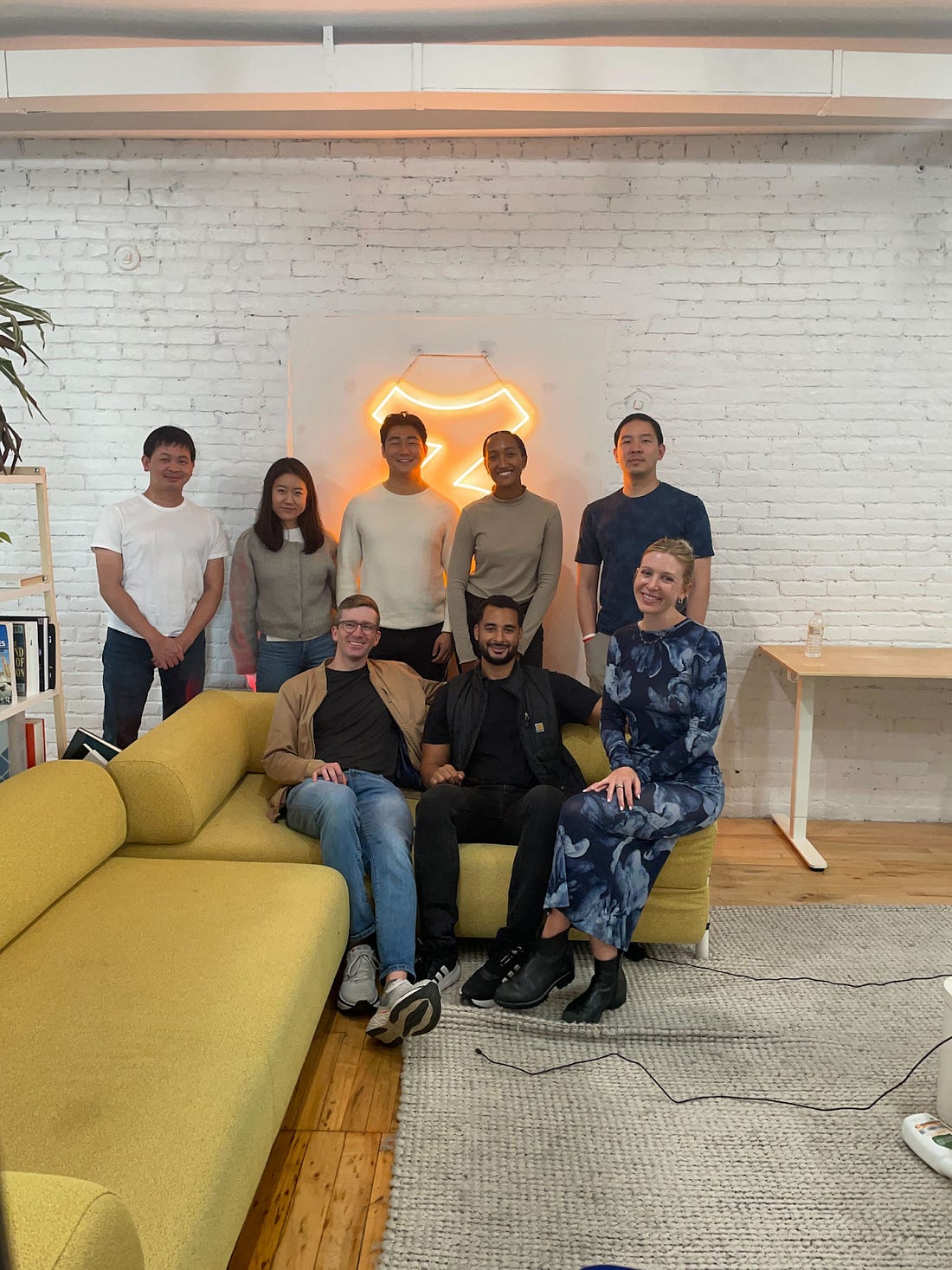
One of the founding engineers at Zingage, Greg Meyer, is a former founder who spent years as CTO at Bearworks and as a software engineer at Datadog. Jackie Jiang, who leads design, was previously a founding designer at Tennr. The list, very literally, goes on: there is not a single person on the Zingage team with an ‘unimpressive’ resume. “Everyone feels like a Navy Seal in their niche,” Jonny Gross, Founding Account Executive, told us. But, of course, resumes only go so far. What matters more is what the team is really able to do. And if there is a through-line in Zingage’s hiring, it is that they have focused on people with proven experience doing real things. People who, in other words, actually do the work. This idea resonated when we chatted with the Zingage team about their culture:
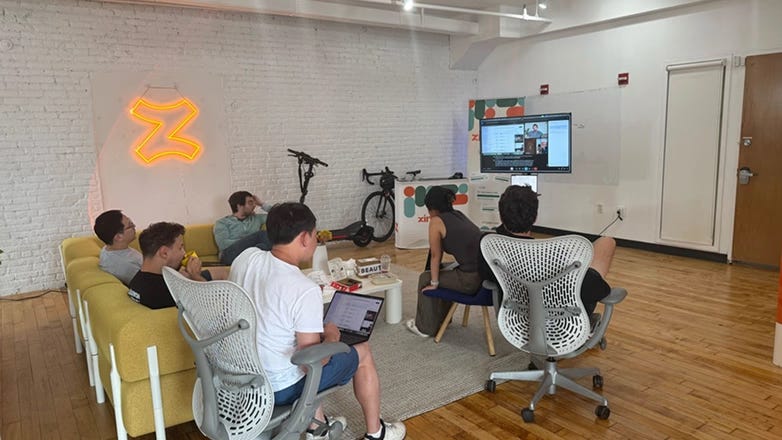
Do a lot of work, do it fast, be high-agency, take accountability. Those are the sorts of things I took away from talking to the Zingage team. And it’s not particularly surprising; you wouldn’t expect a company to do what they have done (millions in ARR, seemingly valuable and complex products, 400+ customers) with what they have (<15 people and very little funding until a few weeks ago) without an intense culture. Should you consider joining? And if so, how?When we asked Victor, the CEO, who should join Zingage, his answer was straightforward: “If you want to be a founder one day then Zingage is the place to learn, if you want to impact millions of sick and senior people then Zingage is the place to build, if you care and want to be proud of your work then Zingage is for you.” According to Victor, there are “Three Cs for success: CARE, CODE, AND CLOSE DEALS.” Diet Coke, he says, is also essential. The rest of the team more or less echoed Victor’s sentiment, noting especially that you need to “high-agency” and that “most days it’s exciting and a ton of fun, [and] sometimes it’s overwhelming.” It is perhaps true to say that Zingage is one of those early-stage startups that is true to how people like Paul Graham write about them: intense, with high expectations and a fast-paced work culture. “You have to know what you’re getting into with an early-stage startup,” David Knack (Head of Sales) told us. “No one is going to [give you] the playbook to be successful in your role.” You need “grit, velocity, and curiosity” to succeed, Elliott Chang (Product) told us. “In my first interview, they didn’t sell a vision; they shared the next hard problem they were tackling and why it mattered.” Simonia J., who leads Caregiver Success, says that at Zingage you need to take initiative. “Zingage’s success relies on our shared vision, passion, heart for success. We have limited space for top-down procedure. It really is about what you can actively bring to the table and if you can’t cook, this kitchen is not for you.” Of course, most startups would tell you that they expect a lot from you, but anyone who has spent any amount of time in tech knows that this is not quite true. There is a sliding scale. Not all companies truly expect the best out of you. (And it may be safe to say that those companies often don’t succeed.) If you want to be on the more difficult, but likely the more successful, side of that scale, you could consider joining Zingage. Jonny Gross, Zingage’s Founding Account Executive, says you should expect to “work really hard and don’t expect routine.” No matter what, though, Jonny says, “everyone at the company has your back and will support you. The majority of the Zingage team today is engineers and that does not appear to be changing anytime soon; in fact, the company is urgently hiring 10 engineers. To close, we will end with a few ideas on how you could join (because trying harder is almost always a good thing):
(Or you could do any of the ideas we write about here.) You're currently a free subscriber to next play. For the full experience, upgrade your subscription.
|
How this AI startup with a high-agency work culture has scaled fast with a tiny team
Thursday, 6 November 2025





Subscribe to:
Post Comments (Atom)


No comments:
Post a Comment