
This AI platform for researchers grew 5X last year and is used by companies like NASCAR and AmazonKnit is building a product to augment researchers, not replace them.
✨ Hey there this is a free edition of next play’s newsletter, where we share under-the-radar opportunities to help you figure out what’s next in your journey. Join our private Slack community here and access $1000s of dollars of product discounts here. TL;DR If you only have a minute or two, here’s what you should know about Knit.
There seem to be two basic kinds of AI products: tools that aim to replace human output and tools that aim to improve human output. It’s unclear whether there is something inherently correct or incorrect about either approach. Much of what ChatGPT does, for example, is designed to replace human output—and ChatGPT is quite valuable. But it is true that humans can be both effective and smart. Our brains, in most ways far beyond anything that has been achieved with LLMs, run on the same amount of wattage it takes to power a dim light bulb. And if today we had to bet between an AI producing an outcome on its own and a smart human using AI to produce an outcome, we’d pick the latter. Humans, as it turns out, are damn good at using tools. So when we come across a new product that aims to help humans become more efficient—rather than to replace our thinking entirely—we start to pay attention. Knit is one of those products.
The goal of Knit’s product is simple: to help companies make far better decisions. Knit does this by helping them conduct fast, high-quality market research. Usually that’s a term associated with headaches, piles of money, and three-month slogs to uncover any useful information. Not with Knit. Using Knit, companies (like NASCAR and Mars Wrigley, some of their customers) can run a research process from start to finish in as little as a week. It’s made possible by AI that gives huge amounts of leverage to talented researchers to do the work they’re best at. Jeff Herbst, whose firm GFT Ventures co-led Knit’s recent $16.1M Series A, describes Knit’s approach as “augmented intelligence, whereby humans can leverage AI to their maximum advantage… rather than relying on AI to supplant human insights and creativity.” Knit is, as Jeff says, “collaborative [and] researcher-driven.”
There’s a lot to like about this approach; about building products that complement humans rather than compete with them. Mostly there is a lot to like because, in Knit’s case, it is quite effective. Researchers at JBL, NASCAR, Amazon, and others have already used Knit to do better research, faster. The company grew 5X over the last year and has quietly built an impressive team (their Head of Engineering built the first version of grocery delivery at DoorDash). And in September, they announced their Series A. The goal of the rest of this essay is to pull back the curtain on what Knit is building, why you might care, and what kinds of people may want to consider joining. Author’s note: At the bottom of this piece, we share some ideas for what to do if you’d like to join Knit. Market research is valuable, but broken Imagine an auditorium, a big one, packed out with people who have all bought tickets to a speech you’re giving. The catch? They have no idea what you are going to talk about. There’s an anticipatory buzz in the crowd. You’re about to walk out onto the stage. This is the moment they have been waiting for. You open your speech with the following words: Market Research. Odds are, unless the auditorium is packed with people like Aneesh Dhawan, the CEO of Knit, this is not what your audience wanted to hear. And that’s okay! It is okay to admit that market research does not initially get blood pumping and motivation soaring for most people who work in (or out of) tech. This is odd, though. Shouldn’t market research be one of the most exciting things around? Running a business is, at some level, just about making a long series of decisions. Whether or not your business succeeds depends on how many of those decisions are actually good. And one of the best ways to make good decisions is to have useful data:
Good market research is how you arrive at answers to questions like these. Which means that in many ways, good market research can be core to making good decisions about the direction of your company. There are rare opportunities in tech to join a company whose product has a direct impact on some of the most important decisions a company will make. That’s important. Companies think it’s important, too—the size of the market in the United States is currently more than $140B, almost double its size in 2008. The trouble is that, traditionally, market research has not always been that simple. Instead, ‘market research’ has come with other connotations: tons of money and months of tedious work to uncover information that may or may not be valuable. You often had to hire an expensive market research agency or take up valuable time to research in-house. You had to spend weeks planning and designing surveys. You had to spend weeks on logistics and recruitment. You had to spend weeks conducting the study. You had to spend weeks running analysis, then more weeks coming up with useful insights. The old way, it might take months and cost ridiculous amounts of money to get results. Which is unfortunate if you need to make decisions quickly (which many businesses do). And which is equally unfortunate if the data you are getting is not accurate and useful (which it sometimes is not). This is why Aneesh Dhawan founded Knit: to put AI in talented researcher’s hands so they can focus on the highest-leverage work—and so they can go from zero to useful information in as little as a week.
Better information leads to better decisions Aneesh is a rather interesting guy. In many ways, he checks the classic boxes for what might expect from a great startup founder. At 16, he founded a cause marketing agency called Feed a Friend, whose goal was to reduce poverty and hunger. At 17, he brought solar-powered lights to a school and the residents of a Haitian village. These are, of course, not typical 16- and 17-year old activities. He describes himself as a “born problem solver” and his team says he “excels at combining humility with conviction.” Angel Mira, an accomplished researcher who now runs customer success at Knit, told me that Aneesh has incredible foresight. When you talk to Aneesh, Angel said, “he’s already considered Door A, B, C, and sometimes D. Impressive.” Perhaps Angel’s analysis is correct. In January of 2023, Aneesh co-founded Knit with Raahish Kalaria (now Knit’s CTO) to build an AI platform for researchers. Today, Knit’s product has four main pillars:
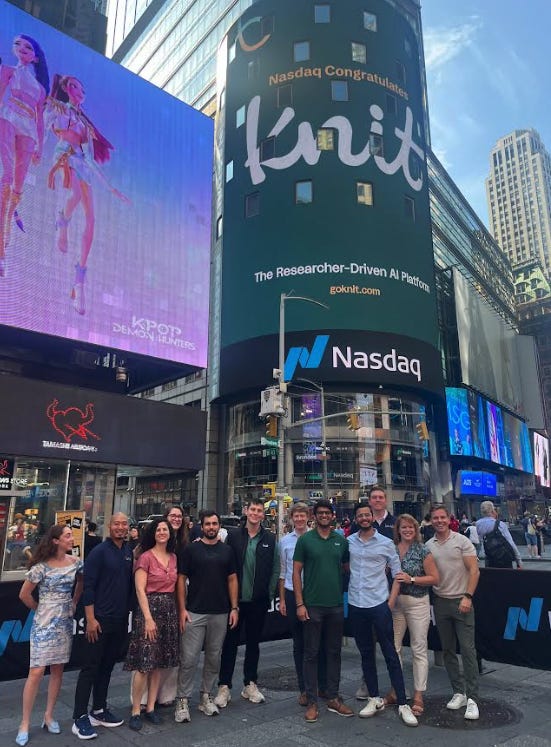
Finally, if you are a company and would like information before making an important decision, you do not have to wait months. You do not have to sign your researchers (or an external agency) up for hundreds of hours of tedious work. You simply hand Knit to your team and get answers in a week or so. It’s crucial, Aneesh says, that Knit is built for researchers—and is not a magical black box companies use to get rid of them entirely. “You can run all [your] data through AI, but what’s missing is the context that the researcher brings. We have the researcher at the center of how we run research.” Momentum is building quickly. In September, Knit announced their $16.1M Series A. They’ve grown 5X over the past year. And, perhaps most importantly, they count more than 60 enterprise companies, like Amazon, NASCAR, and Mars Wrigley, among their customers. Knit’s enterprise success is particularly interesting. It’s notoriously difficult for startups to sell to enterprises, but top-down sales are important. Failing to sell your product to enterprises can eventually sink entire businesses, but Knit has cracked the code in the early innings. (This is especially important because enterprises spend, by far, the most money on market research. Startups often don’t bother.) A quietly impressive team and culture The natural follow-up to all of this is: how? Why is Knit winning so far? The answer, beyond the sheer conviction and effort from their founders, is that they have slowly built a high-caliber team and culture.
Knit’s Head of Engineering, for instance, is Rachel Weems. She was the tenth employee at DoorDash and built the first version of alcohol and grocery delivery, among other things, there. Their COO is Chris Hicks, who was formerly SVP of Employer Growth at Maven (an impressive recent unicorn). And for their founding customer success role, Aneesh and Raahish made the decision to hire not a career customer success operative but an accomplished researcher in Angel Mira, who has held multiple director-level research roles at his previous companies. This speaks to Knit’s approach more broadly, which has been to “invest heavily in an internal research team” so that they can better understand their customers and build a more effective product.
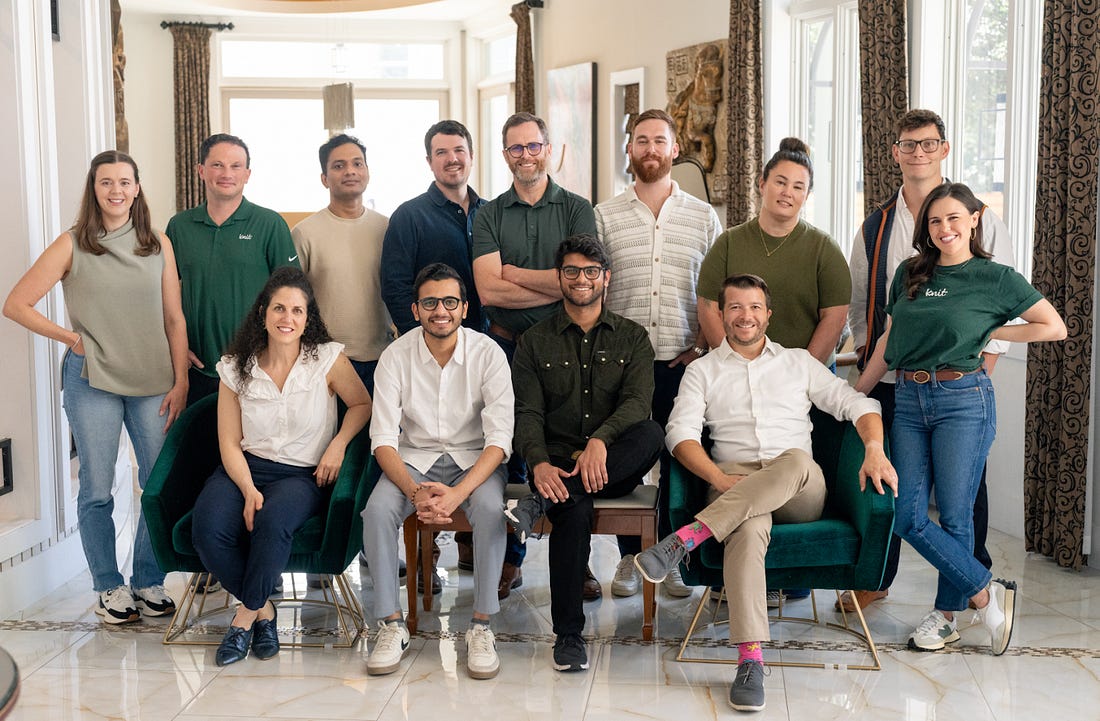
The resulting culture speaks for itself; or, at least, through the team:
Encouragingly, much of the founding team has been working together for longer than Knit has even existed. Logan LeBouef, their Head of Marketing, began working with Aneesh in 2020 on a company that was then called PurPics; McKenzie Zajdel joined back in 2018. (These are people who joined not just before a Series A, but before any kind of major round.) This is a breath of fresh air. At many startups these days, it can feel like staying more than 6 months makes you a ‘veteran’. Not so at Knit. Creating a more valuable future for market research If Knit were able to snap their fingers and immediately capture the entire $50B+ that is annually spent on market research in the United States, they would already be one of the most valuable startups in the world. So the market—which is still growing—is already quite large. Still, market research today is hamstrung by a couple of things. (1) There is a lot of friction associated with doing quality market research, which makes it hard to prioritize and execute at a high quality bar. And (2) there are shrinking market research budgets at many companies; researchers being asked to do more than less. Often, (2) is downstream of (1). In the best case, market research can be a miracle—it can inform decisions that generate millions or billions of dollars in new revenue. That isn’t the state of most research today, though. A natural conclusion, then, is that faster and higher quality market research may actually expand the market. More companies would do research, and more often. It would become a bigger part of the business. It would become more central to decision-making. This is perhaps the future that Knit is betting on. By building the best product for researchers, Knit is aiming to become the default way any company does market research. And, by nature of that product unlocking better insights more quickly, this will lead to a revolution of sort in the industry. If things work out, Knit will be at the center of how companies discover the data that informs their biggest decisions: about their customers, their products, and more. And, in doing so, Knit will aim to revolutionize the market research industry and unlock many trillions in long-term value via better decision-making. Should you consider joining? And if so, how? There are two clear ways to determine whether you may be a fit at Knit: whether you are a fit for the company culture and whether your skills are a fit for their priorities. We asked people at Knit who should, and shouldn’t, work there. People who are good fits to work at Knit “have NO ego and are team players,” their Head of Customer Success told us, and “are not afraid of building processes and workflows from scratch. McKenzie, Knit’s Chief of Staff, said that good fits are “competitive, curious, open-minded, adaptable, and accountable.”
“Personality-wise,” she said, “we love a good dad joke.” If you want to operate in a silo, or if you’re happy being complacent (two valid opinions to have!) Knit may not be the place for you. Like many early-stage startups, the culture at Knit is fast-paced and your responsibilities on Day 1 may not look the same as your responsibilities on Day 60. And you will, true to the nature of the product, constantly be collaborating with others on the team. (Again, this is true of many early-stage startups—roles morph and lots of teamwork is expected of you.) Knit is currently hiring for some key roles that will shape the direction of the company, like Lead Product Designer, Revenue Operations Lead, and a number of engineering roles. This is more or less expected from a startup at their stage building software. What’s unique is that Knit is hiring for a number of research roles; Research Manager, Fieldwork Specialist, Survey Programming, and more. The opportunity for researchers to work at early-stage startups is somewhat rarer, and so if that is something you have experience in or curiosity about—go check out the open roles. To close, here are a few ideas from us about how you might join Knit. The goal of the below is not to give you instructions (this is not a guide), but to give you inspiration for creative ways to apply. Because you can often increase your odds of getting hired at a startup if you put in more effort than others.
You're currently a free subscriber to next play. For the full experience, upgrade your subscription.
|
This AI platform for researchers grew 5X last year and is used by companies like NASCAR and Amazon
Thursday, 30 October 2025






Subscribe to:
Post Comments (Atom)


No comments:
Post a Comment