
This is Brad DeLong's Grasping Reality—my attempt to make myself, and all of you out there in SubStackLand, smarter by writing where I have Value Above Replacement and shutting up where I do not… The State of Trump's Trade War: Short- & Long-Run Consequences of Optics vs. EconomicsSymbolism wins, technocracy bends: the public sees “tough,” firms get exemptions, and growth pays the tab. And then cycle repeats: unilateral tools plus attention incentives make escalation cheap...
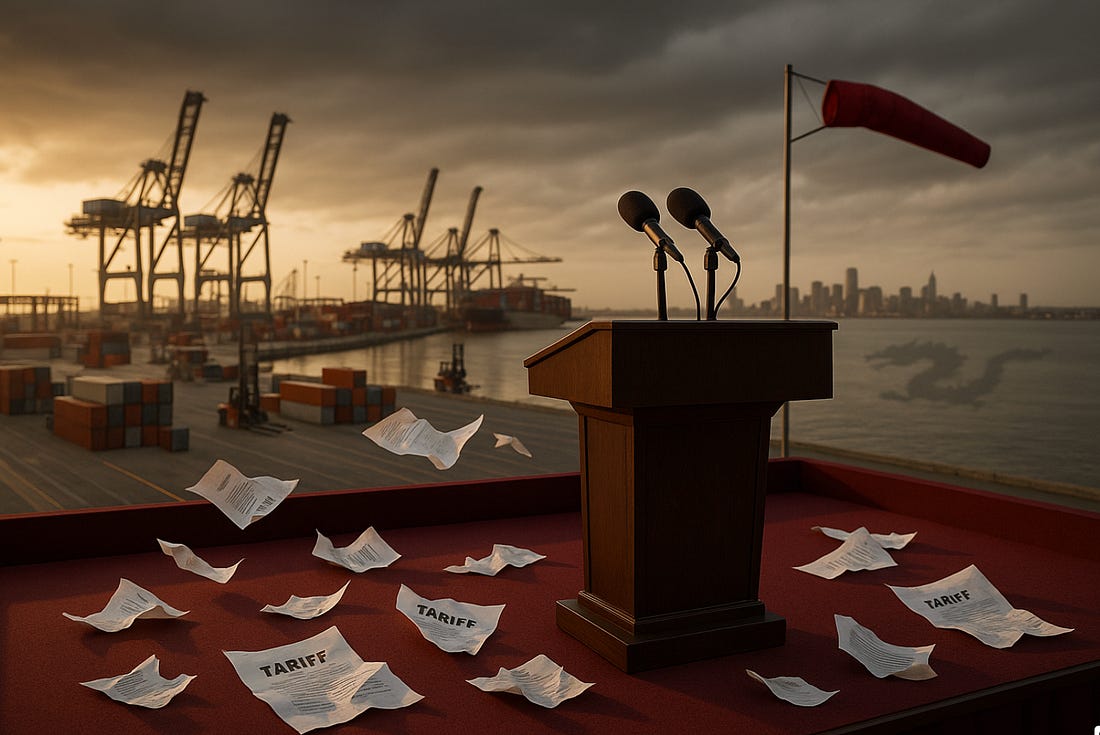
Symbolism wins, technocracy bends: the public sees “tough,” firms get exemptions, and growth pays the tab. And then cycle repeats: unilateral tools plus attention incentives make escalation cheap and endless. And so in the long run China writes the rules of world trade and hogs the surplus from the globalized value-chain economy, while the U.S. suffers under the harrow of a BREXIT-like headwind to productivity growth…Trump’s trade war runs on optics alone, not economics. Loud tariffs with quiet unwinding. That mix stabilizes the short run. But it likely seeds a decade of productivity drag. Foreign leaders have learned the script: flatter publicly, accommodate privately, and move on, while derisking from the United States. The result is political theater. But the real supply‑side costs to U.S. growth are likely to be substantial. And the real wealth and power benefits to China as the global-trade hegemon orchestrator and defender of multilateralism on its terms are likely to be substantial as well.
To start with, recognize that Richard Baldwin is right here:
And this means that there is a path toward, not sanity, but rather much less damage to the productivity of the globalized value-chain economy in the short run than we all thought back last spring:
But for foreign countries to do this their leaders need to be willing to (a) offer the public kowtow to the dominance of Trump, (b) be able to actually make credible threats of imposing real pain in some dimension that Trump or the Trumpists care about—for example, turning off the power in Ohio—and (c) not having too many vulnerabilities themselves that Trump, lashing out because he is angry or just because he wants a headline, can push on some 4 AM on Truth Social. As Richard says, the political-economy dynamic is fascinating. It generates a large degree of short-run stability. The parties most visible to the public and the ones most embedded in the policy apparatus pursue different, complementary goals. On the one hand, a president can claim a symbolic win—announcing “tough” measures and declaring victory—at relatively modest tariff levels that are high enough to satisfy performative politics but low enough to avoid major macroeconomic disruption. On the other hand, the Commerce and Treasury technocracy—nudged by exporters needing foreign market access and importers dependent on global supply chains—quietly works to reopen channels, craft exemptions, and recalibrate enforcement so that, in substance, trade flows revert toward the status quo ante. This asymmetry matters a lot: large rhetorical moves are cheap to manufacture, while large substantive reversals are costly; so the system equilibrates with loud symbolism paired to incremental, bureaucratic unwinding. In effect, the public hears about toughness; the firms get continuity; and nearly the “pre‑April” regime’s practical essence returns under a new banner. This is why, in the near term, such conflicts don’t escalate: optics do the heavy lifting while policy plumbing cushions the economy. I wish I could say that that is the end of the story, and that Trump’s Trade Tariffs are:
But there is a medium run, and a long run... Keep reading with a 7-day free trialSubscribe to DeLong's Grasping Reality: Economy in the 2000s & Before to keep reading this post and get 7 days of free access to the full post archives. A subscription gets you:
|
The State of Trump's Trade War: Short- & Long-Run Consequences of Optics vs. Economics
Sunday, 26 October 2025





Subscribe to:
Post Comments (Atom)


No comments:
Post a Comment