
How to Build Secure MCP Auth With OAuth 2.1 (Sponsored)
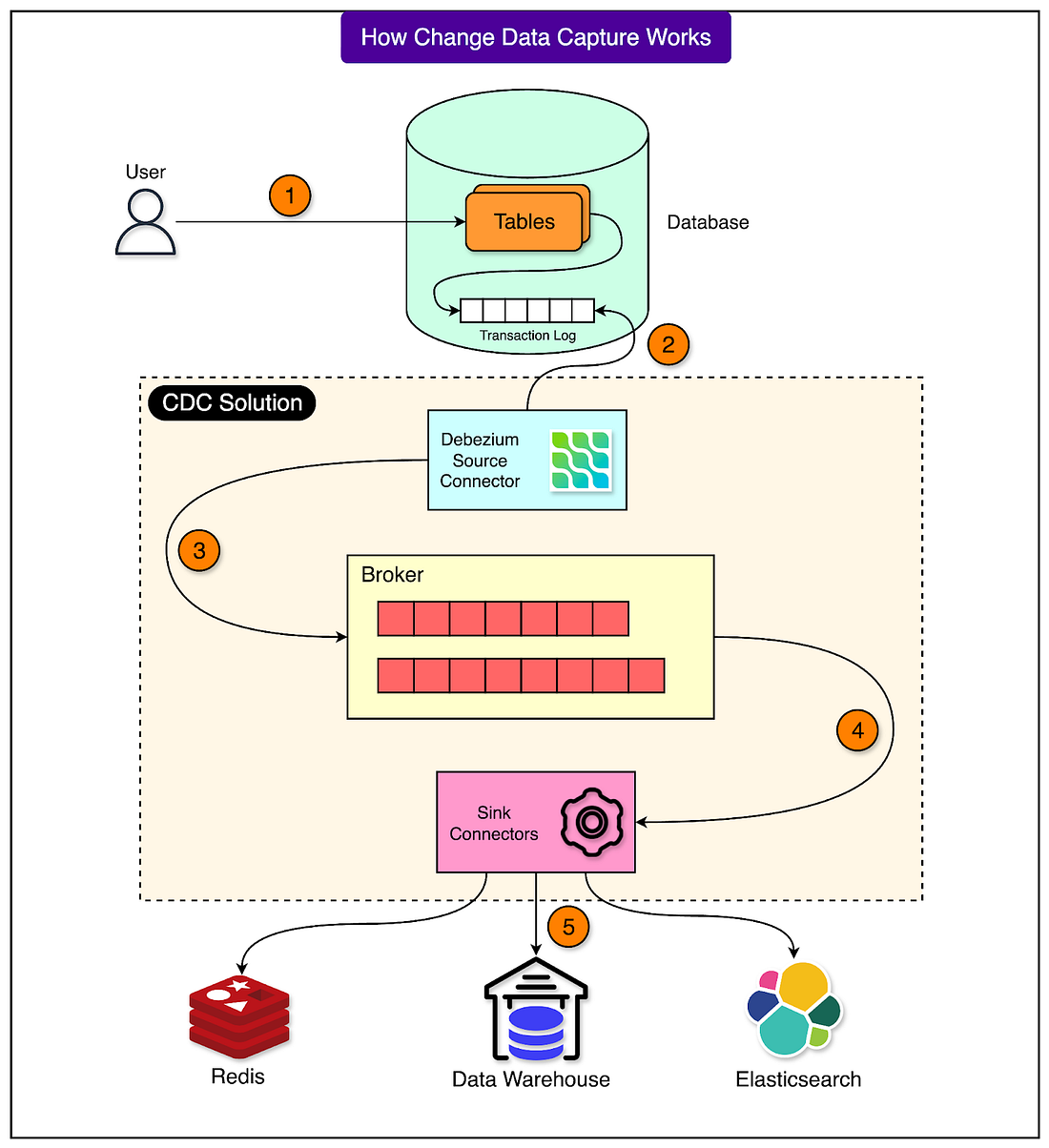
Securely authorizing access to an MCP server is complex. You need PKCE, scopes, consent flows, and a way to revoke access when needed. This guide from WorkOS explains how to implement OAuth 2.1 in a production-ready setup, with clear steps and examples. WorkOS Connect and AuthKit handle the full flow from authorization to token management. Disclaimer: The details in this post have been derived from the details shared online by the Pinterest Engineering Team. All credit for the technical details goes to the Pinterest Engineering Team. The links to the original articles and sources are present in the references section at the end of the post. We’ve attempted to analyze the details and provide our input about them. If you find any inaccuracies or omissions, please leave a comment, and we will do our best to fix them. Apache®, Apache Kafka®, and Kafka® are trademarks of the Apache Software Foundation. Debezium® is a trademark of Red Hat, Inc. Change Data Capture (CDC) has become an essential technique for modern data platforms. It allows companies to detect and record changes in their databases as they happen, rather than relying on slow batch jobs. This enables real-time analytics, faster data synchronization across systems, and more efficient processing of large datasets. At Pinterest, the need for a reliable and scalable CDC system became clear as the company’s data infrastructure grew to support millions of queries per second and thousands of database shards. The Pinterest Engineering team built a generic CDC platform to solve these challenges. Their approach adapts popular open-source tools like Debezium and Apache Kafka to work at a massive scale, while avoiding deep customizations that would make upgrades difficult later. Instead of building isolated solutions for each use case, Pinterest created a unified architecture that can support the entire company’s data needs. In this article, we look at Pinterest’s CDC system and understand how the team dealt with the various challenges they faced. What is CDC?Change Data Capture, or CDC, is a method used to detect and record any change that happens inside a database. These changes include the addition of new data (insert), modification of existing data (update), or removal of data (delete). Instead of repeatedly scanning the entire database to find what has changed, CDC tracks these changes as they happen and makes them available to other systems in real time. See the diagram below that shows this process.
Pinterest uses CDC as a core part of its data platform. It powers several critical functions such as real-time analytics, recommendation engines, fraud detection, and keeping different internal systems in sync. For example, when a user saves a new pin or updates their profile, these changes need to quickly flow to many downstream services. CDC ensures this happens efficiently and reliably. CDC is important for several reasons:
The Initial SolutionBefore building a unified system, Pinterest had many different CDC setups across various teams. Each team created its own solution to solve a specific problem. While this worked in the short term, it created bigger issues over time. The various systems behaved differently. There was no clear responsibility when something broke, and overall reliability suffered. In a company handling huge amounts of data, this kind of fragmentation quickly became a bottleneck. To solve these problems, the Pinterest Engineering team decided to build a single generic CDC platform that everyone could use. The goal was to provide one reliable and scalable system instead of many separate ones. This approach would reduce duplication of effort, make upgrades easier, and give teams a consistent way to capture and process database changes. The new generic CDC platform was designed with several clear goals, such as:
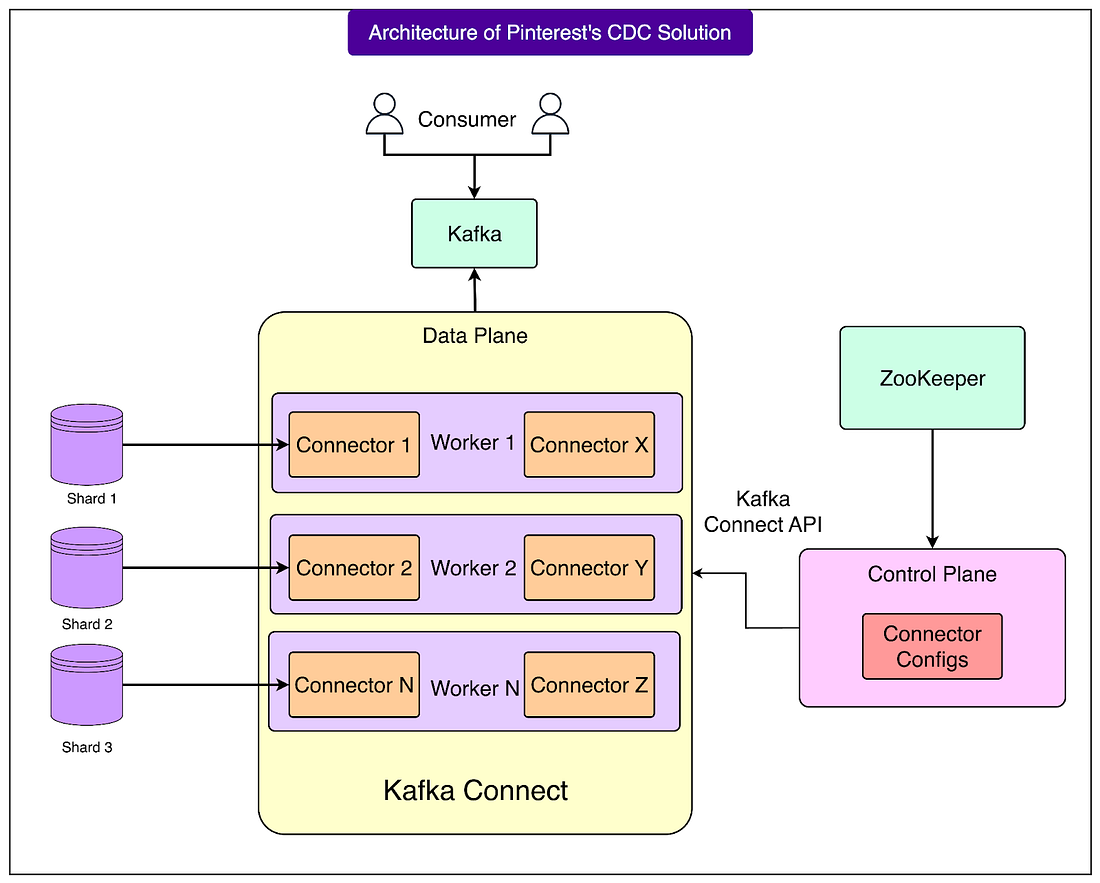
Architecture OverviewPinterest’s databases are extremely large and distributed. Instead of storing all data in one place, the company divides it into thousands of smaller parts called shards. A shard is simply a portion of the database that can be stored and managed separately. This design helps scale the system to handle millions of queries per second, but it also makes tasks like Change Data Capture more complicated. Pinterest chose to build its CDC system on top of Red Hat Debezium, an open-source platform that tracks database changes and streams them into systems like Kafka. Debezium works well when dealing with a single shard, but Pinterest needed a way to manage thousands of shards at once. Instead of changing Debezium’s code directly, which would make future upgrades hard, the Pinterest Engineering team decided to split the system into two layers: a control plane and a data plane. This separation allowed them to scale without heavily modifying the underlying tools. See the diagram below:
Control PlaneThe control plane acts as a central coordinator. Its job is to make sure that all the Debezium connectors (the components that read database changes) are correctly set up, running smoothly, and automatically fixed if something goes wrong. It runs on a single EC2 host in an AWS Auto Scaling Group. The group is set with a minimum and maximum size of one machine. This means if the machine goes down, AWS will automatically replace it. The control plane executes its main loop once every minute. Its workflow has three main steps:
After completing these steps, the control plane emits detailed metrics that help engineers monitor the health and performance of the system. Data PlaneThe data plane is where the real CDC work happens. This is the layer that connects directly to databases, reads the changes, and streams them into Kafka. Here are some key details about it:
Kafka LayerAt the center of the system is Apache Kafka, which acts like a durable, high-speed messaging backbone. It plays three important roles:
Technical Challenges and SolutionsBuilding a CDC system at Pinterest’s scale brought several real-world challenges. The platform processes millions of queries per second and terabytes of data every day, which can push even well-designed systems to their limits. The Pinterest Engineering team encountered multiple issues during deployment and scaled the system through targeted technical solutions. Let’s look at a few of the major challenges: Scalability and Out-of-Memory (OOM) ErrorsSome datasets were so large that they created backlogs in the CDC tasks. A backlog happens when incoming data changes accumulate faster than the system can process them. This caused out-of-memory (OOM) errors, where CDC tasks ran out of available memory and failed. To handle this, Pinterest introduced bootstrapping from the latest offset, which means that when a new CDC task starts, it begins reading from the most recent point in the data stream instead of replaying the entire historical dataset. This reduced the amount of data the task had to process at startup. They also added rate limiting, which controls how quickly data is ingested to prevent memory from being overwhelmed. Rebalancing Timeout IssuesEach CDC connector is assigned to a host machine. With around 3,000 connectors per cluster, Pinterest saw frequent task rebalancing in Kafka Connect. Rebalancing is the process of redistributing tasks across available hosts. However, in this case, it happened too often and unpredictably. Some problems were as follows:
The root cause was that the default rebalance.timeout.ms setting was too short. Kafka Connect did not wait long enough before moving tasks, causing constant reshuffling. Pinterest increased the rebalance timeout to 10 minutes, giving Kafka Connect enough time to stabilize task assignments. This led to a more balanced and predictable distribution of work across hosts. Failover Recovery DelaysPinterest’s key-value (KV) store clusters could take more than two hours to perform a leader failover. A leader failover occurs when the main server in a cluster goes down and leadership shifts to another server. During this period, CDC tasks would fail because they were still pointing to the old leader. The control plane reacted by deleting and recreating tasks repeatedly, which caused constant rebalancing over long periods. Pinterest allowed CDC workers themselves to handle shard discovery and failover instead of relying on the control plane for this. This change reduced failover recovery latency to under one minute and avoided unnecessary task reshuffling. Duplicate Tasks and CPU OverloadA known Kafka bug (KAFKA-9841) caused multiple hosts to run duplicate instances of the same CDC task. This created several problems:
Pinterest upgraded to Kafka 2.8.2 version 3.6, which included a fix for this bug. They also kept the rebalance timeout at the increased value. After applying these changes:
ConclusionPinterest’s journey with Change Data Capture offers a practical look at how to run open-source data tools at massive scale. By building on top of Debezium and Kafka, the Pinterest Engineering team created a system that can handle thousands of database shards and millions of queries per second, all while keeping data flowing reliably in real time. A major strength of their design is the clear separation between the control plane and the data plane. The control plane acts as a centralized coordinator, managing connector configurations and ensuring everything stays in sync. The data plane focuses on streaming actual database changes across a distributed cluster. This split allowed Pinterest to scale without modifying the core Debezium code, which keeps the system easier to maintain and upgrade in the future. Pinterest also demonstrated that operating CDC at this scale requires attention to the small details. Problems like frequent task rebalancing, long failover times, memory overload, and duplicate tasks required careful tuning, configuration changes, and targeted upgrades. References: Help us Make ByteByteGo Newsletter BetterTL:DR: Take this 2-minute survey so I can learn more about who you are, what you do, and how I can improve ByteByteGo SPONSOR USGet your product in front of more than 1,000,000 tech professionals. Our newsletter puts your products and services directly in front of an audience that matters - hundreds of thousands of engineering leaders and senior engineers - who have influence over significant tech decisions and big purchases. Space Fills Up Fast - Reserve Today Ad spots typically sell out about 4 weeks in advance. To ensure your ad reaches this influential audience, reserve your space now by emailing sponsorship@bytebytego.com.
|
How Pinterest Transfers Hundreds of Terabytes of Data With CDC
Tuesday, 21 October 2025




Subscribe to:
Post Comments (Atom)


No comments:
Post a Comment