
🔮 Seven lessons from building with AIPlus a stack of 50+ AI tools we use at Exponential View
Hi there, We first published these reflections on building AI workflows five months ago but they’ve had surprising staying power. Exponential View readers keep returning to them as they figure out how to integrate AI more deeply into their teams and processes. We decided to resurface the full post + our AI toolkit for you today. Enjoy!
Tobi’s memo resonated widely because organizations now recognize what it truly means to integrate AI – not merely as an add-on but fundamentally into their operating structures. At Exponential View, we embraced precisely this mindset to reimagine how we work. We consider ourselves AI-native, which means:
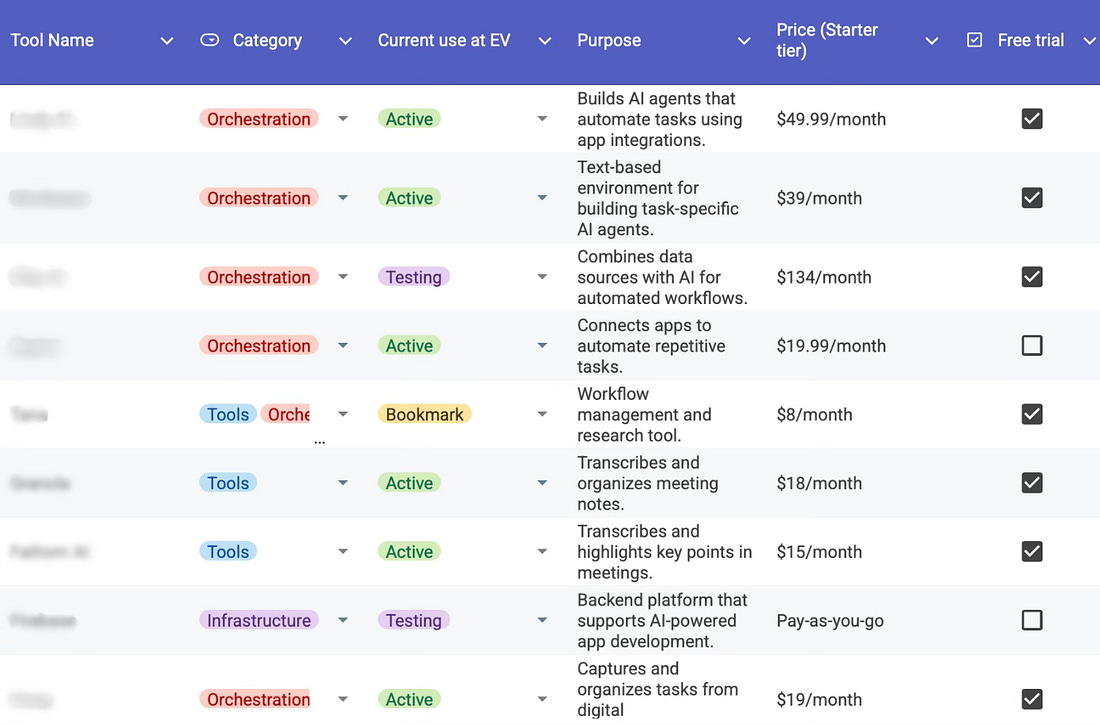
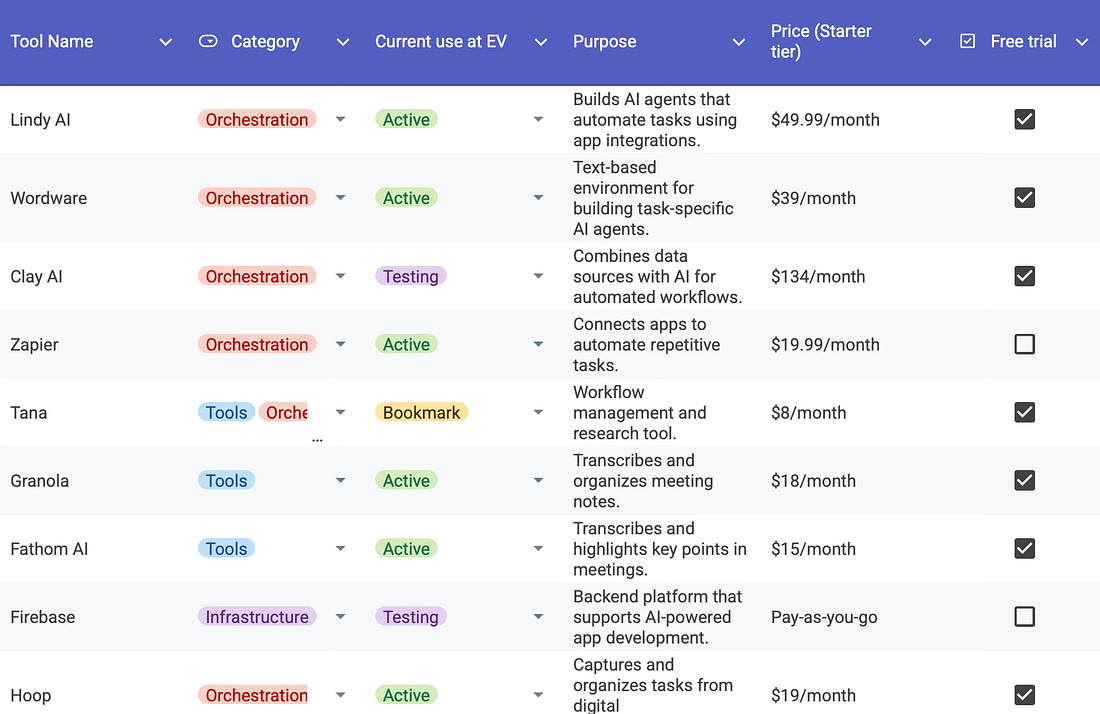
In recent weeks, we sprinted to prototype new workflows using LLMs, automation tools and structured systems thinking. Today, I’ll share our most valuable lessons. At the end, members get access to something unique: our internal stack of 50+ tools – everything we’re actively using, testing or intend to test – to help you decide what tools might work for you.
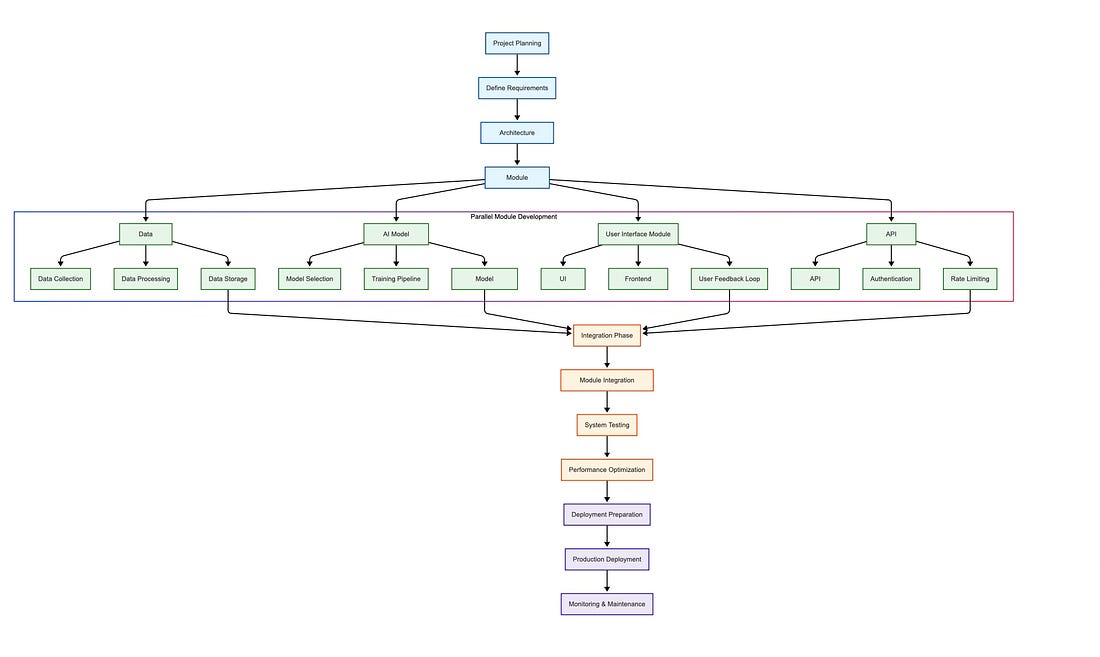
Let’s jump into our seven lessons. 1. The 5x ruleWe’ve started applying a simple heuristic: if a task, or even a question, comes up five times a month, it’s a candidate for automation. This “5x rule” helps spot patterns hiding in plain sight and forces you to think in systems rather than routines. This habit sets the expectation that workflows should evolve constantly, not calcify. Of course, we now ask the question “what do we do five times a month” more than five times a month, making that a candidate for automation. One of Azeem’s favourites is a simple workflow which does his expenses. He has to contend with dozens of invoices a month and his automations, relying on Dext and Gmail filters, are good but not great. Expense reconciliation has involved a lot of time in Gmail. His new expenses agent eliminates that repetition: it pulls out invoices, bills and receipts in his emails and puts them into a correctly structured spreadsheet. It also makes a PDF copy of the bill and sticks it into Google Drive. This saves him his least favourite hour every month. If the bill is a plane, train or hotel booking it also dumps them into a different document. A separate agent reviews that document and turns it into a chronological, structured travel briefing which he uses. With fifty travel days across ten trips to the end of June this is an enormous time saver – perhaps a dozen back-and-forths with Gmail has been replaced by the occasional check of this summary document. 2. Modular workflowsOne early and useful lesson in building with AI was to break down our workflows into smaller, autonomous components, rather than trying to automate an entire process in one go. This modular approach makes it easier to test individual pieces, troubleshoot in isolation and evolve parts of the system without destabilizing the whole. This approach draws inspiration from classic software architecture: encapsulation and separation of concerns. But it also reflects how AI-native workflows behave. When you have an LLM doing part of the work, you want its task to be as narrow and unambiguous as possible. Broad instructions like “write a summary of the latest AI developments” often result in generic or unusable output. In contrast, narrower prompts like “list three key recent breakthroughs in battery technology and explain their relevance to electric vehicle adoption” yield precise answers and clearer points of failure, making them easier to improve iteratively. One modular workflow we’ve found particularly valuable automates the discovery and initial research for potential partnerships. The first module scans our broader ecosystem, discovering companies actively engaging in areas aligned with our priorities. The second module enriches these initial leads, pinpointing key decision-makers and compiling relevant context from publicly available information. Finally, a third module– acting as our digital comms specialist – helps create outreach to get across as clearly as possible. The result is a process that frees our team to focus on building relationships rather than hunting down details. A modular system also helps teams think like system designers. If Module A breaks, we know not to debug Module C. That clarity saves time. It also supports scale: when each unit functions independently, it’s easier to assign ownership, train interns, or plug in new AI tools.
3. LLMs as foremen, not just bricklayersTreat the LLM as the foreman, not the worker. That is, use the model to structure the task, but don’t ask it to do everything. Once the model has identified what tasks need to be carried out, you can decide whether a given task is deterministic (in which case you may need to farm it out to traditional software code) or requires more judgement (in which case an LLM might be able to handle it.) In practice, this means using Gemini 2.5 or Claude to first outline detailed, structured instructions which we then feed into another specialized AI or automation tool (like a Chrome extension script or a no-code platform such as n8n). While this might seem indirect at first, it’s the difference between giving vague directions and providing a clear blueprint. Clear blueprints get you consistently better outcomes.
The biggest productivity gains come when people shift their role from doer to editor and orchestrator. When we use the LLM to lay out a framework, define categories or structure tasks, the rest of the workflow executes far more reliably. As a result, we’ve stopped thinking of the LLM as a tool to do the task and started thinking of it as a tool to define the task. We can use LLMs to help craft specifications and of course, craft better prompts for the workflows. We’ll often use Gemini 2.0 Flash for a workflow because it is cheap and fast, but it isn’t the brightest. I’ll often have to tell Gemini 2.5 Pro that it needs to simplify the prompt because the LLM using it is not as smart as it is. 4. Documentation as a living systemOne of the earliest challenges we faced was keeping documentation up to date. Even with regular edits, specs would drift out of sync within a day or two—especially as we iterated quickly and changed components on the fly. Our fix was surprisingly simple: get the LLM to document the system as you build it. Some of us use WisprFlow to capture voice notes while working, then generate summaries or system updates from the dictation. It’s not uncommon when working as a pair for someone to interrupt the conversation to talk to their computer so that it can go off and process something while the humans move on. Others drop current variables, prompts and task flows into a Google Doc and ask the LLM to rewrite the spec based on the current state of play. The result is a lightweight, living documentation that’s never more than a few minutes out of date. It’s made onboarding smoother, debugging faster and coordination across the team much easier. It’s also shifted how we think about memory and context. When your workflow is fluid and fast-evolving, the ability to snapshot the system on demand may be as important as the system itself. 5. Research + prompting > Prompting aloneThis lesson came from a failed attempt to design a new RAG (retrieval-augmented generation) pipeline for summarizing research papers. Our colleague Nathan Warren initially prompted Gemini for a system design using its existing knowledge. The result was superficial – a generic, unclear outline. He realized the LLM lacked up-to-date context on recent advancements. To fix this, he quickly queried the current state-of-the-art techniques from recent articles, GitHub repos and documentation, then fed that fresh context back into Gemini. With this updated information, Gemini was able to provide a detailed, actionable plan demonstrating that the key was updating the model’s knowledge to reflect the latest developments beyond its training data. Instead of asking, “Can you draft a spec for a RAG system?,” he asked:
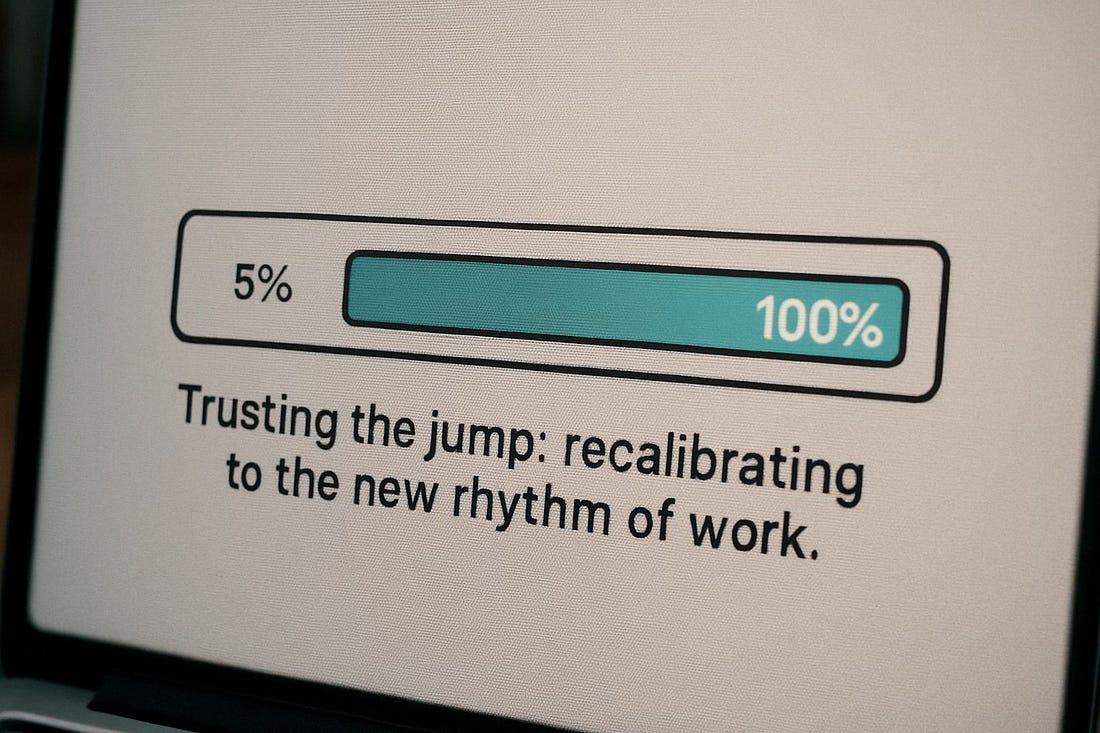
The difference was night and day. The new spec covered chunking strategy, latency considerations, and even output filtering logic. It went from generic fluff to actionable architecture. The lesson here was that we should treat prompting as an act of curation, not just conversation. Bring the model’s recent techniques, working examples, and constraints – then let it build. The more structured your input, the more sophisticated your output. 6. Time compression is the new emotional challengeI’d set aside two hours to complete a complex, multi-step task, something that usually required switching between tools, reviewing materials and coordinating input from two people. But with a new AI-driven workflow in place, I ran the steps through a series of modular prompts and automation scripts. The system parsed, filtered and structured the inputs with minimal human intervention. A light edit at the end and it was done in 15 minutes. And yet, instead of feeling triumphant, I felt… unsettled. Had I missed something? Skipped a crucial step? Was the result too thin? It wasn’t. The work was complete and it was good. But I hadn’t emotionally recalibrated to the new pace. AI workflows compress time but my expectations didn’t keep up. The sense of “it can’t be done yet” lingers, even when the output is solid. It’s easy to spiral into unnecessary tweaking or double-checking just to fill the gap. This taught me that AI doesn’t just shift how I work – it shifts my perception of work. Learning to trust the result, even when it feels “too fast”, is a new muscle. Emotional recalibration might become one of the key skills of the AI-native professional.
7. Humans are still core to the loopPerhaps the most grounding reminder: our intern, Will, did stellar work. He jumped straight into one of the modules and shipped logic that’s now being used daily. His success wasn’t despite the AI tools – it was because of the scaffolding they provided. By breaking the workflow into understandable parts, giving clear briefs generated by an LLM and providing updated documentation, we made it easier for a human contributor to plug in and deliver impact really fast. The real unlock isn’t AI in isolation. It’s AI plus well-scaffolded humans. That’s how we scale our systems without losing our standards or our soul. Want to go deeper?We created an internal tool stack for members of Exponential View — currently 50+ systems we’re using, testing, or watching closely available to members of Exponential View. To view the full stack, become a member.
Our team members have a freedom to choose the tools they think help them get their job done, whether that is building in Python or using a higher-level framework. They can also choose the underlying model they use, although we share our experiences and evals with each other.
|
🔮 Seven lessons from building with AI
Tuesday, 9 September 2025




Subscribe to:
Post Comments (Atom)


No comments:
Post a Comment