
This is Brad DeLong's Grasping Reality—my attempt to make myself, and all of you out there in SubStackLand, smarter by writing where I have Value Above Replacement and shutting up where I do not… DRAFT: Notes on Human Division-of-Labor Globalization from Stone Tools to the Assembly Line: -750000 to 1945I’m going to be giving a guest lecture in Harvard’s GenEd 1120 “The Political Economy of Globalization”, taught by Robert Lawrence and Lawrence Summers. The topic they gave me was “Globalization...
I’m going to be giving a guest lecture in Harvard’s GenEd 1120 “The Political Economy of Globalization”, taught by Robert Lawrence and Lawrence Summers. The topic they gave me was “Globalization from Adam to the Great Depression”, which is not small. Here is one first cut at what I might say. Behind he paywall as it is, after all, only an early draft…
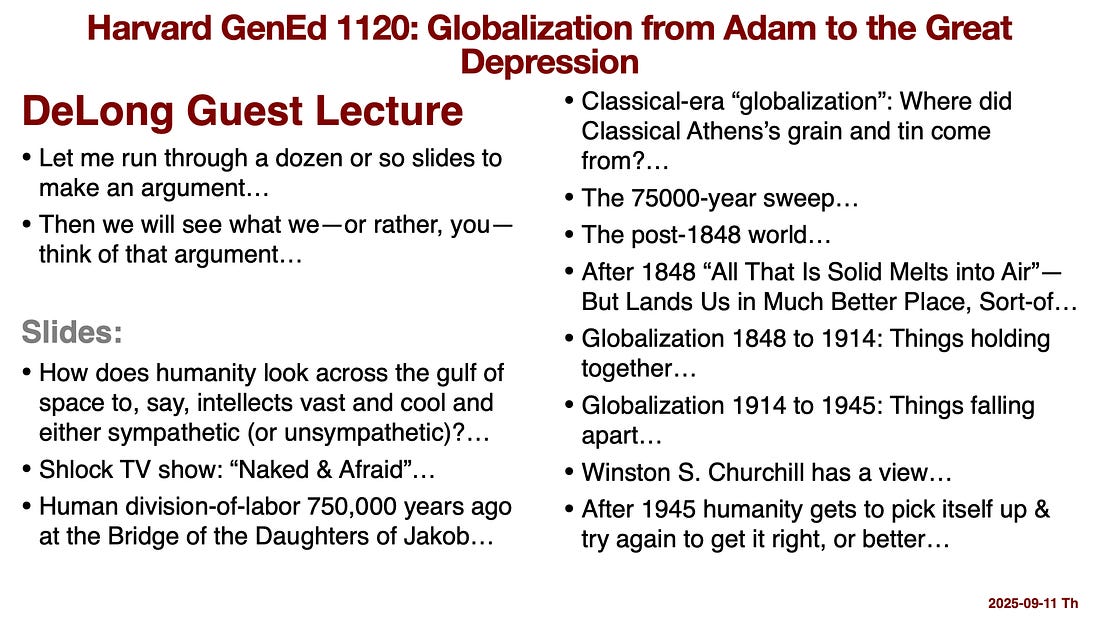
Humanity’s unique superpower is its twin abilities to collaborate in the creation and development of knowledge on the one hand and of the division of labor on the other. And this has then led rapidly to globalization—vast networks of trade and cooperation that transcend any single political authority’s span of control or legal system’s span of jurisdiction. The benefits of global integration are and have always been distributed profoundly unequally. And since 1848 the rapid innovation and industrialization that have driven unprecedented wealth and social change have also greatly widened global inequality and risks from globalization gone wrong, or gone smash. I’m happy to be here. I’m happy to accept the invitation. I am not sure it is kind to have the topic be “Globalization from Adam to the Great Depression”, but while we are not such as move heaven and earth, what we are, we are; and we will do what we can. I want to run through a dozen or so slides. And then we—or rather you—will try to decide whether I have in fact made an argument, and, if I have, whether you believe it. Animal Behavior & the Human Superpower:
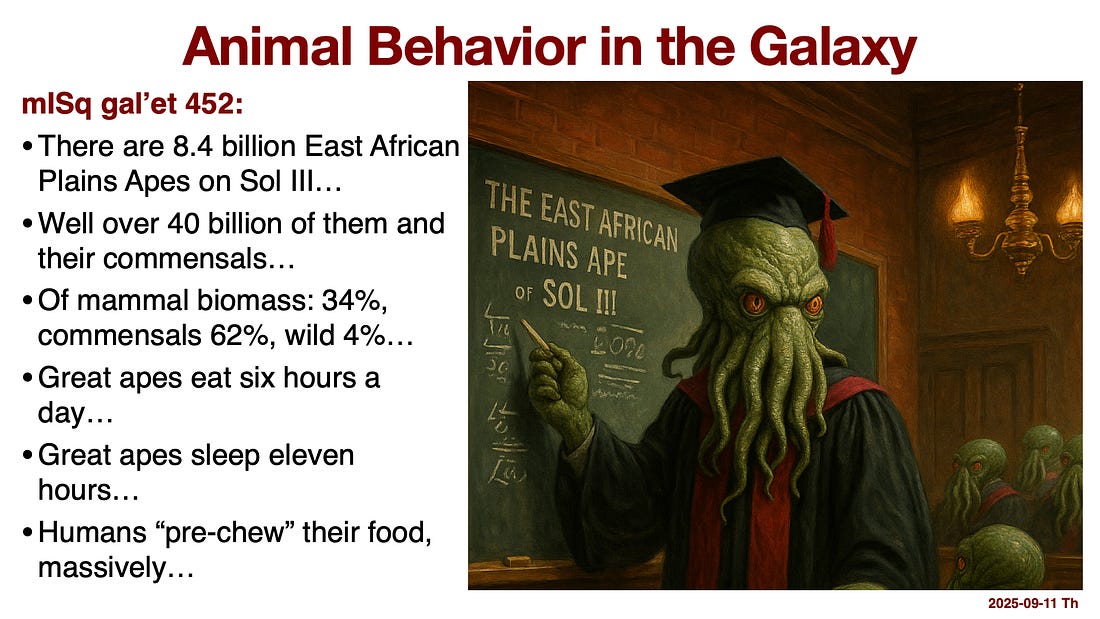
Step outside and view us from an exterior standpoint. What would distant intellects—vast, cool, and sympathetic or not—find notable? Perhaps, somewhere, a being is lecturing about the fauna of Sol III, mainly the East African Plains Ape. They would see that we number 8.4 billion. We and our domesticated animals make up 96% of global mammal biomass. Humans sleep only about two-thirds as much as our closest relatives. We spend two, not six, hours a day chowing down. We do not eat raw broccoli for hours and hours, but rather food “pre-chewed” in various ways. Come to think of it, even raw broccoli itself has been heavily biotechnologized—made tasty, nutritious, and easy to digest. The Broccoli family created it before moving into “James Bond” movies. That’s one set of observations.
Consider the shlock TV show “Naked & Afraid.” Melissa Miller is dropped into the Amazon. Over the next 21 days, she loses 17 pounds: a daily metabolic deficit of 2800 calories which given her BMR of 1500 calories is quite a feat. Her partner, Chance David, loses 32 pounds. Meanwhile, back in the Amazon, other mammals eat, avoid being eaten, mate; and manage to raise their young. It is homo sapiens, stripped of division-of-labor, cultural capital, and technology, flounder. Melissa faces severe stress: fungus colonizes her nails, bug bites turn into multiple abscesses needing surgery, and hundreds of thorns have peirced her skin. Back in civilization, Ms. Miller needs a lot of medical attention as she rapidly regains her weight. And she puts on another 16 pounds before she next ventures in front of the “Naked & Afraid” cameras, this time in South Africa.The lesson is clear: our superpower is not “raw” survival, but civilization.
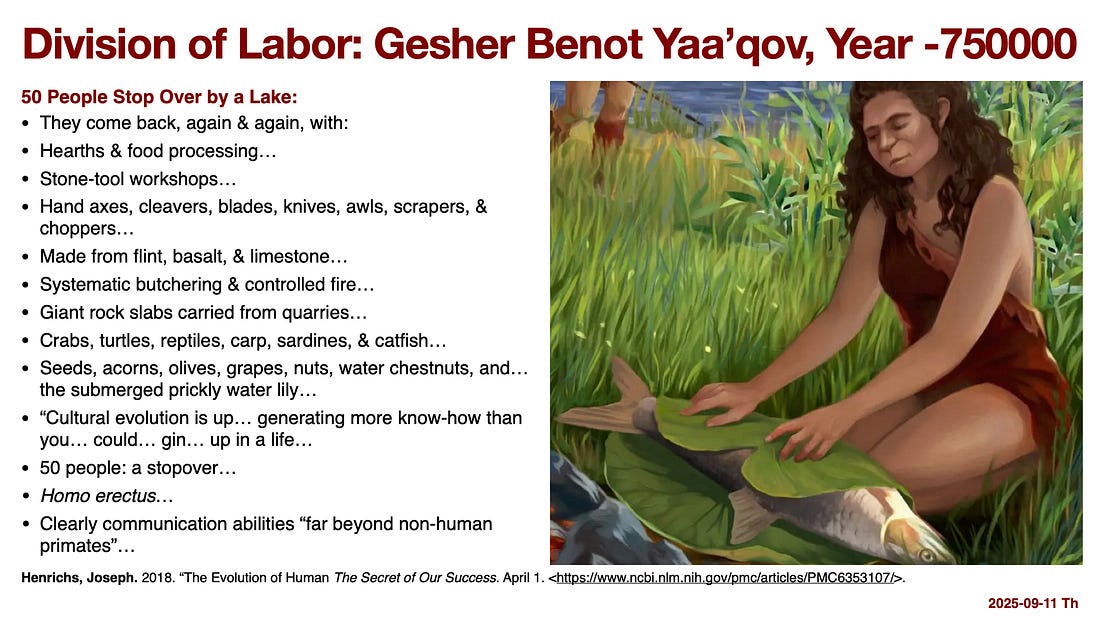
“Humans are very dumb”, an outside observer might conclude. It’s not just that when she is home in Michigan she can barely remember where she left her keys last night. It is that, out in the Amazon basin, she fails at her brain’s one job for which Darwin's Daemon gave us mammals our cerebral cortex and cognition. And yet we know that 750,000 years ago, groups of 50 or so of homo erectus, people who were us or whose descendants were to become us—homo erectus—would periodically come in camp by a lake in the Middle East at the site we call the Bridge of the Daughters of Jacob—Gesher Benot Yaa’qov. They quarried rock from nearby hills, dragged slabs to the lakeshore, made tools, built fires, butchered their catch, cooked, and ate as proto-engineers and proto-chefs. Hearths, stone-tool workshops with hand axes, cleavers, blades, and awls made from flint, basalt, and limestone. Their menu was cosmopolitan—crabs, turtles, carp, sardines, seeds, acorns, olives, grapes, nuts, water chestnuts, and prickly water lilies—each needing its own method of preparation. This was not isolated genius, but the product of division-of-labor and cultural evolution. Systematic butchering, controlled fire, and a varied menu point to communication and collaboration far beyond other primates. Fifty people pooled cognitive resources, transmitting knowledge across generations in a division-of-labor was far more sophisticated than any other mammal’s. Behaviors were learned from elders, creating a cultural capital stock much greater than, say, lions learning ambush tactics from matriarchs. Division-of-labor and cultural capital—ideas about manipulating nature and organizing humans—were our superpowers then. They are even more so today. Globalization in the Year -450
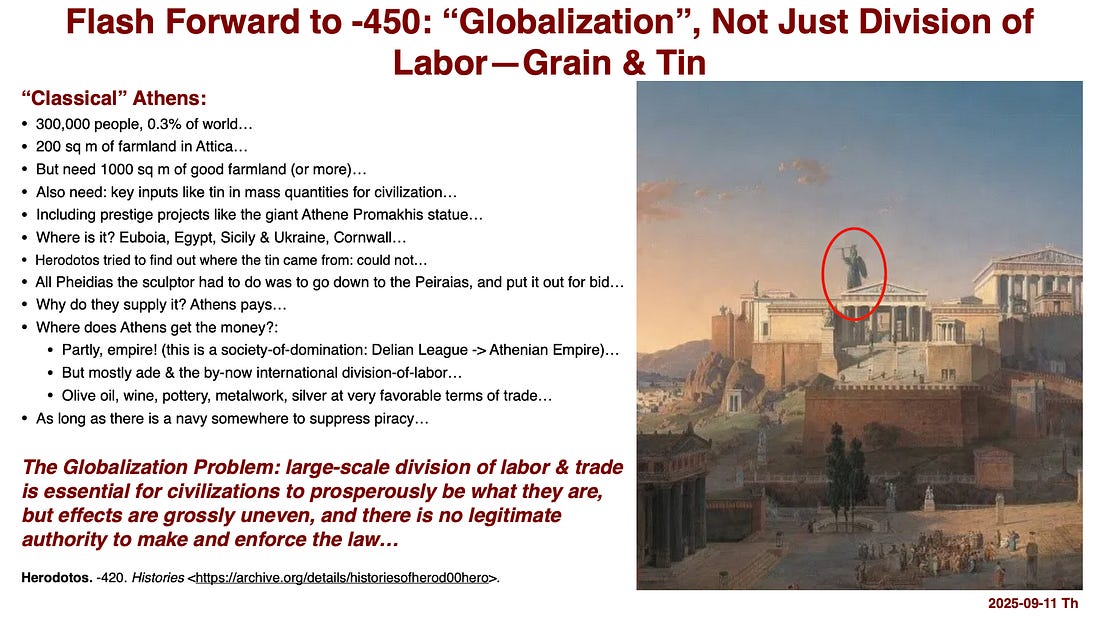
Flash forward to the year -450, and 750 miles northwest of Gesher Benot Yaa’qov to the city of the Athenai: Athens. Athens then had 0.3% of the global population, 300,000 people: 3/5 adults, with only 1/4 of those male citizens. Food fell into three categories: oinos (drink, almost always wine, usually watered), opson (toppings for flatbread), and siton (main calories—flatbread from wheat or barley, sometimes porridge). Attica’s farmland was poor, able to feed just 60,000. Where did the grain for the other 240,000 come from? The solution was not local ingenuity, but global reach. Athens imported grain from Euboia, Egypt, Sicily, and Ukraine—wherever there was surplus—and paid with olive oil, wine, pottery, metalwork, and silver, all on favorable terms. And not just grain. The most famous sculptor of the day, Pheidias, needed tin to make bronze. The historian Herodotos tried to trace where the tin ingots sold in Athens’s agora came from. He could not. But Pheidias did not care. He put a contract out to bid at the Peiraias port, and the world market supplied it. Why did the world supply Athens? Partly empire—tribute from the Delian League, shifting from alliance to domination. But mainly, payment and trade. The international division-of-labor worked as long as naval power suppressed piracy. Thus arises the “Globalization Problem”: civilization thrives on vast, uneven exchange networks, but no legitimate authority exists with the reach to set and enforce a legal framework.. The construction of Pheidias’s workshop’s statue of Athene Promakhis—Athena Fighting-in-Front—was the prestige project of the Athenian state in the -450s. You could see the sun gleaming off of it as you rounded the southern cape of Attica, sailing into Athens, showing you what Athens could do and be. But it would not have happened without the world—well, the trans European—market. Globalization as it was in the -450s was prerequisite for the prosperity as well as the survival of the Athenians, which depended on a deep, broad division-of-labor extending across thousands of miles, across a span of land and sea that far exceeded the area where the writ of any one government regarded as legitimate could run. Hence already in -450 we have the Globalization Problem in its essence: Large-scale division-of-labor & trade is essential for civilizations to prosperously be what they are, but effects are grossly uneven—slavery in the Ukraine because the horse-lords have an incentive to capture people and make them work, prosperity in Athens, glory for Perikles—and there is no legitimate authority to make and enforce a law across that span… And ever since then, dealing with what we call “globalization” has been a major problem of human governance, of organizing our coöperative (and, at times and places, very much not-coöperative) division-of-labor that underpins our prosperity. The 75000-Year Sweep
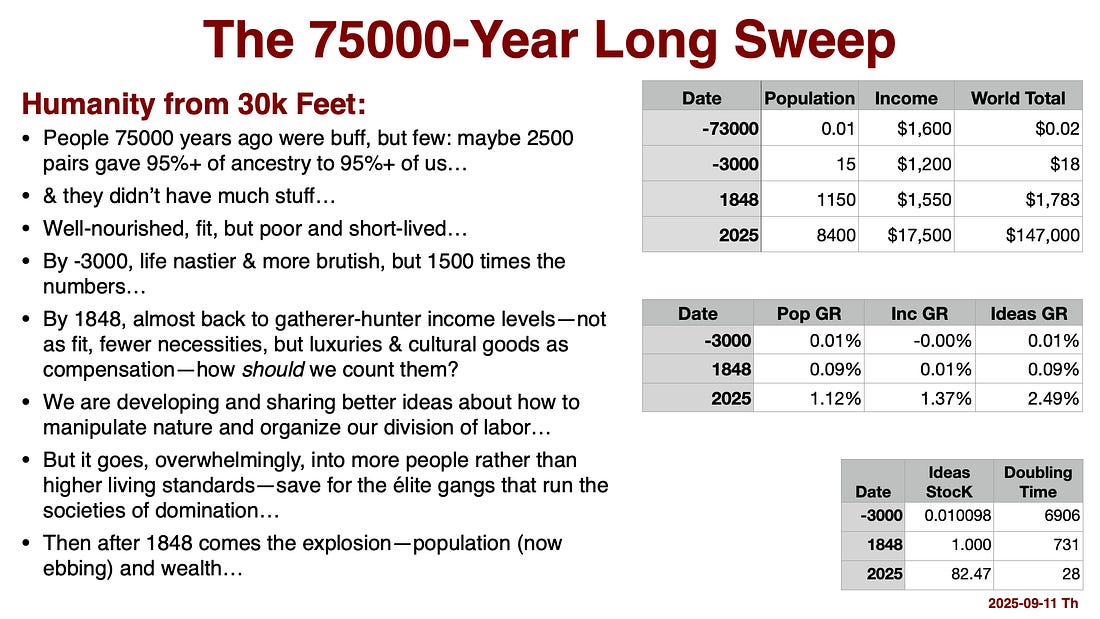
Stepping back and looking at the human economy over the long run—but this time not 750,000 but only 75,000 years—we see back then about 100 East African bands of about 100 people who became the principal ancestors of almost all of us. They were fit and well-fed, but short-lived and materially poor. The World Bank would not classify them as in the dire poverty of today’s bottom half billion, but close. If we have to pick a number, say an annual per capita consumption level of 1600. By Flash forward to -3000, and we guess that the world’s population was 1,500 times larger. We are also confident that life was harsher and shorter—a Malthusian world where technology meant more mouths, not more prosperity, and where since you did not have to be fit and well-nourished to be a farmer, population expanded until most people could not be. By 1848, the gathering Industrial Revolution had perhaps lifted average incomes back to hunter-gatherer levels, but with fewer necessities and more luxuries and cultural goods. However, the picture is one in which, over millennia, income gains went only to elite ruling groups. Only after 1848 did explosive growth in both population (now ebbing) and distributed wealth begin. Post-1848
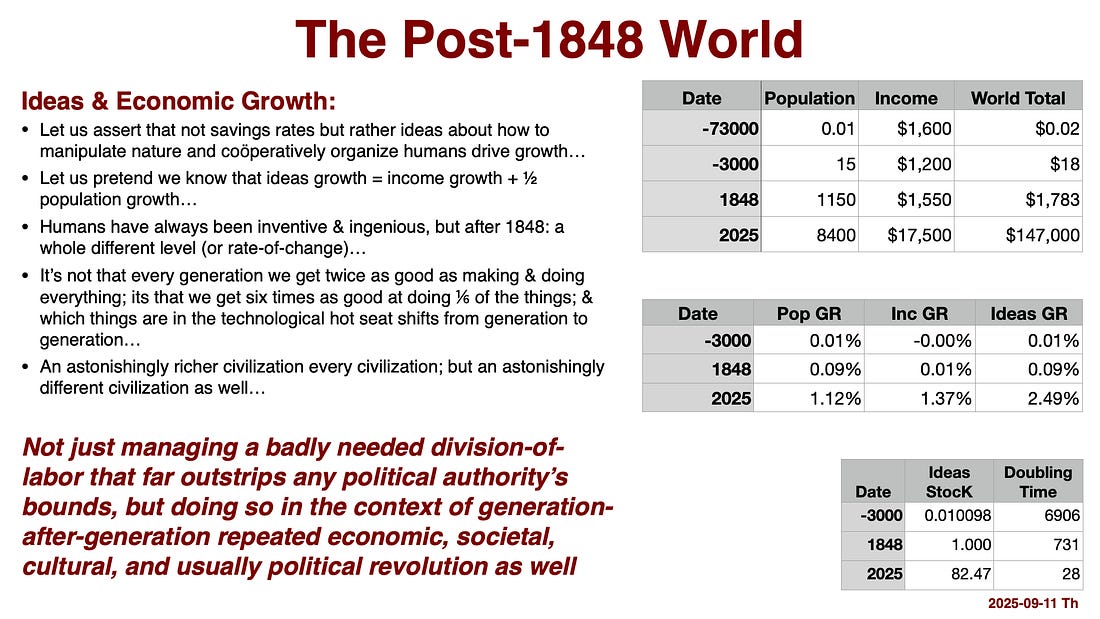
The true engine of growth is ideas—how to manipulate nature and organize large-scale cooperation. Suppose, with some hubris, that the growth rate of useful ideas equals income growth plus half the rate of population growth. For most of history, human ingenuity advanced slowly. After 1848, everything changed. Innovation sped up—not by doubling output each generation, but by becoming six times better at doing one-sixth of all possible things, with the technological “hot seat” shifting from sector to sector, decade to decade. The result is not just a richer civilization, but a perpetually novel one. Each era feels alien to those who grew up in the last generation, and nearly unrecognizable to those two generations past—in material abundance and in social arrangements. This modern form of globalization is more and harder than managing a division-of-labor beyond any political authority’s reach. This modern form is also the orchestration of constant economic, social, cultural, and political revolutions. The post-1848 world, I think, is defined by this relentless churn.
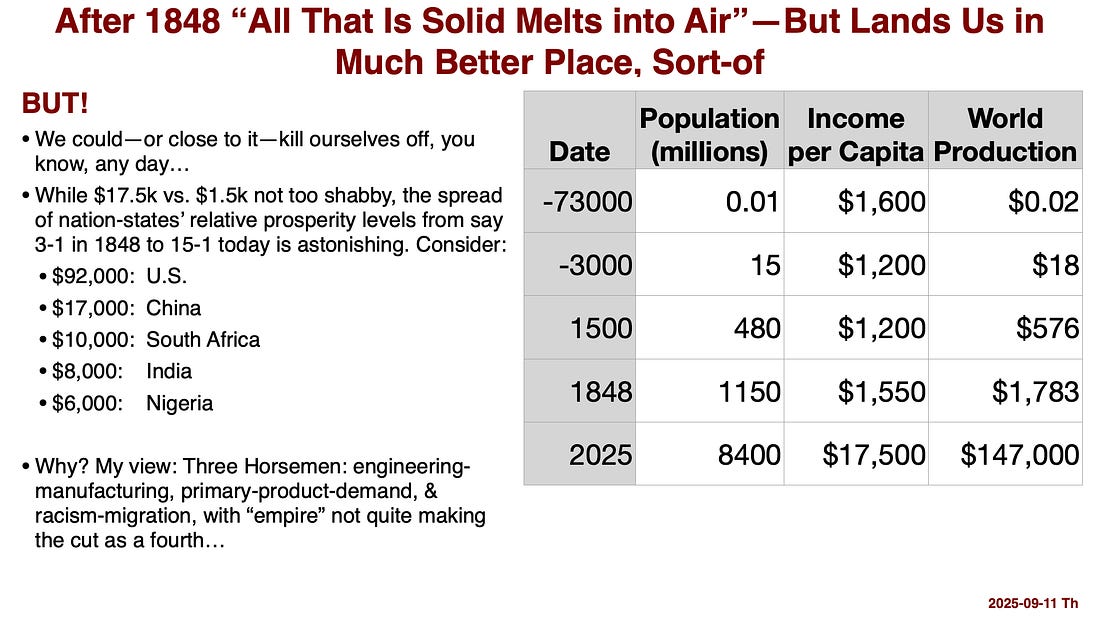
Relentless innovation, industrialization, and social change have put us in a much better place—sort of. Global average income has jumped from $1,500 to $17,500. Yet prosperity is highly uneven. In 1848, the richest countries had three times the income of the poorest; today, the gap is 15-to-1. The U.S. has a per capita income of $92,000; China, $17,000; South Africa, $10,000; India, $8,000; Nigeria, $6,000. Why this extraordinary divergence? My view: three principal “Horsemen” drive the spread. First, engineering and manufacturing prowess—those who ride the wave of technological innovation reap outsized rewards. Second, primary-product demand—nations blessed or cursed by the vagaries of global commodity markets. Third, racism and migration—the politics of exclusion and migration. Only some since 1848 have had the chance to move to true opportunity. Others have found their livelihoods undermined by competition from serf-plantations created elsewhere by global capitalism. And then there is “empire” itself. I think it does not quite make the cut as a full Fourth Horseman of the global inequality near-apocalypse. And always, lurking in the background, there are our nuclear weapons, and the chance that we could, through folly or malice, end our civilization tomorrow.
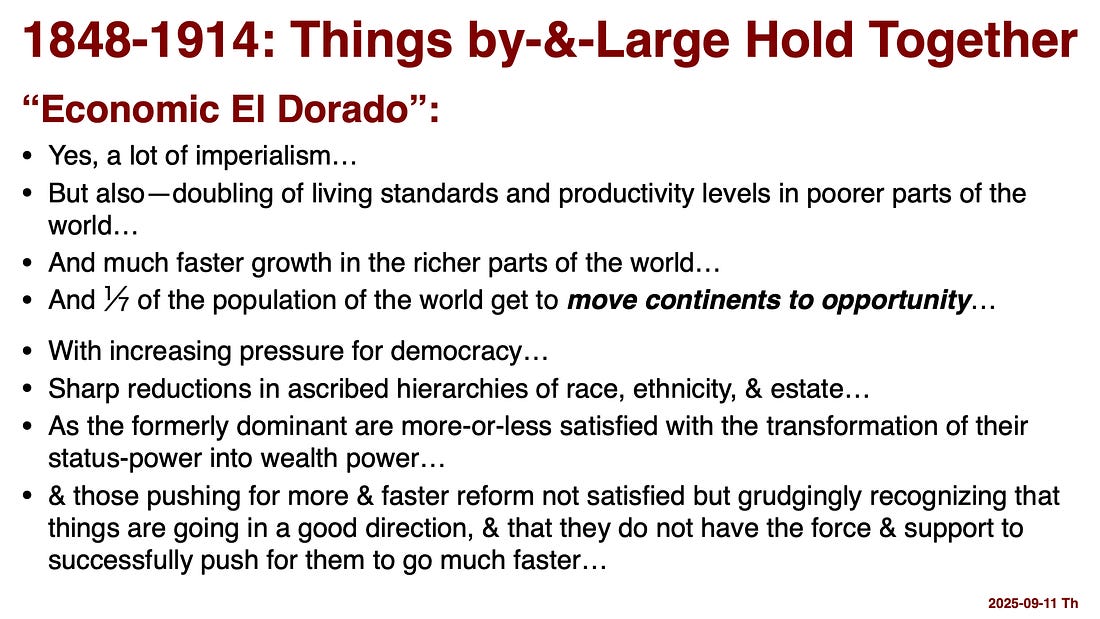
We can divide the period from 1848 to the present into three. In the first act, from 1848 to 1914, the world experienced what John Maynard Keynes called “Economic El Dorado”. Things mostly held together. Yes, imperialism. But worldwide living standards and productivity doubled in the typical poorer region, while richer parts surged ahead faster. And one in seven people moved continents for better prospects—a migration scale never seen before. This era also saw mounting pressure for democracy and a marked erosion of rigid social hierarchies based on race, ethnicity, and estate. The formerly dominant classes were more or less mollified by the transformation of their status-power into wealth-power. Meanwhile, those agitating for deeper and swifter and juster reforms grudgingly acknowledged that the arc of history was bending, and that they lacked the support to accelerate the process and make a much better world today. The world, for the moment, managed to keep itself on the best course ever seen in history.
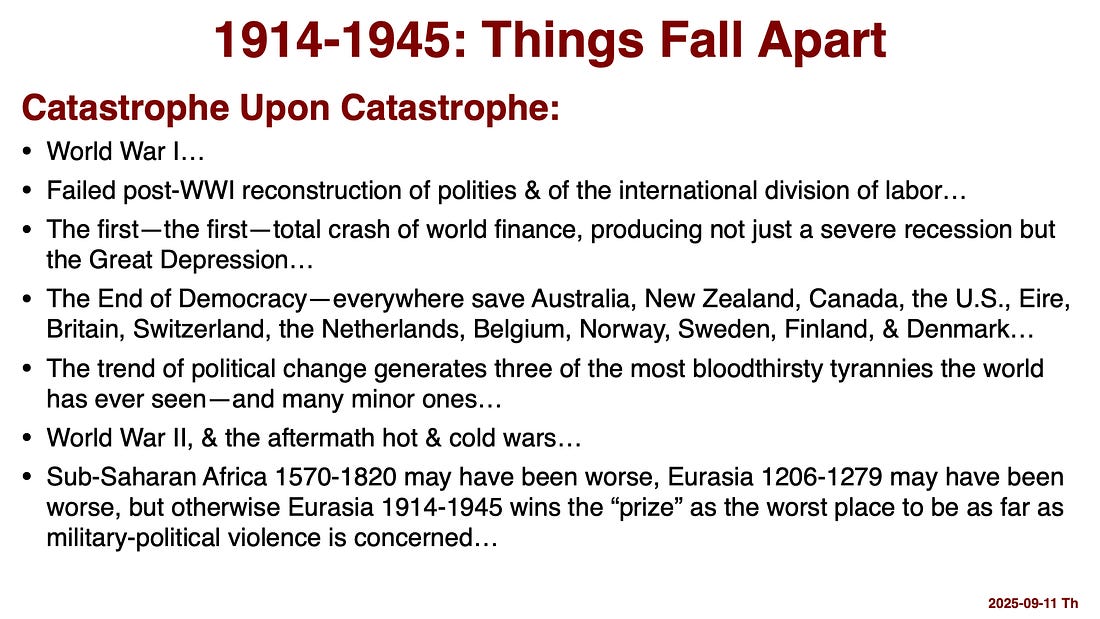
And then things fell apart. Between 1914 and 1945, the long nineteenth century collapsed in a series of unprecedented catastrophes. World War I destroyed the old order, and the failure to rebuild political systems and global trade left the world adrift. The first true global financial crash—the Great Depression—shattered livelihoods and upended societies. Democracy nearly vanished, surviving only in a few outposts: Australia, New Zealand, Canada, the U.S., Ireland, Britain, Switzerland, the Netherlands, Belgium, Norway, Sweden, Finland, and Denmark. Elsewhere, the political storm spawned three of history’s most brutal tyrannies—Stalin’s Soviet Union, Hitler’s Germany, and Imperial Japan—plus many lesser despots. The world then plunged into a second, even more destructive global conflict, followed by uneasy peace and recurring wars. If one seeks historical analogues for the level of military-political violence seen in Eurasia over 1914 to 1945, I can think of only two. Perhaps Sub-Saharan Africa between 1570 and 1820. Perhaps Eurasia under the Mongol Storm of the 1200s. But, quite possibly, from the outbreak of World War I to the Great Famine aftermath of Mao’s Great Leap Forward, for sheer concentrated catastrophe, Eurasia from 1914 to 1945, may well have been the place and time to be.
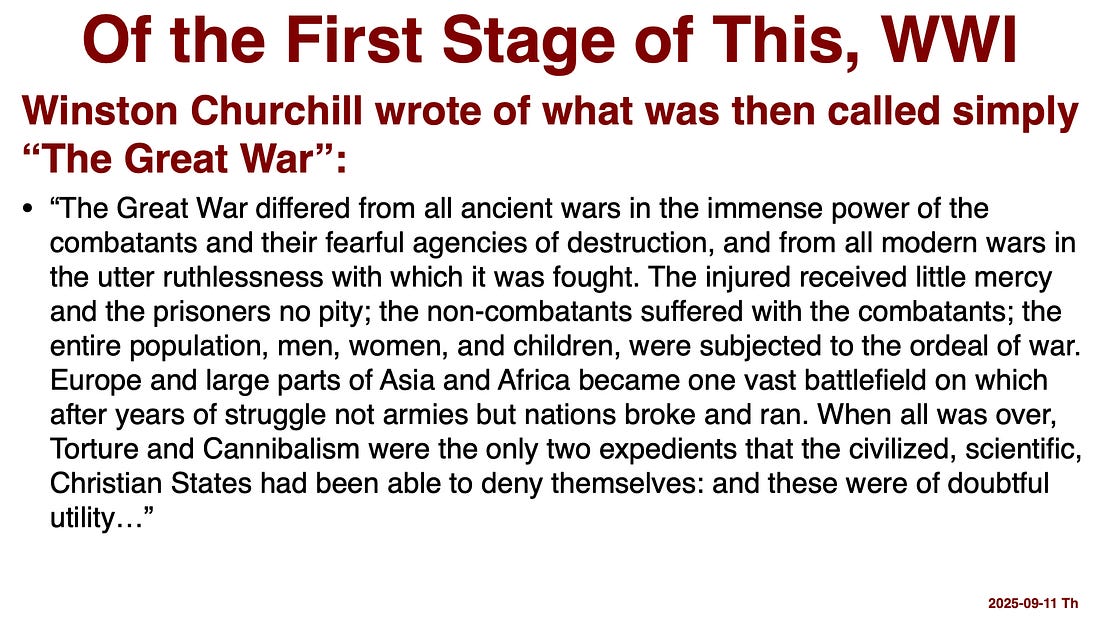
Winston Churchill wrote of the first stage of this, of what was then called simply “The Great War”:
And after 1945, humanity had another chance—it got to try again to do it more successfully… If reading this gets you Value Above Replacement, then become a free subscriber to this newsletter. And forward it! And if your VAR from this newsletter is in the three digits or more each year, please become a paid subscriber! I am trying to make you readers—and myself—smarter. Please tell me if I succeed, or how I fail…#notes-on-human-division-of-labor -globalizationPlease forward the email & otherwise share it to everyone you think would appreciate it…
|
DRAFT: Notes on Human Division-of-Labor Globalization from Stone Tools to the Assembly Line: -750000 to 1945
Monday, 1 September 2025






Subscribe to:
Post Comments (Atom)


No comments:
Post a Comment