
Hey, Luca & Nicola here — welcome to a ✨ monthly free edition ✨ of The Hybrid Hacker! Together we write original articles about engineering management, career growth, and productivity, to more than 150K friends! Here are the latest articles you may have missed:
To read all the editions and join the private community, subscribe to the paid version: How to Define your Team's Mission 🔭Why it matter, and how to translate company statements into practical, effective ones for your team.
Over time I have radically changed my mind about vision and mission statements. When I was a founder, I didn’t take the very seriously — to my defense, most of the other founders I knew didn’t, too. Still, I admired those from more famous, established startups. Apparently, this doesn’t make any sense. The truth, though, is simple: it’s easy to recognize a great vision and mission when you see them, but it’s damn hard to come up with your own. In fact, many teams find themselves caught between two extremes:
How do you find the right balance? How do you create vision and mission statements that actually help your company? And your team? And yourself? In this article, we explore why these things matter, and how to create them effectively. As always, we’ll look at three things: 1) first principles, 2) practical strategies, and 3) real-world examples. Here’s what we will cover:
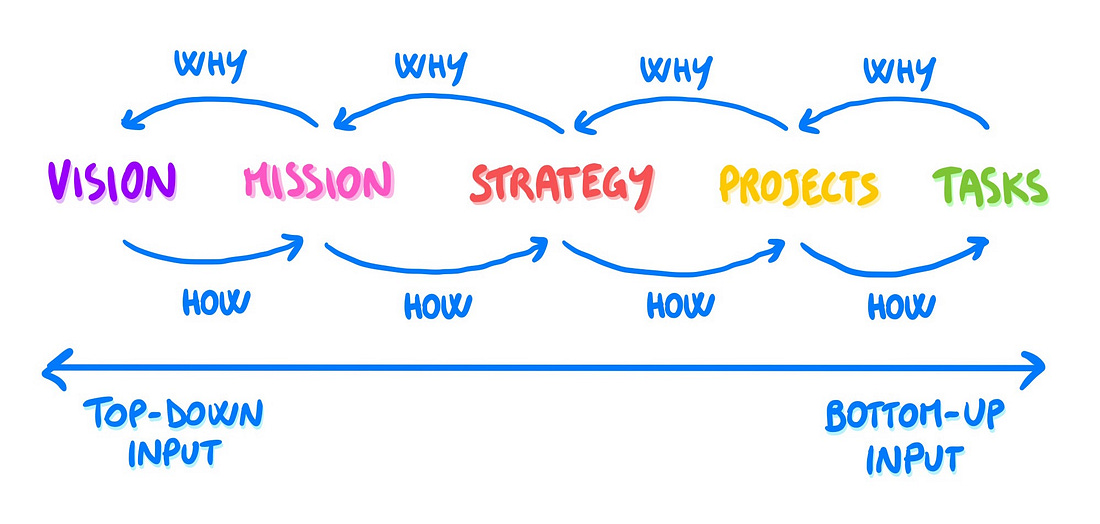
Let’s dive in! Ship faster, with context-aware AI that speaks your languageThis free article is brought to you by today’s sponsor, Augment Code! Augment Code is the only AI coding agent built for real engineering teams. It understands your codebase—across 10M+ lines, 10k+ files, and every repo in your stack—so it can actually help: writing functions, fixing CI issues, triaging incidents, and reviewing PRs. 🎯 Vision vs MissionAs a founder, I was always confused about the difference between vision and mission. To understand their relationship, I believe it’s helpful to view them as part of a bigger hierarchy:
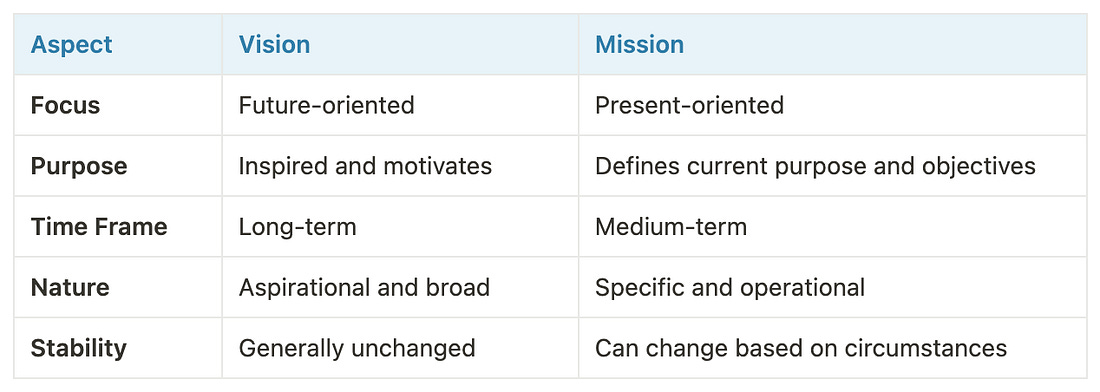
A vision statement is like the North Star—a fixed point in the distance that guides your journey. It is far in the future, aspirational (and inspirational), and relatively stable over time. It paints a picture of the world you want to contribute to. It’s not what your product does, but the impact you want it to have. If the vision is the destination, the mission is the journey you are currently on. It is more tangible, focused on what you do and who you serve, and crucially, subject to change.
One of the best examples of vision vs mission relationship is 🚗 Tesla:
The mission provides the what, and the vision supplies the why, which is broader and leaves room for evolving the mission in the future. 1) Mission comes first 🥇Counterintuitively, in most situations I believe it is easier to come up with the mission first. Missions are still broad, multi-year initiatives, and chances are you already have one in mind for your company. Then, to craft your vision, you may ask yourself a few questions:
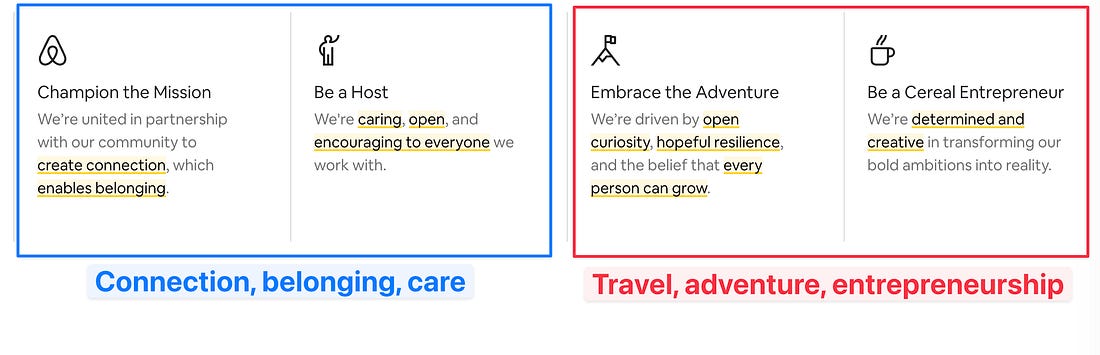
We all want to do things that are net positive to the world so chances are, on an instinctive level, you already know that your mission contributes to a positive vision. Still, the questions are useful to articulate it and put it in writing. 2) Why vision and mission matter? 🔭We started this piece by talking about alignment and autonomy, which are the most practical upsides of a good vision & mission. They drive productivity and better outcomes, which very directly create value. However, I have found that vision & mission have a wider ripple effect. In particular, they 1) shape values and 2) create purpose. These things can look fluffy, so let’s make an example. If you ask me, one of the world’s best visions is from Airbnb: To create a world where anyone can belong anywhere This visualizes a better version of the world, which is enabled by Airbnb’s mission. Now, a great vision makes it easy to find your values, because these are literally the reasons why such a vision matters to you. Airbnb’s vision is about human connection (belong) and adventure (travel), and, in fact, their core values reflect exactly that 👇
People are incredibly driven by purpose and values that feel like their own. It makes them happier, more motivated, and more resilient. Having a great vision + mission + values makes you a magnet for talent: it helps you hire the right people and retain them for longer than you could possibly imagine. It’s a superpower, which very few companies possess. 🪜 Strategy, Projects, and GoalsBig, ambitious work—like a mission—always needs to be broken down into smaller pieces in order to be addressed by separate teams and individuals. This simple need eventually leads to a proliferation of concepts, which often have confusing relationships: like goals, projects, or strategy. Without going into too much detail, I believe a few basic definitions are useful to disambiguate these concepts, because I have found many people conflating goals with strategy, projects with missions, and so on: 1) Strategy 🗺️Strategy is how you plan to achieve the mission — it’s how you plan to get there. We wrote two pieces on Refactoring about technical strategy that you may want to check out 👇
2) Goals 🎯Goals are measurable milestones that tell you that what you are doing is successful and goes in the right direction. If you want to reach 1M ARR over the next 6 months, that’s neither a strategy nor a project: it’s a goal. It’s one of the ways you measure progress. 3) Projects 🔨Projects (and tasks, and possibly levels in-between) live on the same imaginary line that answers “how?” when you go to the right, and “why?” when you go to the left 👇
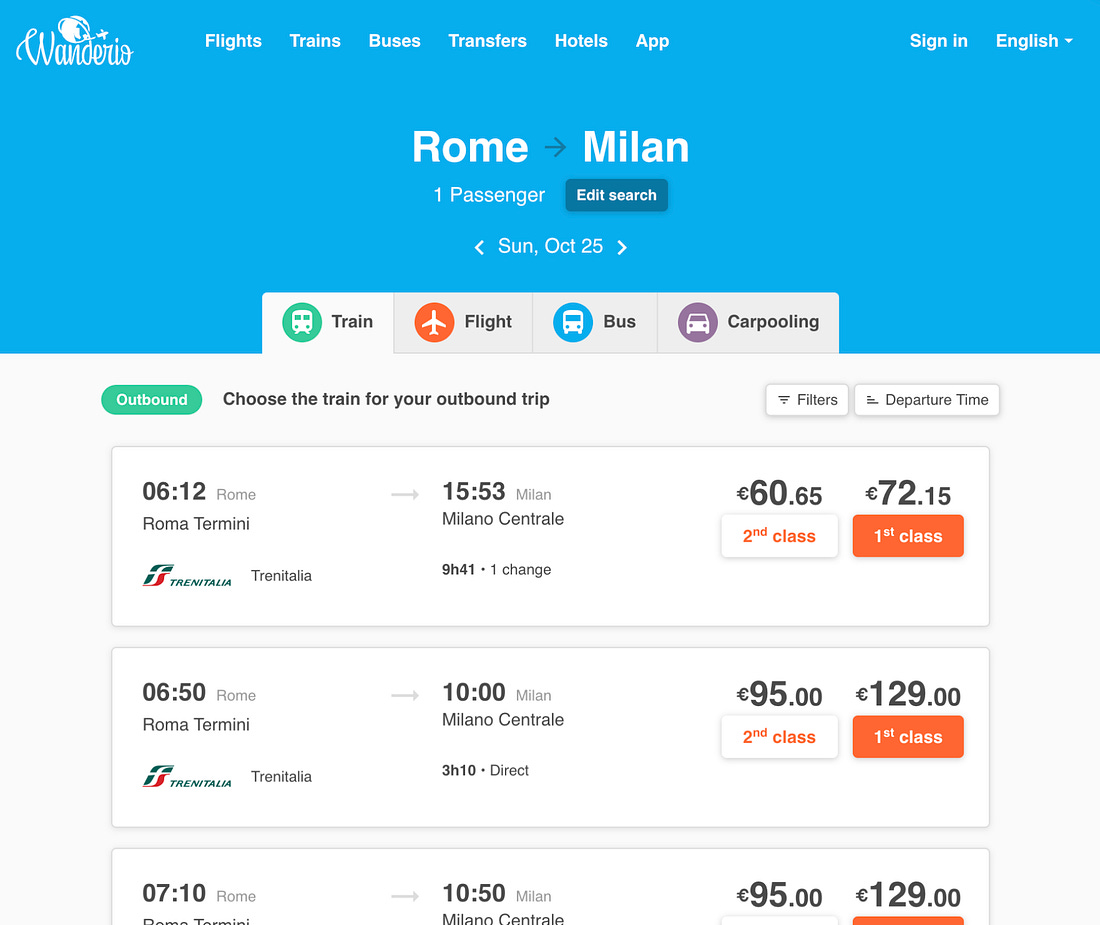
All these concepts are important because they represent how the torch of your mission gets passed down to the work of individual teams and people. All the benefits we discussed, like purpose, alignment, and autonomy, are only possible when this link is clear, visible, and uninterrupted. But how does this look in practice? Let’s make it clearer with a detailed example: 🚆 Case study: WanderioWanderio has been my startup for 8 years. Our mission was to help people travel by comparing and booking all transports in one place, including flights, trains, buses, and more. We always believed in the power of travel as a way of connecting people (similarly to Airbnb), and we wanted to create a world where traveling is incredibly easy (vision): people should be able to book everything they need to go from A to B at the press of a button.
At any given time, this mission had practical goals and targets attached, typically related to the next funding round: users, number of bookings, monthly growth, revenues. Now, to achieve this mission and make the product successful, we always had two main problems:
We eventually developed a strategy for both, to be carried out by separate teams: 1) Using SEO for customer acquisition 🔍We figured out that most of our competitors — at least the ones best positioned on Google — were focused on flights. This means that if you searched for how to go from A to B, and one of those nodes was not close to an airport, SEO competition was low. Wanderio, instead, because of our coverage of trains and buses, could serve those searches perfectly, so this was our opportunity. SEO became a big area of investment within the company, with clear statements:
The SEO team was always one of the most focused and driven within Wanderio, because their statements were extremely clear, and it was also clear how they contributed to the wider mission. So, in about 4 years, we went from zero to 2M+ organic visits / month. 2) Transport coverage engine 🚆The other main challenge for us has always been to grow transport coverage. This has unique challenges, especially with long tail transports like buses and local trains: data quality is poor, APIs are not always available, and suppliers deal with extremely legacy tech. Still, most of the opportunity relied exactly on those long-tail suppliers, because they had little exposure online. So here is what we came up with:
This flexibility proved unvaluable. It allowed us to move fast, often releasing new coverage before the full integration was complete: e.g. if the booking part was not ready yet, or not available on the supplier tech, our operators could jump in and book tickets manually, e.g. from the supplier’s website. 🛠️ How to craft your team’s statementsOur mission + strategy was not perfect, but it made sense, and everyone knew what they had to do to make it happen. However, it took a long time to get there, a lot of iteration, and it was probably only 100% clear in hindsight. So, how do you get there? Each team is different, but here is some advice that worked for me and is shared by many other teams I know: 1) Balance top-down & bottom-up 🔃The best outcomes always combine top-down input from leaders and bottom-up ideas from the rest of the team. In fact, in my experience, people who are the closest to action always provide valuable ideas, which leadership would otherwise miss. So, if you walk down the hierarchy of concepts we discussed, the ideal participation, to me, it looks like:
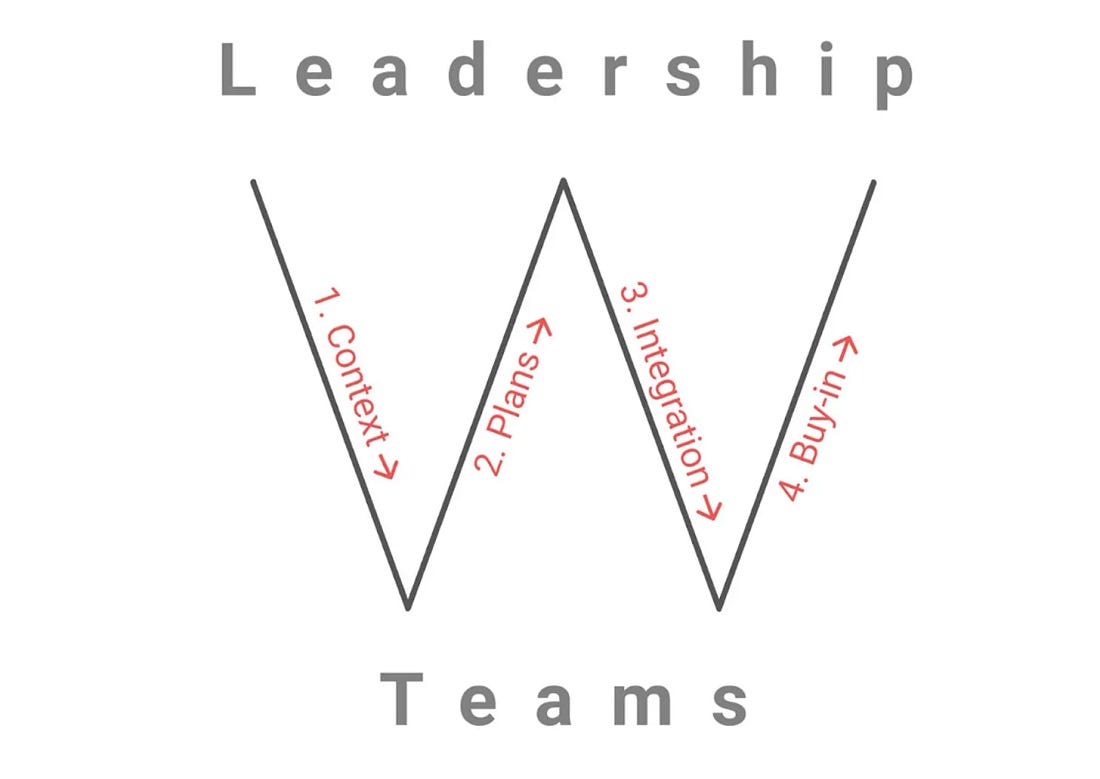
The whole topic is a fractal so the way you implement this depends on the level you are at: at company level, top-down input comes from founders & leadership team, while in a team it might come from the PM. As for how to enable participation in practice, I am a fan of the W Framework, which we covered other times. It is made up of four steps:
2) Create disagreeable statements ❌Good statements are practical and guide decisions. The best way to figure out if yours is practical enough is by asking yourself if anybody could disagree with it. Here are a few questions you may ask yourself:
If you have answered “no” to more than a few of these, chances are you should go back to the drawing board. 3) Test with people 💬Go to people both inside and outside your company and tell them the whole story, top down: vision, mission & strategy. See how they react: do they understand it? Are they excited by it? Do they have questions? It is also useful to do the opposite: get people to explain what you do and see how it compares to the picture you have in mind. This is especially great for individual teams: you might go to other teams and ask them how they see yours — trust me you will be surprised by the answers (often in a bad way). 4) Make everything visible to everyone 👓Finally, make all of this extremely visible:
And that’s it for today! What do you think about your team’s vision and mission? Are they clear enough to guide you, and practical enough to be actually useful? Let’s chat in the comments if you like! 👇 See you next week! Sincerely
|
How to Define your Team's Mission 🔭
Thursday, 14 August 2025




Subscribe to:
Post Comments (Atom)


No comments:
Post a Comment