
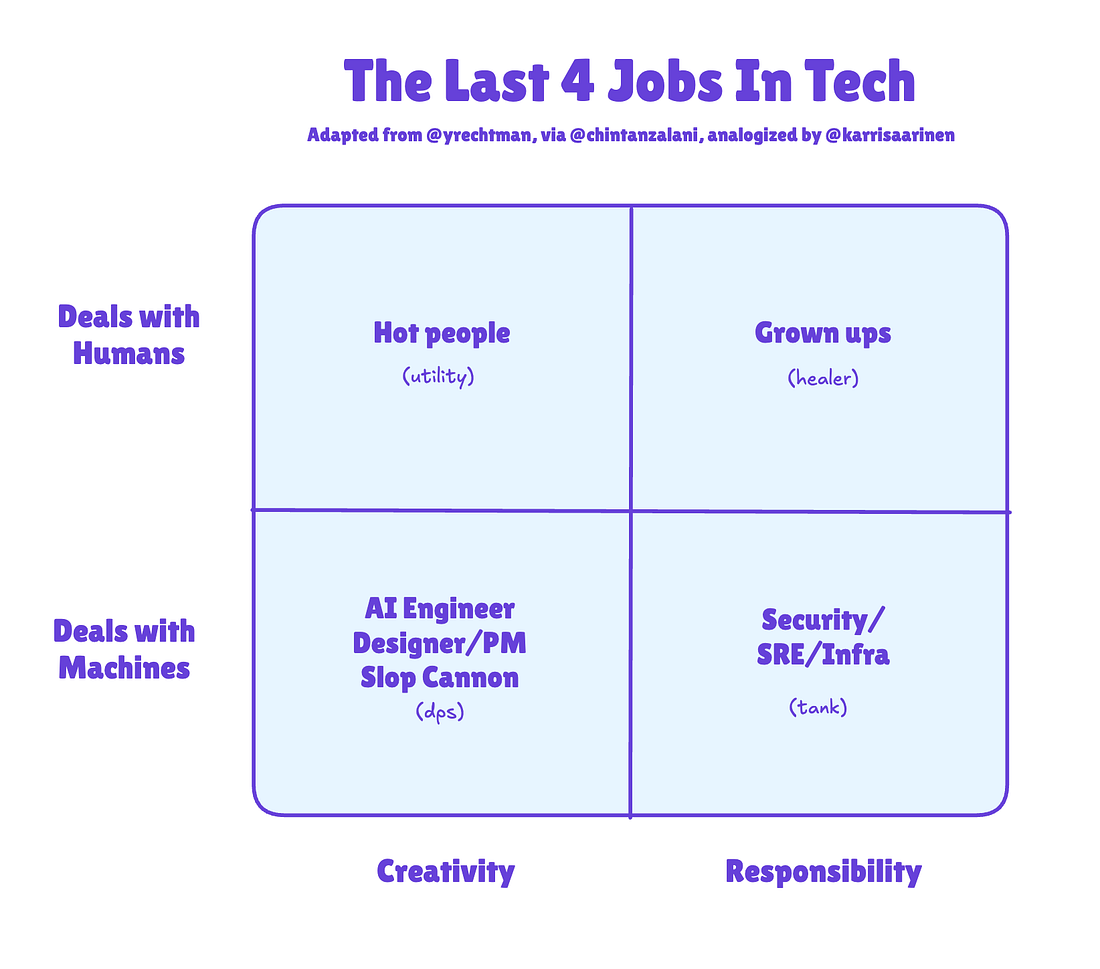
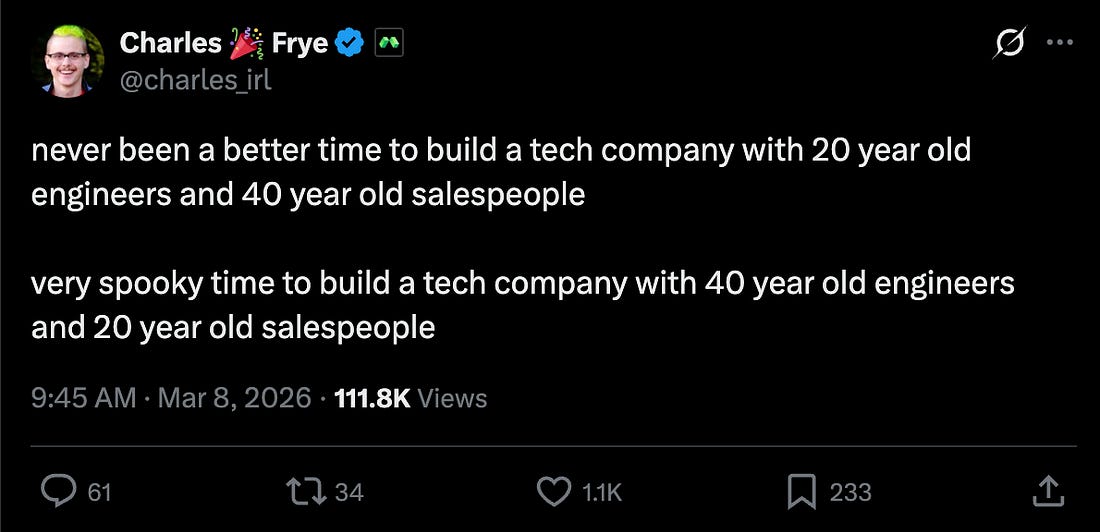
It’s well known that org charts are changing with AI - the first trend we called out was in 2023 with the Rise of the AI Engineer (now an official org at Meta!), and then in 2025 with Tiny Teams (hired by Meta!), but it seems Yoni Rechtman over at the 99D Substack has the mental model for the new post-AI roles (at least in white collar tech): Karri Saarinen, CEO of Linear, made a popular analogy to the teamwork roles that emerged in World of Warcraft. This is a good 2D augmentation of an earlier age-based company model (much less realistic, name a tech company that fits the latter format, they exist but are very hard to find):
AI Twitter RecapClaude Code Computer Use, Codex Interop, and the Coding-Agent Harness Race
Hermes Agent’s Rapid Rise, Multi-Agent Profiles, and the Open Harness Ecosystem
Qwen3.5-Omni, GLM-5-Turbo/AutoClaw, and the Push Toward Local/Agentic Specialization
Local Inference and Systems: llama.cpp at 100k, Flash-MoE on MacBooks, and Web/Serving Toolchains
Agent Research: Natural-Language Harnesses, Meta-Harness, Async SWE Agents, and Long-Context via Filesystems
Training, Optimization, Evaluation, and Production Case Studies
Top tweets (by engagement)
AI Reddit Recap/r/LocalLlama + /r/localLLM Recap1. Qwen Model Developments and Applications...Keep reading with a 7-day free trialSubscribe to Latent.Space to keep reading this post and get 7 days of free access to the full post archives. A subscription gets you:
|
[AINews] The Last 4 Jobs in Tech
Monday, 30 March 2026



Confused Notes on the War on Iran: Everyone Is Losing Except for Surviving IRGC Officers Getting Swift Promotions
This is Brad DeLong's Grasping Reality—my attempt to make myself, and all of you out there in SubStackLand, smarter by writing where I have Value Above Replacement and shutting up where I do not… Confused Notes on the War on Iran: Everyone Is Losing Except for Surviving IRGC Officers Getting Swift PromotionsThis is not a war about “victory”; it is a slow, grinding competition in which the prize is to lose the most. A reckless White House and a very large, not‑very‑important Iran have managed to trap...
This is not a war about “victory”; it is a slow, grinding competition in which the prize is to lose the most. A reckless White House and a very large, not‑very‑important Iran have managed to trap each other—and us—inside the Strait of Hormuz…
Never forget: This is what happens every day in terms of communications from the U.S. government. This morning we have:
And
Nava Freiberg and Jacob Magid, writing for The Times of Israel <https://www.timesofisrael.com/trump-says-he-expects-deal-shortly-with-iran-threatens-to-blow-up-power-plants-if-not/>, explain that Trump believes—or at least says—that the replacements for the Iranian leaders led by Khameini killed by the Israeli decapitation strike are and constitute the “new and more reasonable régime” ruling Iran. Rubio, however, says that although Trump says that the current negotiating time, apparently headed by hardline Iranian parliament speaker Mohammad Bagher Ghalibaf, is:
And Bessent declares that:
What the other straits are besides the Strait of Hormuz that Bessent believes the U.S. needs to and will retake control over is not clear. A clearer-eyed view, in my mind, comes from the extremely sharp:
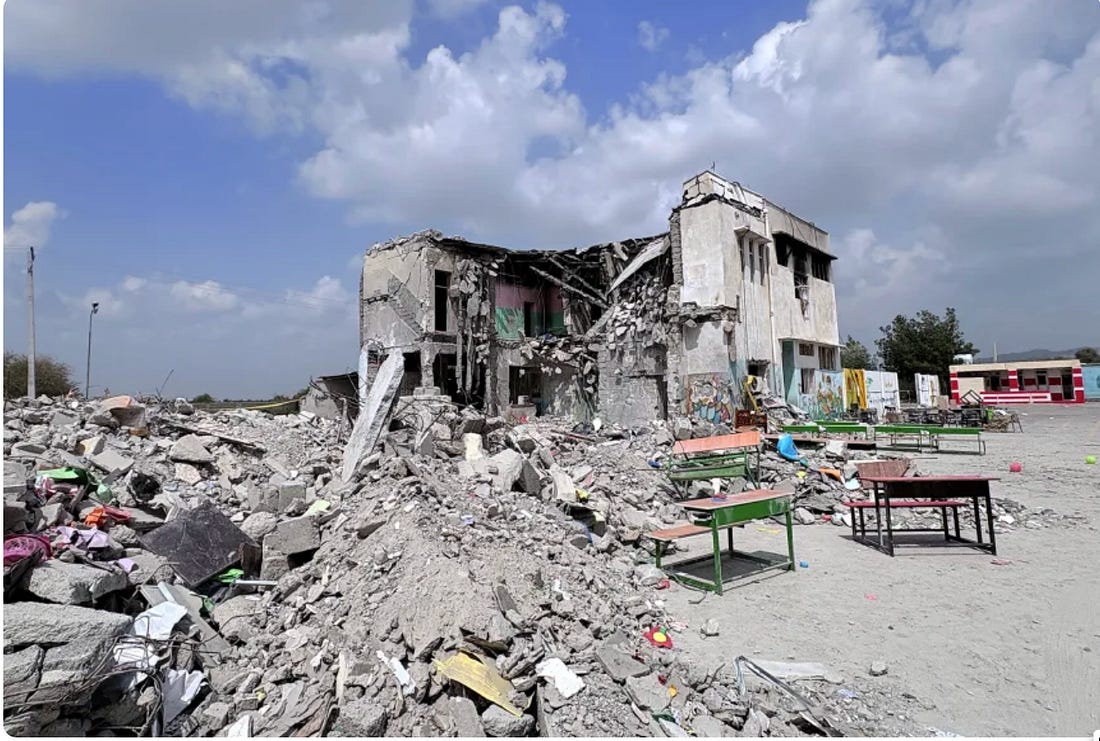
I have not views so much as notes: A reckless, senile or non compos mentis prince, no adult supervision: Start with the internal dynamics in Washington. A sane administration, confronted with the current situation, would be looking for an avenue to de‑escalate and slink home. That is simply what prudence dictates. But we do not have a sane administration. We have a “prince” whose preferences are volatile, who can be worked by whoever last got him on the phone, and whose senior staff behave—at best—like courtiers guessing which way he will jump this afternoon rather than officials executing a stable strategy. Plus there are Trump whisperers like, Stephen Miller, who simply call people on the phone to tell people: never mind what he said yesterday; do what I say, because I know what he will say after I talk to him. The traditional realist admonition is: do not look at the prince’s preferences, look at his constraints. But this advice assumes the prince is at least minimally rational and goal‑directed. If the prince is not, constraints are a much weaker predictor of outcomes. Institutions can buffer some madness, but they cannot fully neutralize it. And this administration has no figure who can say: this is the line, this is the plan, we are not doing anything crazier than this. The current military and political situation is unknown: What is happening militarily in and around the Persian Gulf? We do not really know: -How many of our air bases in the Gulf are still fully functional. - How badly we have been attrited by Iranian missiles, drones, and sabotage. - Whether our aircraft and support assets are in hardened shelters or sitting vulnerably in the open. One would hope. But then one sees an E‑3 AWACS parked outside, visible to satellite reconnaissance, and wonders what on earth is going on. There are reports that “everyone’s working from home” at some of the bases—a striking image of a great power supposedly in theater, yet trying to run a war partly over Zoom. That may be exaggerated, but even the rumor points to a serious degradation of operational confidence and resilience. Meanwhile, the Israeli government is in its “mow the lawn” mode: systematically degrading Iranian capabilities and regional proxies, treating this as a kind of ongoing maintenance of deterrence. There is no long‑term political strategy visible from the outside. Should one ask, “What is your long‑term plan?”, the likely answer is to maintain control for the the next 15–20 years; after that it’s the next guy’s problem. That is not a strategy. That is a rolling postponement of strategic thinking. To Netanyahu’s people, this probably feels like a success. They have hit targets, inflicted real damage, and demonstrated capability—with the United States, at least nominally, behind them. Are there senior figures who think this has gone badly wrong, who would desperately like to get back to something like the Obama‑era Iran nuclear deal (the JCPOA), and see this escalatory path as a strategic failure? Or is the internal mood mostly triumphalist, viewing this as a necessary and successful round of “mowing the lawn”? The strategic bind: slink away, escalate, or blow things up: Given this setup, what happens next? (1) Trump (or whoever turns out to be deciding for him) might, at some point, “unleash a nuke”—and then we see how much civil disobedience there is at STRATCOM. (2) Trump (or whoever turns out to be deciding for him) might order U.S. boots-on-the-ground to Kargh Island or to all territory within artillery range of the sealine Strait of Hormuz. The U.S. military is institutionally conservative. Its default is: you give us a mission, we salute, and we carry it out. It is not designed to say: this is strategically idiotic, we refuse. It relies on civilian leadership to set sane objectives. Perhaps U.S. airpower is so overwhelming that Iranian forces cannot mass without being smashed from the air. That is the optimistic operational scenario. But even then, what does “attack” mean in this environment? Iranians sit in tunnels and bunkers, fly drones, launch missiles, rely on asymmetric harassment and mining, and try to keep communications sufficiently low‑signature to avoid being obliterated. A long limited war over control of the global oil chokepoint. (3) Trump (or whoever turns out to be deciding for him) might try to slink away, effectively cutting losses and de‑escalating, accepting Iran’s collecting $3/barrel for oil shipment through the Strait of Hormuz in return for no oil price shock, and leaving the Iranian nuclear program for future “negotiations”. Cutting losses, declaring some kind of mission accomplished, and reducing the visible footprint in theater. Financial markets are currently pricing a high likelihood that, under constraints, decision‑makers will ultimately choose the least insane path. None of these paths is in any sense “safe”. Consider the third: The regime’s high command will have suffered grevious losses. But everyone still surviving will have been promoted, hardened, and empowered. Surviving elites in such a system tend to be more radical and more confident, not less. If and when the dust settles, Iran is left with more resources to pursue its nuclear program than it had before. It is very hard to see how this sequence leaves us better off than we were under the Obama‑era JCPoA, which seriously constrained enrichment and gave us intrusive inspections. Trump and company should now be desperate to get back to something like the Obama Iran deal. But the deal they torched is now so far outside the attainable set that they are trapped. They cannot admit error domestically; they cannot reconstruct international trust; and they have empowered exactly the Iranian hardliners who argued that the U.S. would never keep its word—and were proven correct What is the real state of our military in the drone era?: We sent two carriers into a theater dense with anti‑ship missiles, drones, and asymmetric maritime threats. One of them has exited the theater—the story is of a laundry fire. Or is it that while carriers are cool, were the symbolic centerpiece of American power, and had Top Gun a recruiting tool for a generation, they were always too fragile for any world in which something like the USN’s 1944 force superiority ratios were lacking. And in a world of precision anti‑ship missiles and cheap, smart drones, these floating cities are becoming even more large, vulnerable targets. Were the carriers always a bluff—symbols of resolve rather than practical assets in a high‑end fight? Were they always a non‑starter operationally, but no one could admit that without jeopardizing careers? Was it really a laundry fire? Or is what we are seeing now is a genuine strategic surprise to the Navy? The upshot is grim: We see:
If reading this gets you Value Above Replacement, then become a free subscriber to this newsletter. And forward it! And if your VAR from this newsletter is in the three digits or more each year, please become a paid subscriber! I am trying to make you readers—and myself—smarter. Please tell me if I succeed, or how I fail…##confused-notes-on-the-war-on-iran-everyone-is-losing-except-for-surviving-irgc-officers-getting-swift-promotions |


| ||||||||||


